
Federal Law Enforcement in New Hampshire
Federal law enforcement agencies in New Hampshire investigate federal crimes, coordinate border security, and protect federal courts from Concord and Manchester. Citizens and legal professionals can access federal public records, report interstate crimes, and navigate federal investigative procedures. Explore our verified directory below to locate federal agency field offices, reporting contacts, and regulatory resources across New Hampshire.

U.S. Marshals Service - District of New Hampshire - Concord, NH
Federal Law Enforcement Authority & Jurisdiction in New Hampshire
In the State of New Hampshire, federal law enforcement agencies operate under the judicial umbrella of the United States District Court for the District of New Hampshire, seated at the Warren B. Rudman U.S. Courthouse in Concord. The United States Attorney's Office for the District of New Hampshire serves as the chief federal prosecutor, coordinating investigations and grand jury indictments involving interstate drug trafficking, financial fraud, cybercrimes, firearms trafficking, and civil rights offenses.
Multiple federal investigative bureaus maintain permanent field offices and resident agencies across the state, primarily concentrated in Manchester, Bedford, and Portsmouth. These include the Federal Bureau of Investigation (FBI) Bedford Resident Agency, the Drug Enforcement Administration (DEA) Manchester Field Office, and the Bureau of Alcohol, Tobacco, Firearms and Explosives (ATF) Manchester Field Office. The United States Marshals Service operates directly out of Concord, executing federal arrest warrants, managing the federal witness security program, and transporting federal pretrial detainees.
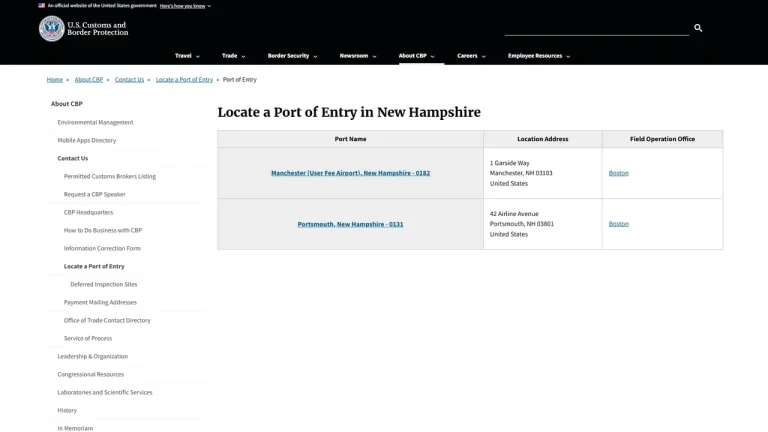
Along New Hampshire's northern international boundary with Canada, the United States Border Patrol operates stations in towns such as Pittsburg and Colebrook, while U.S. Customs and Border Protection (CBP) officers regulate maritime operations at the Port of Portsmouth. All criminal offenses prosecuted under federal statutes are subject to exclusive federal jurisdiction pursuant to 18 U.S. Code § 3231.
Key New Hampshire Federal Law Enforcement Inquiries, Filings & Timelines
| Service / Matter | Required Documents / Prerequisites | Statutory Fee (USD) | Processing Timeline |
|---|---|---|---|
| Federal Freedom of Information Act (FOIA) Request | Formal written request specifying records, subject matter, contact information, and fee category | $0 for initial search time within statutory limits; reproduction costs apply | 20 statutory working days (5 U.S. Code § 552) |
| Federal Tort Claims Act Claim (Form SF-95) | Executed Standard Form 95, sum certain damage claim, and itemized supporting bills | $0 filing fee | 6 months statutory agency evaluation period (28 U.S. Code § 2675) |
| Federal Pretrial Detention Hearing Appearance | Formal charging document (indictment or complaint), financial affidavit for appointed counsel | $0 court fee | Conducted within 3 to 5 business days of initial appearance (18 U.S. Code § 3142(f)) |
| Federal Seized Property Administrative Petition | Petition for Remission or Mitigation, proof of ownership interest, and verified statement | $0 administrative petition fee | 30 to 60 days following notice of administrative forfeiture |
Critical Legal Deadlines & Statutes in New Hampshire
Engaging with federal law enforcement proceedings in New Hampshire requires strict adherence to federal procedural rules and statutory deadlines:
- Initial Appearance Requirement: Under Federal Rule of Criminal Procedure 5(a)(1)(A), a person arrested under a federal warrant in New Hampshire must be taken without unnecessary delay before the nearest available United States Magistrate Judge at the Warren B. Rudman U.S. Courthouse in Concord.
- Pretrial Detention Timetable: Under the Bail Reform Act, codified at 18 U.S. Code § 3142(f), a detention hearing must be held immediately upon the defendant's first appearance, unless a continuance is granted, which cannot exceed 5 days on motion of the defendant or 3 days on motion of the government.
- Federal Tort Claims Presentation: Under 28 U.S. Code § 2401(b), any tort claim against a federal law enforcement agency operating in New Hampshire must be presented in writing to the appropriate federal agency within 2 years after the claim accrues, and a federal civil lawsuit must be filed within 6 months of agency denial.
- Administrative Forfeiture Claims: Under 18 U.S. Code § 983(a)(2), any person claiming an interest in seized property subject to federal administrative forfeiture must file a verified claim with the seizing agency within 30 days after the final publication of notice or 35 days after personal mailing of notice.
Direct Agency Access vs. Legal Counsel
Members of the public can interact directly with federal law enforcement agencies in New Hampshire for routine administrative needs. Citizens may submit tips regarding suspected criminal violations through online portal reporting systems, request non-exempt agency public records under the federal Freedom of Information Act (5 U.S. Code § 552), or request information regarding federal victim assistance programs through the U.S. Attorney's Office Victim-Witness Unit without retaining an attorney.
However, when an individual becomes a subject, target, or witness in a federal criminal investigation-or is contacted by special agents from the FBI, DEA, HSI, or ATF-retaining experienced federal criminal defense counsel is essential. Federal criminal investigations rely on federal grand juries, complex electronic surveillance, and specialized federal prosecutors. Answering questions or submitting to an informal interview with federal agents without legal representation carries immense peril, as false statements to federal officers constitute a separate federal felony under 18 U.S. Code § 1001. An attorney admitted to the bar of the United States District Court for the District of New Hampshire can intervene with prosecutors, determine whether grand jury target letters have been issued, and safeguard constitutional Fifth and Sixth Amendment rights.
While New Hampshire Circuit Court District Divisions maintain a small claims docket with a monetary limit of $10,000 under N.H. Rev. Stat. Ann. § 503:1, small claims courts possess zero jurisdiction over federal agencies, federal crimes, or constitutional claims against federal personnel. Federal legal matters require representation in federal court.
Common Red Flags & Regulatory Pitfalls
- Phone Scams Impersonating Federal Agents: Fraudulent telephone callers claiming to be deputy U.S. Marshals or DEA agents demanding immediate payment through wire transfers or cryptocurrency to clear an arrest warrant; genuine federal agencies never solicit fines or bond over the phone.
- Voluntarily Answering Federal Agents Without Counsel: Consenting to informal interviews with federal investigators in the mistaken belief that cooperating will avoid an indictment, creating statements that can be used under 18 U.S. Code § 1001.
- Missing Administrative Forfeiture Deadlines: Failing to file a verified claim within the strict 30-day window under 18 U.S. Code § 983, resulting in automatic summary forfeiture of seized cash or property.
- Unofficial FOIA Expediter Fees: Paying third-party commercial websites high fees for standard federal public records forms that can be submitted directly to federal agencies at no cost.
Frequently Asked Questions
Where is the main federal courthouse and U.S. Attorney's Office located in New Hampshire?
The primary federal courthouse is the Warren B. Rudman U.S. Courthouse located in Concord, New Hampshire, which houses the U.S. District Court, the U.S. Magistrate Judges, the U.S. Attorney's Office, and the U.S. Marshals Service.
How quickly must a person arrested on federal charges appear before a judge in New Hampshire?
Under Federal Rule of Criminal Procedure 5, an arrested individual must be brought before a United States Magistrate Judge without unnecessary delay, typically within 24 to 48 hours of arrest.
What should I do if federal agents from the FBI or DEA contact me in New Hampshire?
You have the constitutional right to decline an interview and request the presence of legal counsel. Contact a licensed federal criminal defense attorney immediately before making any verbal or written statements.
How do I file a Freedom of Information Act request with a federal agency in New Hampshire?
A FOIA request must be submitted in writing to the specific federal agency's national or regional FOIA officer. The agency is required under 5 U.S. Code § 552 to respond within 20 working days.
What is the deadline to contest property seized by federal law enforcement in New Hampshire?
Under 18 U.S. Code § 983(a)(2), a claimant must file a verified claim with the seizing agency within 30 days after the final publication of notice or 35 days after personal written notice is mailed.