
County Clerk in New York
Accessing the County Clerk in New York connects citizens with essential judicial dockets, public property records, and official commercial registrations across all sixty-two counties. Operating as the clerk of the Supreme Court, this office safeguards public filings and official legal transcripts. Explore our directory below to locate your local County Clerk, access electronic filing portals, and review statutory filing requirements.




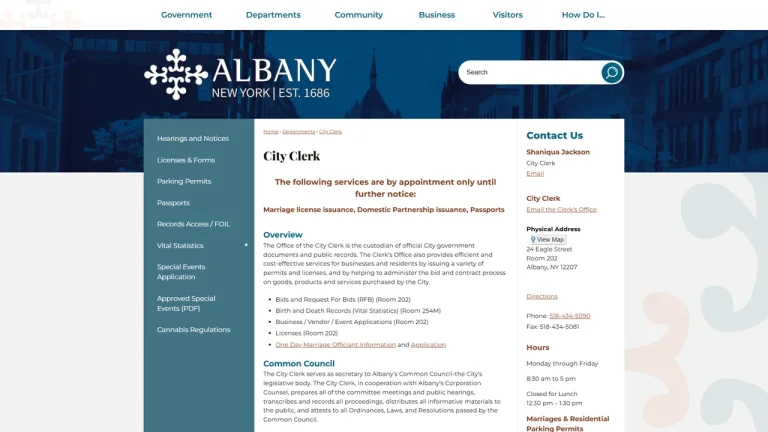


Constitutional Authority and State Infrastructure of the New York County Clerk
In the State of New York, the County Clerk is a constitutional officer established under the state constitution, serving as the official custodian of public records and the chief clerk of the Supreme Court and County Court within each of the state's sixty-two counties. From upstate jurisdictions such as Erie, Monroe, and Onondaga to the Capital District in Albany and the suburban counties of Westchester, Nassau, and Suffolk, the County Clerk oversees critical judicial, real estate, and municipal filings.
A critical organizational distinction exists between upstate/suburban counties and the City of New York. In the fifty-seven counties outside New York City, the County Clerk performs dual functions: serving as the clerk of the courts and operating as the statutory recorder of deeds and mortgages. Conversely, in the five counties that comprise New York City-New York, Kings, Queens, Bronx, and Richmond-the County Clerks primarily manage judicial filings, notary public qualifications, passport applications, and commercial business certificates (DBAs), while land conveyance records are largely administered by the Office of the City Register within the Department of Finance.
Statewide court operations interface directly with the County Clerk through the New York State Courts Electronic Filing (NYSCEF) portal. As court clerk, the County Clerk is responsible for issuing index numbers, docketing civil judgments, preserving lis pendens notices, and maintaining permanent judgment rolls that establish enforceable public liens under state law.
County Clerk Filing Schedules and Statutory Fees
| Service / Matter | Required Documents / Prerequisites | Statutory Fee (USD) | Processing Timeline |
|---|---|---|---|
| Supreme Court Index Number Filing | Summons with notice or summons and complaint, NYSCEF submission | $210.00 statutory fee under CPLR 8018 | Immediate electronic processing |
| Certificate of Assumed Name (Business DBA) | Completed business certificate form, notarized signatures of owners | $25.00 - $100.00 (varies by county) | Same-day walk-in / 5 to 7 days mail |
| Transcript of Judgment Docketing | Certified transcript from lower court, formal filing request | $10.00 - $15.00 statutory fee | 1 to 3 business days |
| Notary Public Commission Qualification | Department of State appointment card, executed oath of office | $60.00 statutory fee | 1 to 2 business days |
Critical Deadlines & Statutes in New York
The statutory responsibilities of the County Clerk are codified primarily under N.Y. County Law § 525, which establishes the clerk's obligation to maintain and protect judicial and county archives. In civil litigation, the commencement of an action is controlled by N.Y. C.P.L.R. § 304, which mandates that an action or special proceeding in the Supreme Court must be initiated by filing a summons and complaint or petition with the County Clerk, accompanied by the mandatory index number fee set forth in N.Y. C.P.L.R. § 8018.
When a civil judgment is entered and docketed with the County Clerk pursuant to N.Y. C.P.L.R. § 5018, it automatically creates a binding statutory lien against any real property owned by the judgment debtor located within that county. Under N.Y. C.P.L.R. § 5203, this real estate lien remains enforceable for a statutory period of ten years, requiring the creditor to seek a renewal judgment under N.Y. C.P.L.R. § 5014 prior to expiration to maintain legal priority.
In the commercial sector, sole proprietorships and general partnerships must comply with N.Y. Gen. Bus. Law § 130, which strictly requires filing an Assumed Name Certificate (commonly known as a DBA) with the County Clerk of every county in which the enterprise conducts business prior to executing contracts or opening commercial banking accounts.
Direct Citizen Filings vs. Retaining Legal Counsel
New York citizens can independently interact with their local County Clerk's Office to handle routine administrative responsibilities. Individuals can register sole proprietorship DBAs, qualify for state notary public commissions, submit passport applications, record military discharge papers (DD-214), or search public judgment rolls without legal representation.
However, when filings intersect with contested litigation, property encumbrances, or commercial debtor rights, retaining licensed legal counsel is imperative. Commencing a lawsuit in the Supreme Court requires strict adherence to the New York Civil Practice Law and Rules regarding jurisdictional service and electronic filing deadlines. Furthermore, filing a Notice of Pendency (lis pendens) to encumber real property under CPLR Article 65 requires precise legal descriptions and verified pleadings; an improperly filed notice can expose the filer to court sanctions and commercial damages. Attorneys are equally necessary to vacate void judgments, resolve mechanics' lien disputes, or petition the court to correct historical errors in land archives.
Red Flags When Dealing with Public Filings and Clerk Services
- Beware of deceptive third-party commercial services charging $100 or more to prepare standard business DBA forms that can be completed directly at the County Clerk's Office for statutory municipal fees.
- Ensure that all documents filed in the Supreme Court via NYSCEF strictly comply with state redaction rules to prevent the public exposure of Social Security numbers, dates of birth, or confidential bank details.
- Do not rely on informal agreements when resolving civil judgments; ensure a formal Satisfaction of Judgment is executed and docketed with the County Clerk to clear property title clouds.
- Watch judgment expiration timelines: failing to file an action for renewal under CPLR 5014 prior to the expiration of the initial ten-year lien period forfeits real estate priority against intervening creditors.
Frequently Asked Questions
What are the primary responsibilities of a New York County Clerk?
The County Clerk serves as the official custodian of county public records, chief clerk of the Supreme Court and County Court, administrator of business certificates (DBAs), registrar of notary commissions, and, in 57 counties outside New York City, the recorder of deeds and mortgages.
How does the County Clerk differ in New York City compared to upstate counties?
In upstate and suburban counties, the County Clerk records both court papers and real property conveyances. In New York City, the five County Clerks handle court filings and business certificates, while land recordings are administered by the Office of the City Register.
How do I search court records filed with a New York County Clerk?
Most contemporary civil Supreme Court case records can be searched online for free through the New York State Courts Electronic Filing (NYSCEF) system or in person using public access terminals at the county courthouse.
How long does a docketed judgment remain a lien on real property in New York?
Under CPLR 5203, a money judgment docketed with the County Clerk creates an automatic legal lien on the debtor's real property located within that county for ten years from the date of judgment entry.
What is an Assumed Name Certificate (DBA) and who must file it?
Under General Business Law Section 130, any individual or general partnership operating a business under a name other than their legal personal name must file a Certificate of Assumed Name with the County Clerk of each county where business is conducted.