
Federal Law Enforcement in Rhode Island
Find official information on Federal Law Enforcement in Rhode Island. Locate agency field offices, U.S. Attorney resources, and federal investigative contacts across the Ocean State. Browse our comprehensive directory below to identify federal agency responsibilities, official filing protocols, and federal defense representation requirements.
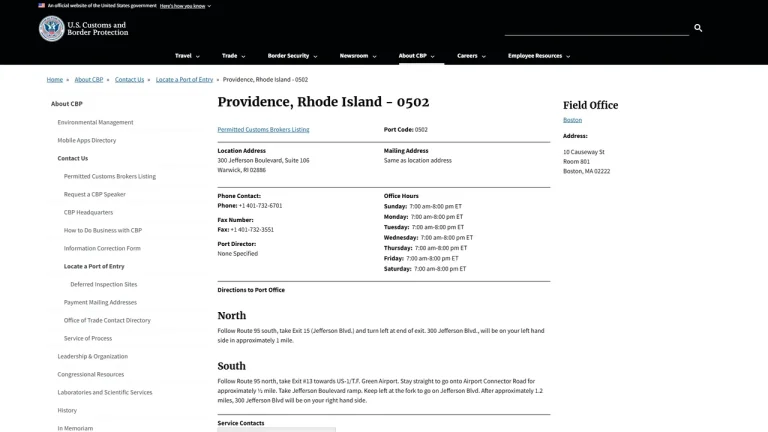
U.S. Customs and Border Protection - Providence Service Port - Warwick, RI


Scope & Jurisdiction of Federal Law Enforcement in Rhode Island
Federal law enforcement in the District of Rhode Island operates under the judicial oversight of the United States District Court for the District of Rhode Island and the prosecutorial authority of the United States Attorney's Office located in downtown Providence. As the smallest federal judicial district by land area, Rhode Island maintains a highly coordinated federal investigative network addressing violations of federal criminal code, interstate commerce, maritime infractions, public corruption, and multi-jurisdictional narcotics trafficking.
Key primary investigative entities operating within the state include the Federal Bureau of Investigation (FBI) Providence Resident Agency (operating under the regional Boston Field Office), the Drug Enforcement Administration (DEA) Providence Resident Office, and the Bureau of Alcohol, Tobacco, Firearms and Explosives (ATF) Providence Field Office. These agencies collaborate through joint specialized strike forces with state and local partners to combat violent firearms offenses and organized illicit enterprises.
Judicial enforcement and prisoner custody are executed by the United States Marshals Service (USMS) based at the John O. Pastore Federal Building and U.S. Courthouse in Providence. The Marshals manage federal fugitive apprehension, witness security, and courthouse protections. In coastal sectors, maritime security, fisheries compliance, and port enforcement throughout Narragansett Bay and Rhode Island Sound fall under the active operational jurisdiction of the United States Coast Guard Stations located at Castle Hill in Newport and Point Judith in Narragansett.
Federal Agency Services, Fees & Statutory Timelines
| Service / Matter | Required Documents / Prerequisites | Statutory Fee (USD) | Processing Timeline |
|---|---|---|---|
| Freedom of Information Act (FOIA) Request | Written request, identity verification, clear records description | $0.00 base fee (statutory search fees may apply) | 20 statutory business days |
| Federal Grand Jury Subpoena Response | Subpoena duces tecum, responsive document index, privilege log | $0.00 agency filing fee | 14 to 21 calendar days from service |
| FBI Identity History Summary Check | Form 1-783, complete fingerprint card (FD-258), identity proof | $18.00 statutory fee | 3 to 5 business days electronically |
| Administrative Asset Forfeiture Claim | Verified claim, statement of proprietary interest, seizure number | $0.00 agency fee | 30 calendar days from notice |
Critical Legal Deadlines & Statutes in Rhode Island
Proceedings involving federal investigative agencies are governed by strict national statutory deadlines that permit virtually no discretionary delay. For administrative disclosure, public requests directed to federal entities in Rhode Island follow the Freedom of Information Act codified in 5 U.S. Code § 552, mandating an initial determination response within twenty business days. Complex searches allow an agency to claim a ten-day statutory extension upon formal written notice.
In criminal proceedings, the general federal statute of limitations codified in 18 U.S. Code § 3282 requires an indictment or formal information for non-capital federal crimes to be filed within five years of the offense. For individuals arrested by federal law enforcement, the Speedy Trial Act under 18 U.S. Code § 3161 mandates an indictment within thirty days of custodial arrest and requires the commencement of a federal trial within seventy days of the indictment or initial appearance.
When federal agencies initiate non-judicial administrative forfeiture of cash or personal property, the claimant must file a verified judicial claim within thirty days of the date of personal notice pursuant to 18 U.S. Code § 983. For federal civil rights claims filed against federal officers under the Bivens doctrine, the federal court borrows Rhode Island's three-year general personal injury limitations deadline under R.I. Gen. Laws § 9-1-14.
Direct Access vs. Legal Representation
Citizens can engage directly with federal law enforcement agencies for basic informational or reporting procedures. Individuals may submit confidential public safety tips online through the FBI or DEA tip portals, file identity history summary requests for foreign visa clearance, or direct basic FOIA requests to regional agency headquarters.
Conversely, whenever an individual or commercial enterprise becomes the subject of a federal inquiry, retaining experienced federal criminal defense counsel admitted to the Bar of the U.S. District Court for the District of Rhode Island is imperative. Receiving a target letter from the U.S. Attorney's Office, being contacted by federal special agents for a "voluntary interview," or being served with a federal grand jury subpoena requires strategic representation. Participating in federal investigative interviews without counsel creates immense legal exposure under federal false statement statutes, while self-representation in federal criminal prosecutions exposes individuals to harsh federal sentencing guidelines.
Red Flags & Public Service Warnings
Members of the Rhode Island public should exercise caution to avoid sophisticated federal impersonation scams and administrative pitfalls:
- Federal Agent Impersonation Calls: Scammers spoofing telephone caller IDs to appear as the FBI Providence Resident Agency or U.S. Marshals Service, demanding wire transfers or digital currency to cancel phantom federal warrants.
- Commercial FOIA Filing Middlemen: Unofficial private companies charging exorbitant fees to submit standard federal FOIA requests that can be completed directly with the respective federal agency free of charge.
- Non-Attorney Federal Subpoena Advisors: Commercial consultants offering informal advice on federal subpoena compliance, which can inadvertently cause waivers of Fifth Amendment protections or attorney-client privilege.
- Guaranteed Asset Forfeiture Recovery Firms: Unlicensed recovery organizations claiming inside access to the U.S. Attorney's Office to secure the release of seized assets for high upfront contingency fees.
Frequently Asked Questions
Where is the United States Attorney's Office located in Rhode Island?
The United States Attorney's Office for the District of Rhode Island is located in the Fleet Center building on Westminster Street in downtown Providence, serving as the principal federal prosecution headquarters for the state.
What should I do if federal agents contact me for an interview in Rhode Island?
You have the constitutional right to remain silent and to decline questioning without an attorney present. Politely request the agents' business cards and inform them that your legal counsel will contact their office before providing any verbal or written statements.
How do I submit a FOIA request to a federal agency branch in Rhode Island?
FOIA requests can be filed electronically through the centralized federal portal (FOIA.gov) or submitted directly to the specific agency's regional disclosure office, specifying the exact records sought and agreeing to applicable search fee terms.
What is the primary role of the U.S. Marshals Service in Rhode Island?
The U.S. Marshals Service for the District of Rhode Island secures federal courthouses, protects federal judges and prosecutors, transports federal pretrial detainees to the federal courthouse, and leads multi-agency violent fugitive apprehension task forces.
How does federal criminal jurisdiction differ from state prosecution in Rhode Island?
Federal jurisdiction applies to offenses involving interstate commerce, violations of federal statutes, maritime crimes, or activities occurring on federal property. State charges involve violations of Rhode Island General Laws prosecuted by the state Attorney General in state circuit courthouses.