
Patent Attorneys in Los Angeles
Securing patent protection in Los Angeles demands registered patent counsel admitted before the USPTO and experienced in federal court. An accomplished patent attorney structures comprehensive claim scope while safeguarding your proprietary technology against competitive infringement. Browse our directory below to schedule a case review with leading patent practitioners across Los Angeles County.
Omni Legal Group - Los Angeles, CA

Syed Law | Trademark Attorney - Los Angeles, CA
Hatch Law, PC - Los Angeles, CA
JCIP - Los Angeles, CA
Yang Law Offices - Los Angeles, CA
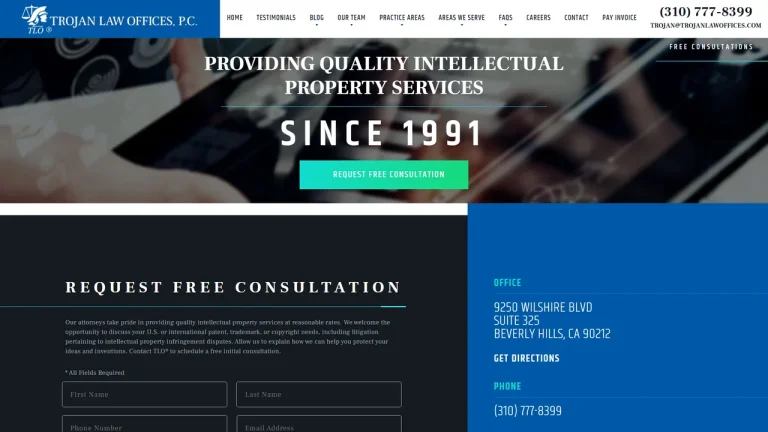
Trojan Law Offices - Los Angeles, CA
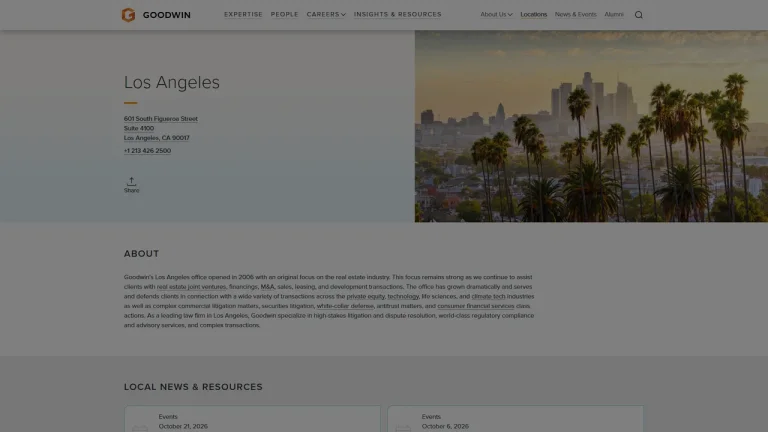
Goodwin Procter - Los Angeles, CA
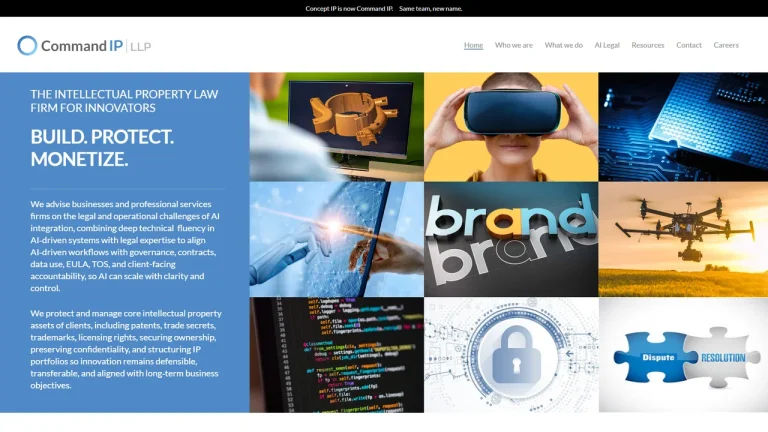
Command IP LLP - Los Angeles, CA
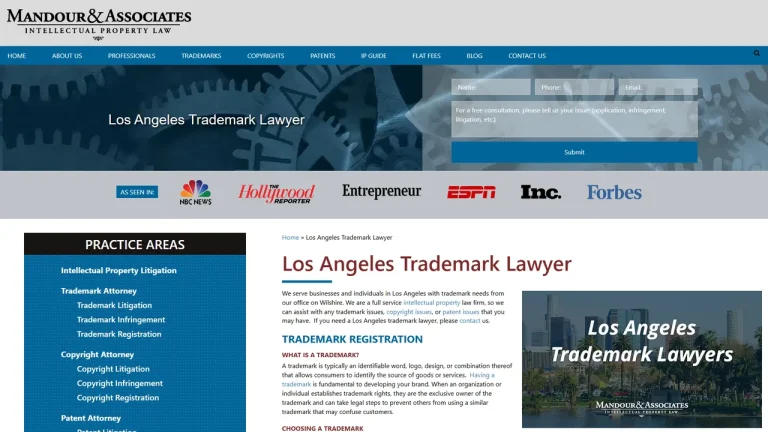
Mandour & Associates, APC - Los Angeles, CA
Eichenstein Law Firm P.C. - Los Angeles, CA
Hankin Patent Law - Los Angeles, CA
McConnell Law Firm, P.C. - Los Angeles, CA
Cislo & Thomas LLP - Los Angeles, CA

Milord Law Group, PC - Los Angeles, CA
Protecting Inventions & Proprietary Technology in Los Angeles
Securing, prosecuting, and defending patent assets in Southern California requires specialized legal credentials bridging administrative agency practice and federal courtroom advocacy. The Los Angeles metropolitan region is an internationally recognized center of technological development, housing aerospace innovators in El Segundo and Long Beach, biotech and medical research institutions in Pasadena, digital technology firms across Silicon Beach in Santa Monica and Playa Vista, and industrial designers throughout Downtown Los Angeles.
Patent prosecution is conducted directly before the United States Patent and Trademark Office (USPTO), supported by regional resources including the Silicon Valley Regional Office. When proprietary rights are infringed or claims require defensive litigation, all patent infringement actions originating in Los Angeles County fall under the exclusive jurisdiction of the U.S. District Court for the Central District of California, headquartered at the First Street U.S. Courthouse in Downtown Los Angeles.
Successfully navigating patent prosecution requires an attorney admitted to the State Bar of California who is also registered to practice before the USPTO Patent Bar. This dual qualification ensures your inventions are protected through airtight patent specifications and enforceable claims that withstand validity challenges.
Patent Legal Fees & Prosecution Cost Breakdown
| Case Scenario | Fee Structure | Estimated Cost (USD) | Key Cost Determinants |
|---|---|---|---|
| Prior Art Search & Patentability Opinion | Fixed Fee | $1,500 - $3,500 | Scope of worldwide database searching, technical discipline, and analysis of competing claims. |
| Provisional Patent Application | Flat Fee + USPTO Fees | $3,000 - $6,500 | Number of formal technical drawings, specification breadth, and readiness of engineering disclosures. |
| Non-Provisional Utility Patent | Staged Flat Fee | $8,500 - $16,000 | Independent and dependent claim counts, technology sector (software, biotech, mechanical), and USPTO fees. |
| Office Action Response & Defense | Hourly or Fixed Fee | $2,500 - $5,500 | Substantive rejection complexity under Section 102 or 103, examiner interviews, and claim amendments. |
Critical Legal Deadlines & Statutes in California
Patent rights are governed strictly by federal statutory deadlines under the Leahy-Smith America Invents Act. Under 35 U.S. Code § 102, the United States operates under a strict first-inventor-to-file regime. If an invention is publicly disclosed, commercially sold, or offered for sale, a strict one-year grace period begins, after which all domestic patent rights are forfeited permanently, while foreign rights are often lost immediately.
Filing a provisional application secures an immediate priority filing date pursuant to 35 U.S. Code § 119. However, inventors must file a corresponding non-provisional application within precisely 12 months to benefit from the earlier priority date. Once a substantive Office Action is issued by the USPTO, applicants have a statutory deadline not to exceed six months to respond under 35 U.S. Code § 133, with extension fees applying after three months. For infringement litigation in the Central District of California, recovery of damages is capped at six years prior to the complaint date under 35 U.S. Code § 286.
Small Claims Courts vs. Federal Patent Litigation
Under California law, the Small Claims Division of the Los Angeles County Superior Court hears claims up to $12,500 for natural persons pursuant to Cal. Civ. Proc. Code § 116.221. However, state courts possess zero subject-matter jurisdiction over patent disputes. Under 28 U.S. Code § 1338, federal district courts hold exclusive jurisdiction over any civil action arising under patent laws.
Moreover, representation before the USPTO requires passing the Patent Bar Examination and admission under 37 C.F.R. § 11.6. While inventors may file patent applications pro se, unrepresented applicants routinely draft overly narrow claims or commit disclosure errors that dedicate valuable aspects of their invention to the public domain. Retaining a dedicated patent attorney guarantees robust claim construction capable of surviving inter partes review and federal court litigation.
Red Flags When Selecting a Los Angeles Patent Lawyer
- Lack of USPTO Registration: Always check the USPTO Office of Enrollment and Discipline directory to confirm that your attorney holds a valid registration number and is authorized to prosecute patents.
- Invention Marketing Companies: Avoid consumer promotion services that offer invention packaging or licensing deals in exchange for steep upfront retainers without providing patent attorney representation.
- Guaranteed Patent Issuance: Patent examiners evaluate novelty and non-obviousness independently; any legal practitioner who guarantees the issuance of utility patent claims is misleading you.
- Absence of Relevant Technical Background: Retain counsel with an engineering or scientific degree matched to your technology, ensuring accurate technical drafting for complex mechanical, electrical, or software inventions.
Frequently Asked Questions
What is the difference between a provisional and non-provisional patent application?
A provisional application acts as a temporary 12-month placeholder that establishes priority without being formally examined. A non-provisional application is reviewed by a USPTO examiner and can mature into an enforceable patent.
Can any licensed California attorney file a patent application for me?
No. Preparing and prosecuting patent applications before the USPTO requires passing the federal Patent Bar examination and holding an active registration number as a patent attorney or agent.
Where is patent infringement litigation heard in Los Angeles County?
Patent litigation in Los Angeles is filed exclusively in the United States District Court for the Central District of California, primarily at the First Street U.S. Courthouse in Downtown Los Angeles.
What occurs if I publicly disclose my invention prior to filing?
Under U.S. law, you have a one-year grace period from the initial public disclosure to file an application. However, public disclosure generally destroys patent eligibility in most international jurisdictions immediately.
How long does the USPTO patent examination process typically take?
On average, the examination process requires 18 to 36 months from the filing date, though applicants can utilize Track One prioritized examination to obtain final disposition within 12 months.