
Workers' Compensation Lawyers in Los Angeles
Retaining an experienced Los Angeles workers' compensation lawyer protects your statutory rights, ensures necessary medical care, and maximizes disability benefits. Dedicated legal counsel regularly resolves benefit disputes and denied claims through mandatory settlement conferences without prolonged administrative trials. Browse our directory below to consult verified workers' compensation attorneys across Los Angeles.

Workers Compensation Attorney Group - Los Angeles, CA
KJ Injury and Accident Lawyers P.C. - Los Angeles, CA
The Law Offices of Jacob Emrani - Los Angeles, CA
Law Office of Laleh Ensafi - Los Angeles, CA

Barsoum Law A.P.C. - Los Angeles, CA

Hinden & Breslavsky - Los Angeles, CA
C&B Law Group, LLP - Los Angeles, CA
Iglow, Bachrach & Herrera - Los Angeles, CA

The Law Offices of Larry H. Parker - Los Angeles, CA

Morgan & Morgan - Los Angeles, CA

CA Workers' Compensation Attorney - Los Angeles, CA

Lee Legal Group - Los Angeles, CA
GEKLAW - Los Angeles, CA
The Accident Guys - Los Angeles, CA
Levin & Nalbandyan LLP - Los Angeles, CA

The Law Collective - Los Angeles, CA

The Barnes Firm Injury Attorneys - Los Angeles, CA

Ariel Law Group - Los Angeles, CA
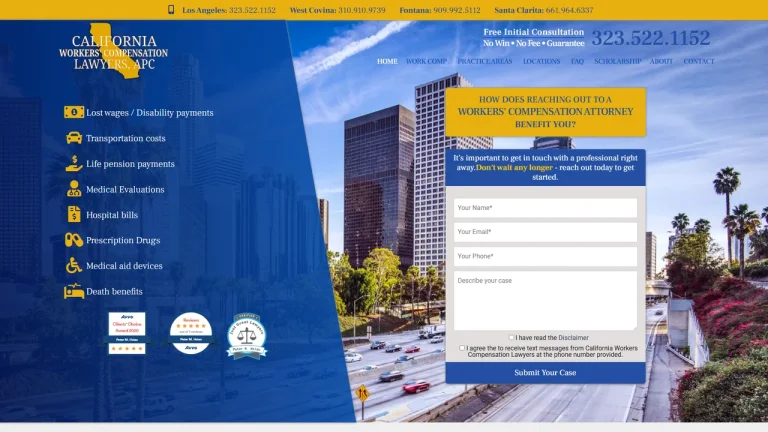
California Workers' Compensation Lawyers - Los Angeles, CA
Cherepinskiy Law Firm, PC - Los Angeles, CA

Khanuja Law - Los Angeles, CA
The L.A. Law Firm - Los Angeles, CA
EAccidents - Los Angeles, CA
Workers' Compensation Jurisdictions in Los Angeles County
Employees injured on the job in Los Angeles County operate within an administrative system managed by the California Division of Workers' Compensation (DWC). Workplace injury claims are adjudicated by the California Workers' Compensation Appeals Board (WCAB). The WCAB maintains dedicated district offices throughout Los Angeles County, including the Los Angeles District Office on West 4th Street in Downtown LA, the Van Nuys District Office, the Long Beach District Office, and the Marina del Rey District Office.
Los Angeles supports a massive workforce across diverse sectors, including commercial logistics and cargo handling at the Port of Los Angeles, aviation and aerospace manufacturing, entertainment and studio production, healthcare delivery, and commercial construction. Whether an injury results from an acute trauma on a job site or continuous ergonomic strain over months of work, employers and claims administrators frequently delay treatment or dispute permanent disability impairment ratings.
Under California law, workers' compensation is an administrative remedy where disputes over medical treatment necessity, temporary total disability, and permanent impairment ratings are resolved before administrative law judges. Retaining experienced workers' compensation counsel ensures timely filing of claims, proper selection of Qualified Medical Evaluators (QME), and effective representation during mandatory settlement conferences.
Workers' Compensation Fee Structures & Disability Scales in Los Angeles
| Case Scenario | Fee Structure | Estimated Cost (USD) | Key Cost Determinants |
|---|---|---|---|
| Acute Workplace Accidents (Fractures, Lacerations, Concussions) | Statutory Contingency (Cal. Lab. Code § 4906) | 12% - 15% of settlement award | Medical provider network utilization, Qualified Medical Evaluator disability impairment ratings, and temporary disability arrears. |
| Cumulative Trauma & Repetitive Strain Injuries | Statutory Contingency (Cal. Lab. Code § 4906) | 12% - 15% of settlement award | Medical causation assessments, continuous employment records, and vocational ergonomics evaluations. |
| Occupational Exposure & Pulmonary Illness Claims | Statutory Contingency (Cal. Lab. Code § 4906) | 12% - 15% of settlement award | Toxicological diagnostics, pulmonary function testing, and long-term future medical care allocations. |
| Denied Injury Claims & Mandatory Settlement Conferences | Statutory Contingency (Cal. Lab. Code § 4906) | 12% - 15% of settlement award | Witness statements, personnel record subpoenas, and administrative trial representation before WCAB judges. |
Critical Legal Deadlines & Statutes in California
Employees in California must observe strict administrative deadlines to preserve their eligibility for workers' compensation benefits. Failing to follow statutory notification protocols can compromise a claim:
- Notice of Injury to Employer: An injured worker must provide written notification of a work injury to their employer within 30 days under Cal. Lab. Code § 5400.
- Filing Formal Claim Application: An Application for Adjudication of Claim must be filed with the WCAB within 1 year from the date of injury or the last provision of medical benefits under Cal. Lab. Code § 5405.
- Employer 90-Day Decision Window: An employer or insurance administrator has 90 days to accept or deny a claim under Cal. Lab. Code § 5402, during which they must authorize up to $10,000 in immediate medical treatment.
- Qualified Medical Evaluator (QME) Requests: Parties must submit a panel request to the Medical Unit within strict statutory timeframes following an objection to a treating physician's report under Cal. Lab. Code § 4062.2.
- Surviving Dependent Death Benefits: Claims for death benefits by dependents must be filed within 1 year of death and within 240 weeks from the original date of injury under Cal. Lab. Code § 5406.
Small Claims Courts vs. WCAB Exclusive Jurisdiction
Under the exclusive remedy doctrine codified in Cal. Lab. Code § 3600, civil courts-including the Small Claims Division of the Los Angeles County Superior Court-have no authority to hear workplace injury disputes. Injured employees cannot sue employers in civil court for ordinary negligence; all claims must proceed through the WCAB administrative system.
Navigating the WCAB system without legal representation exposes injured workers to strategic advantages held by insurance adjusters and defense counsel. Unrepresented workers risk accepting inadequate disability ratings or signing compromised settlement contracts that terminate future medical rights. Licensed workers' compensation attorneys manage medical disputes, secure accurate disability ratings, and negotiate settlements through Compromise and Release or Stipulations with Request for Award.
Red Flags When Hiring a Los Angeles Workers' Compensation Lawyer
- Demanding Upfront Retainer Fees: Charging upfront legal fees for workers' compensation representation is illegal in California; all legal fees must be formally approved by a WCAB judge upon case resolution under Cal. Lab. Code § 4906.
- Unrealistic Settlement Guarantees: Any attorney promising specific monetary payouts before receiving primary treating physician reports or QME ratings violates ethical standards.
- Unsupervised Non-Attorney Representatives: Ensure that your case is overseen by a licensed attorney rather than handed off entirely to non-attorney hearing representatives at WCAB district offices.
- Unverified Professional Standing: Verify that prospective counsel maintains active licensing without disciplinary sanctions on The State Bar of California directory.
Frequently Asked Questions
Where are workers' compensation hearings held in Los Angeles County?
Hearings are conducted at the local district offices of the California Workers' Compensation Appeals Board (WCAB), located in Downtown Los Angeles (West 4th Street), Van Nuys, Long Beach, and Marina del Rey.
How much does a workers' compensation attorney charge in California?
Workers' compensation attorneys in California work on a contingency basis. Legal fees typically range between 12% and 15% of the total disability award or settlement and must be reviewed and approved by a WCAB administrative law judge under Cal. Lab. Code § 4906.
What should I do if my workers' compensation claim is denied?
If your claim is denied, you must file an Application for Adjudication of Claim with the WCAB, request a panel of Qualified Medical Evaluators under Cal. Lab. Code § 4062.2, and calendar a Mandatory Settlement Conference to challenge the denial before a judge.
What is a Qualified Medical Evaluator (QME) in California?
A QME is an independent physician certified by the Division of Workers' Compensation to evaluate medical disputes, determine work-related causation, and assign permanent disability impairment ratings when treating physician findings are contested.
Can an employer retaliate against an employee for filing a claim?
No. Under Cal. Lab. Code § 132a, it is illegal for an employer to discharge, threaten to discharge, or discriminate against an employee for filing a workers' compensation claim. Violations can result in statutory financial penalties, back pay, and job reinstatement.