
Patent Attorneys in Chicago
Securing patent rights in Chicago requires registered patent counsel admitted before the USPTO and experienced in federal intellectual property litigation. A knowledgeable patent attorney protects proprietary inventions and structures defensible claim scope to withstand infringement challenges. Explore our directory below to connect with top-rated patent attorneys across the Chicago area.

Alison King - Winston & Strawn LLP - Chicago, IL
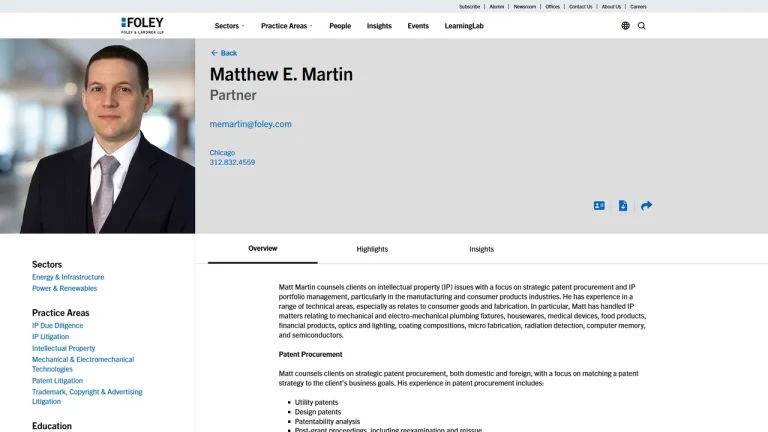
Foley & Lardner LLP: Matthew E. Martin - Chicago, IL
Law Offices of R. Tamara de Silva - Chicago, IL

Samantha Maxfield Lerner - Winston & Strawn LLP - Chicago, IL
Prospect Law LLP - Chicago, IL
Chiacchio IP - Chicago, IL

Kevin J. Boyle - Winston & Strawn LLP - Chicago, IL

Vivek V. Krishnan - Winston and Strawn LLP - Chicago, IL

Ivan M. Poullaos - Winston & Strawn LLP - Chicago, IL
Fitch Even Tabin & Flannery LLP - Chicago, IL
Sarah J. Kalemeris - Norton Rose Fulbright - Chicago, IL

Kimball R. Anderson - Winston & Strawn LLP - Chicago, IL
The Law Offices of Konrad Sherinian, LLC - Chicago, IL
Oliver D Yang - Chicago, IL
Neal, Gerber & Eisenberg LLP - Chicago, IL
Michael K. Nutter - Winston & Strawn LLP - Chicago, IL

Maureen L. Rurka - Winston and Strawn LLP - Chicago, IL
Quarles & Brady LLP - Chicago, IL

John R. McNair - Winston & Strawn LLP - Chicago, IL
Invention Mine LLC - Chicago, IL
Dickinson Wright - Chicago, IL
Armstrong Teasdale LLP - Chicago, IL
Winston & Strawn LLP - Chicago, IL
Protecting Inventions & Proprietary Technology in Chicago
Securing, prosecuting, and defending patent assets in the greater Chicago metropolitan area requires specialized legal representation that bridges federal administrative procedures and federal trial advocacy. Chicago is an international hub of commercial innovation, anchoring advanced manufacturing, transportation logistics, biotechnology, financial technology (FinTech) associated with major trading exchanges, and medical device research across the Illinois Medical District.
Patent prosecution is conducted directly before the United States Patent and Trademark Office (USPTO). When proprietary technology is infringed or patent claims require courtroom enforcement, all federal patent lawsuits arising in Cook County fall under the exclusive jurisdiction of the U.S. District Court for the Northern District of Illinois, located at the Everett McKinley Dirksen United States Courthouse in Downtown Chicago. The Northern District is nationally recognized for its specialized Local Patent Rules that govern patent litigation timelines and discovery.
Navigating patent prosecution successfully demands an attorney admitted to the Illinois State Bar who is also officially registered to practice before the USPTO Patent Bar. This dual qualification ensures your technical disclosures are structured into defensible claims capable of surviving validity challenges in federal court.
Patent Legal Fees & Prosecution Cost Breakdown
| Case Scenario | Fee Structure | Estimated Cost (USD) | Key Cost Determinants |
|---|---|---|---|
| Prior Art Search & Patentability Opinion | Flat Fee | $1,500 - $3,500 | Scope of worldwide database searching, mechanical vs. software architecture, and competing patent landscape. |
| Provisional Patent Application Filing | Flat Fee + USPTO Fees | $3,000 - $6,500 | Number of formal technical drawings, engineering specification detail, and complexity of disclosed embodiments. |
| Non-Provisional Utility Patent Prosecution | Staged Flat Fee | $8,500 - $16,500 | Independent and dependent claim counts, technology sector (software, biotech, mechanical), and USPTO fees. |
| Office Action Defense & PTAB Proceedings | Hourly or Fixed Fee | $2,500 - $6,000 | Section 102 novelty or Section 103 obviousness rejections, examiner interviews, and claim amendments. |
Critical Legal Deadlines & Statutes in Illinois
Patent law is governed strictly by federal statutory timeliness rules under the Leahy-Smith America Invents Act. Under 35 U.S. Code § 102, the United States follows a first-inventor-to-file framework. If an invention is publicly disclosed, sold, or offered for sale, a strict one-year grace period begins, after which all domestic patent rights are forfeited permanently, while foreign rights are typically extinguished immediately.
Filing a provisional patent application establishes an immediate priority filing date pursuant to 35 U.S. Code § 119. However, inventors must file a corresponding non-provisional application within precisely 12 months to claim the benefit of that earlier filing date. When the USPTO issues an Office Action, applicants have a statutory window not to exceed six months to respond under 35 U.S. Code § 133, with extension fees applying after three months. For infringement actions in the Northern District of Illinois, recovery of monetary damages is limited to infringements occurring within six years prior to filing the complaint pursuant to 35 U.S. Code § 286.
Small Claims Limits vs. Professional Representation
In Cook County, the Small Claims Division of the Circuit Court of Cook County handles disputes up to $10,000 under Ill. Sup. Ct. R. 281. However, state courts possess zero subject-matter jurisdiction over patent validity, licensing ownership disputes under patent law, or patent infringement claims. Under 28 U.S. Code § 1338, federal district courts have exclusive jurisdiction over any civil action arising under any Act of Congress relating to patents.
Furthermore, prosecuting patent applications before the USPTO requires passing the Patent Bar examination and admission pursuant to 37 C.F.R. § 11.6. While inventors may file applications pro se, unrepresented applicants routinely make fatal drafting errors, such as drafting overly narrow claims or inadvertently dedicating valuable aspects of their invention to the public domain. Retaining an experienced patent attorney ensures comprehensive claim drafting that withstands invalidation scrutiny during litigation.
Red Flags When Hiring a Chicago Patent Lawyer
- Attorneys Not Registered with the USPTO: Always verify that your attorney holds an active registration number with the USPTO Office of Enrollment and Discipline, rather than holding only a general state law license.
- Invention Promotion Scams: Steer clear of commercial invention marketing firms that charge substantial upfront fees for packaging or market research without providing licensed patent attorney drafting services.
- Guaranteed Patent Issuance: Patentability decisions rest entirely with USPTO examiners; no ethical lawyer can promise that an application will issue as an enforceable patent.
- Lack of Technical Alignment: Retain counsel who possesses an academic engineering or scientific degree relevant to your technology, ensuring accurate technical drafting for complex mechanical, electrical, or software inventions.
Frequently Asked Questions
What is the difference between a provisional and non-provisional patent application?
A provisional application acts as a temporary 12-month placeholder that establishes priority without formal examination. A non-provisional application is reviewed by a USPTO examiner and can mature into an enforceable patent.
Can any licensed Illinois attorney file a patent application for my business?
No. Preparing and prosecuting patent applications before the USPTO requires passing the federal Patent Bar examination and holding an active registration number as a patent attorney or agent.
Where are patent infringement lawsuits filed in Chicago?
Patent litigation in Chicago is filed exclusively in the United States District Court for the Northern District of Illinois, located at the Everett McKinley Dirksen United States Courthouse in The Loop.
What happens if I publicly disclose my invention before filing a patent application?
Under U.S. patent law, you have a one-year grace period from the date of disclosure to file your application. However, public disclosure generally eliminates patent eligibility in foreign jurisdictions immediately.
How long does it take for a patent to issue through the USPTO?
On average, the examination process requires 18 to 36 months from the filing date, though applicants can utilize Track One prioritized examination to obtain a final disposition within 12 months.