
Employment & Labor Lawyers in Kansas
Consulting an experienced Kansas employment and labor lawyer ensures your workplace rights are defended under state wage payment and anti-discrimination laws. Skilled employment litigators recover unpaid wages, contest retaliatory discharge, and represent employees before administrative agencies and district courts. Explore our statewide directory to connect with an accomplished Kansas employment attorney today.
Sean McGivern - Graybill & Hazlewood, L.L.C. - Wichita, KS

Vaughn Burkholder - Overland Park, KS

Tara Eberline, Attorney at Law - Overland Park, KS
Hite, Fanning and Honeyman LLP - Wichita, KS
Morris Laing Evans Brock & Kennedy Chartered - Wichita, KS
Foulston Siefkin LLP - Overland Park, KS

Fisher Patterson Sayler Smith - Topeka, KS

Dugan Schlozman - Overland Park, KS

Colantuono Guinn Keppler LLC - Overland Park, KS

Jackson Lewis PC - Overland Park, KS
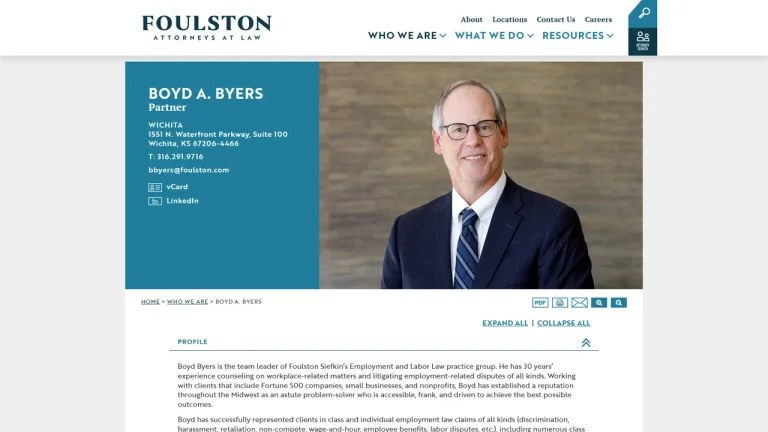
Boyd A. Byers - Wichita, KS

Henson, Hutton, Mudrick, Gragson & Vogelsberg, LLP - TOPEKA, KS

Hinkle Law Firm LLC - Wichita, KS

Fisher Patterson Sayler Smith - Overland Park, KS
Franklin Law Office PA - Wichita, KS

Employee and Labor Law Group of KC - Overland Park, KS

Pate & Paugh, LLC - Wichita, KS
Gary Albin - Wichita, KS
Eric Kjorlie - Topeka, KS

Littler Mendelson P.C. - Overland Park, KS
Tomasic & Rehorn - Kansas City, KS
Conlee Schmidt & Emerson - Wichita, KS
Joseph, Hollander & Craft LLC - Overland Park, KS
Kansas Workplace Jurisdictions & Labor Law Framework
Employment relations in the State of Kansas are governed by a complex intersection of state statutory protections, federal labor acts, and common-law judicial doctrines. Whether working within corporate, aerospace, logistics, or healthcare industries across Sedgwick County, Johnson County, Wyandotte County, or Shawnee County, workers face distinctive legal rules. While Kansas adheres to the foundational doctrine of at-will employment, employers remain strictly bound by state wage standards and public policy exceptions prohibiting retaliatory termination.
Employment litigation in Kansas is conducted within county District Courts or before federal trial courts. State court actions are administered via the Kansas Courts eFiling system, while federal claims proceed in the United States District Court for the District of Kansas, with divisions in Wichita, Kansas City, and Topeka. Attorneys admitted to the Kansas Bar Association represent employees and employers through statutory claims under the Kansas Wage Payment Act and civil rights actions initiated with administrative enforcement bodies.
Before filing civil lawsuits for workplace discrimination or sexual harassment, employees must exhaust mandatory administrative avenues through the Kansas Human Rights Commission (KHRC) or the Equal Employment Opportunity Commission (EEOC). An experienced Kansas labor lawyer ensures that administrative charges are timely submitted, retaliatory actions for workers' compensation filings are challenged, and statutory wage penalties are aggressively pursued.
Kansas Employment Law Representation & Fee Structures
| Case Scenario | Fee Structure | Estimated Cost (USD) | Key Cost Determinants |
|---|---|---|---|
| Kansas Wage Payment Act (Unpaid Wages / Overtime) | Contingency / Statutory Fee-Shifting | 33.3% of recovery (or employer-paid fees) | Payroll records, willful nonpayment penalty assessment under K.S.A. 44-315, KDOL administrative claim. |
| Severance Agreement & Non-Compete Review | Flat Legal Fee / Hourly | $750 - $2,500 | Non-compete geographic reasonableness, general release terms, negotiation of additional severance pay. |
| KHRC / EEOC Discrimination & Retaliation Charge | Contingency / Hybrid Retainer | $2,500 - $6,500 | Drafting formal complaint, employer position statement rebuttal, representation at KHRC conciliation. |
| Retaliatory Discharge / Whistleblower Lawsuit | Contingency Fee (Litigation Stage) | 33.3% - 40% of recovery | Workers' compensation retaliation documentation, executive depositions, economic wage loss modeling, jury trial. |
Critical Legal Deadlines & Statutes in Kansas
Employees pursuing claims against employers in Kansas must navigate strict administrative and statutory filing deadlines. For unpaid wages, commissions, or earned vacation pay, the primary statutory mechanism is the Kansas Wage Payment Act (KWPA), codified at K.S.A. § 44-313. Under K.S.A. § 44-314, employers must pay all wages due at least once per month on regular paydays. If an employer willfully fails to pay wages upon separation of employment under K.S.A. § 44-315, the employee is entitled to recover the unpaid wages plus a statutory penalty of 1 percent per day up to an additional 100 percent of the unpaid amount.
Under K.S.A. § 60-512, actions brought under the Kansas Wage Payment Act or liabilities created by statute carry a three-year statute of limitations. However, when an employee suffers workplace discrimination based on race, religion, color, sex, disability, national origin, or ancestry, the Kansas Act Against Discrimination (KAAD) applies under K.S.A. § 44-1001. Under K.S.A. § 44-1005, an administrative complaint must be filed with the Kansas Human Rights Commission (KHRC) within six months (180 days) after the alleged discriminatory act. Missing this tight 180-day window permanently extinguishes state civil rights claims.
While Kansas is an at-will state, the Kansas Supreme Court recognizes common-law tort exceptions for retaliatory discharge in violation of public policy. Specifically, employers cannot terminate workers for filing a workers' compensation claim or for whistleblowing on infractions of rules pertaining to public health and safety. These common-law tort actions are subject to the two-year statute of limitations set forth in K.S.A. § 60-513.
Small Claims Limitations vs. District Court Employment Litigation
Under the Kansas Small Claims Procedure Act, K.S.A. § 61-2703, small claims actions are capped at $4,000, and parties are generally barred from having attorneys represent them at the trial hearing. While an employee could theoretically file a claim in small claims court for a modest final paycheck, doing so forfeits the ability to recover full statutory damages. Small claims judges cannot award the 100 percent liquidated damages penalty under K.S.A. § 44-315 or award emotional distress and punitive damages available in Chapter 60 district court lawsuits.
Filing an employment claim in District Court provides substantial procedural advantages. Retaining legal counsel enables employees to issue subpoenas for electronic payroll systems, depose supervisors who manufactured pretextual write-ups, and utilize state fee-shifting provisions that require non-compliant employers to pay reasonable attorney fees. Whether pursuing a wage theft claim through the Kansas Department of Labor (KDOL) or litigating a complex whistleblower action in court, professional legal representation is vital to secure full financial recovery.
Red Flags When Hiring a Kansas Employment Attorney
- Missing the 180-Day KHRC Filing Deadline: Any lawyer who fails to submit discrimination charges to the KHRC within six months under K.S.A. § 44-1005 permanently forfeits your state civil rights remedies.
- Failing to Seek the 100 Percent Statutory Wage Penalty: An attorney who only demands base unpaid wages without seeking the daily penalty under K.S.A. § 44-315 leaves significant statutory compensation behind.
- Advising Employees to Resign Prematurely: Quitting before documenting ongoing workplace harassment makes proving constructive discharge under Kansas law exceptionally difficult.
- Demanding Out-of-Pocket Retainers for Wage Theft: Legitimate wage and overtime attorneys handle valid employee claims on contingency or statutory fee-shifting, advancing initial filing costs.
Frequently Asked Questions
What penalties can an employer face for unpaid wages in Kansas?
Under K.S.A. § 44-315, if an employer willfully fails to pay wages upon termination, they can be penalized 1 percent per day up to a maximum penalty of 100 percent of the unpaid wages, in addition to the base compensation owed.
What is the deadline to file a discrimination complaint in Kansas?
Under K.S.A. § 44-1005, you must file a formal complaint with the Kansas Human Rights Commission (KHRC) within six months (180 days) from the date the discriminatory act occurred.
Can an employer in Kansas fire an employee for filing workers' compensation?
No. Kansas common law strictly prohibits retaliatory discharge for filing a workers' compensation claim. Such terminations constitute an actionable tort under K.S.A. § 60-513 with a two-year filing deadline.
Are non-compete agreements enforceable in Kansas?
Yes, Kansas courts enforce non-compete covenants provided they protect a legitimate business interest, do not place undue hardship on the employee, and are reasonable in geographic territory and duration.
Is an employer required to pay out unused vacation pay in Kansas?
Under K.S.A. § 44-313 and Kansas Department of Labor regulations, earned vacation pay constitutes wages and must be paid upon termination unless the employer written policy clearly states that unused vacation is forfeited.