
Probate Lawyers in Wichita
Connect with top probate lawyers in Wichita to navigate Sedgwick County estate administration, validate wills, and distribute assets efficiently to heirs. A seasoned local probate attorney helps families avoid contentious courtroom battles through structured mediation and probate administration out of court whenever possible. Browse our verified directory below to schedule an estate consultation with trusted Wichita probate counsel.
Weber Law Office, P.A. - Wichita, KS
Alex Mitchell Law Office - Wichita, KS

Peggs Wheeler, LC - Wichita, KS

James A. Peter, Attorney At Law - Wichita, KS

Law Office of Lane R. Palmateer - Wichita, KS

The Law Office of Andrew Rowe - Wichita, KS
Jeffrey L. Willis PA - Wichita, KS
Riley Don W - Wichita, KS

Eidelman Law Firm - Wichita, KS
Larson, Brown & Ebert, PA - Wichita, KS

Frank M Ojile - Wichita, KS
Law Office of Gregory L. Bernhardt - Wichita, KS
Law Office of Cathleen A. Gulledge - Wichita, KS

Bruce, Bruce & Lehman, L.L.C. - Wichita, KS

Henry & Mathewson PA - Wichita, KS
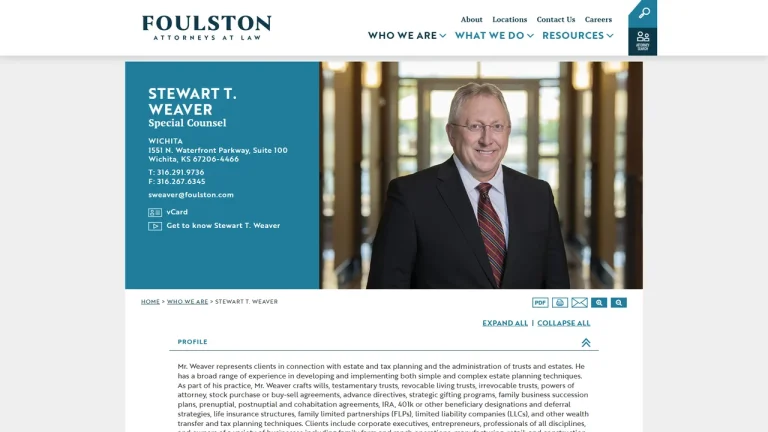
Stewart T. Weaver - Wichita, KS

Martin Law - Wichita, KS

Depew Gillen Rathbun & McInteer LC - Wichita, KS
Clinkscales Elder Law Practice, P.A. - Wichita, KS

Timothy P. O'Sullivan - Wichita, KS

Legacy Legal, LLC - Wichita, KS

Coultis Law, LLC - Wichita, KS
Ann T. Rider, Attorney at Law - Wichita, KS
Estate Administration and Probate Practice in Wichita
Administering a decedent's estate in Wichita requires navigating the 18th Judicial District of Kansas. Probate matters for Sedgwick County residents are administered through the Probate Department of the Sedgwick County Courthouse, located at 525 North Main Street in Downtown Wichita.
A local probate attorney guides executors, administrators, and heirs through the formal probate process, determination of descent, or simplified estate administration. Counsel coordinates notice to creditors, estate asset inventories, tax clearances, and real estate transfers recorded with the Sedgwick County Register of Deeds.
Families across Wichita neighborhoods-including College Hill, Riverside, Delano, Crown Heights, and Eastborough-rely on local counsel during times of bereavement. Dedicated attorneys resolve beneficiary disputes and claims against the estate through structured negotiation, avoiding protracted courtroom litigation.
Probate Legal Fee Structures in Wichita
| Case Scenario | Fee Structure | Estimated Cost (USD) | Key Cost Determinants |
|---|---|---|---|
| Small Estate Affidavit & Summary Settlement | Flat Fee | $750 - $2,000 | Personal property value, number of distributees, transfer of titled vehicles. |
| Kansas Simplified Estate Administration | Flat Fee or Hourly ($250 - $425/hr) | $2,500 - $6,500 | Uncontested heirs, court-supervised asset sales, real estate title deeds. |
| Formal Court-Supervised Estate Administration | Hourly Retainer ($275 - $475/hr) | $4,500 - $14,000+ | Accounting objections, complex creditor claims, multiple probate hearings. |
| Contested Will & Fiduciary Litigation | Hourly Retainer ($300 - $550/hr) | $8,500 - $30,000+ | Allegations of undue influence, lack of testamentary capacity, bench trials. |
Critical Legal Deadlines & Statutes in Kansas
Kansas probate law imposes strict procedural deadlines on estates. Under Kan. Stat. Ann. § 59-618, a will must be offered for probate within six months after the death of the testator. If a will is not presented within this six-month statutory deadline, it is barred from probate, and the estate must be distributed under Kansas intestate succession laws.
If six months have passed without an estate being formally opened, an interested party may file a petition for determination of descent pursuant to Kan. Stat. Ann. § 59-2250 to transfer real property and personal assets to legal heirs. Under the Kansas nonclaim statute, Kan. Stat. Ann. § 59-2239, creditors must exhibit their claims within four months after the date of first published notice to creditors, or within 30 days of actual notice for known creditors, after which unfiled claims are forever barred.
For modest estates, Kan. Stat. Ann. § 59-1507b permits estates with personal property not exceeding $75,000 to be settled via affidavit without formal court administration. In addition, surviving spouses may claim statutory allowances under Kan. Stat. Ann. § 59-403 and homestead protections pursuant to Kan. Stat. Ann. § 59-401.
Small Claims Limits vs. Professional Representation
The Kansas Small Claims Procedure Act is capped at $10,000 pursuant to Kan. Stat. Ann. § 61-2703, where attorneys are excluded from representing parties in hearings under Kan. Stat. Ann. § 61-2707. While small claims can handle minor debt disputes between living parties, small claims courts have zero legal authority over decedents' estates.
Estate administration is governed exclusively by the Kansas Probate Code under Chapter 59 in the Sedgwick County District Court. Transferring marketable real estate title, resolving tax liens, and defending against disinherited family challenges require formal court orders. Retaining a probate lawyer protects personal representatives from personal liability and ensures compliance with statutory accountings.
Red Flags to Avoid When Hiring a Probate Lawyer
- Attorneys who fail to warn families about the strict six-month deadline to file a will under Kansas law.
- Firms that charge percentage-of-estate fees without accounting for the actual hourly effort or complexity involved.
- Lawyers lacking specific courtroom experience in the Probate Department of the Sedgwick County Courthouse.
- Firms that fail to communicate required statutory publication notices to creditors in a timely manner.
Frequently Asked Questions
What is the deadline to file a will for probate in Wichita?
Under Kan. Stat. Ann. § 59-618, a will must be offered for probate within six months of the testator's death, or it becomes legally invalid.
Where are probate cases handled in Sedgwick County?
Probate proceedings are heard in the Probate Department of the Sedgwick County District Court at 525 North Main Street in Downtown Wichita.
What qualifies for a small estate affidavit in Kansas?
Under Kan. Stat. Ann. § 59-1507b, estates with total personal property not exceeding $75,000 can be transferred by affidavit without formal probate court administration.
What is a petition for determination of descent?
Under Kan. Stat. Ann. § 59-2250, if no probate action is filed within six months of death, heirs may petition to determine legal ownership of the decedent's property.
How long do creditors have to file claims against an estate in Kansas?
Under Kan. Stat. Ann. § 59-2239, creditors must file claims within four months of the first published notice to creditors, or within 30 days of direct notice.