
Criminal Defense Lawyers in Boston
Facing criminal prosecution in Boston puts your liberty, record, and future in immediate jeopardy under Massachusetts penal laws. Retaining a skilled local criminal defense lawyer allows you to challenge arrest procedures, argue effectively at dangerousness hearings, and negotiate dismissals before trial. Explore our verified directory below to connect with a reputable criminal defense attorney serving Suffolk County courthouses.

Bletzer & Bletzer, P.C. - Boston, MA

Boz Law Offices, LLC - Boston, MA

Brabant & Huynh, LLP - Boston, MA

Law Office Of Paul M Derby - Boston, MA

Gold, Albanese & Barletti, L.L.C. - Boston, MA
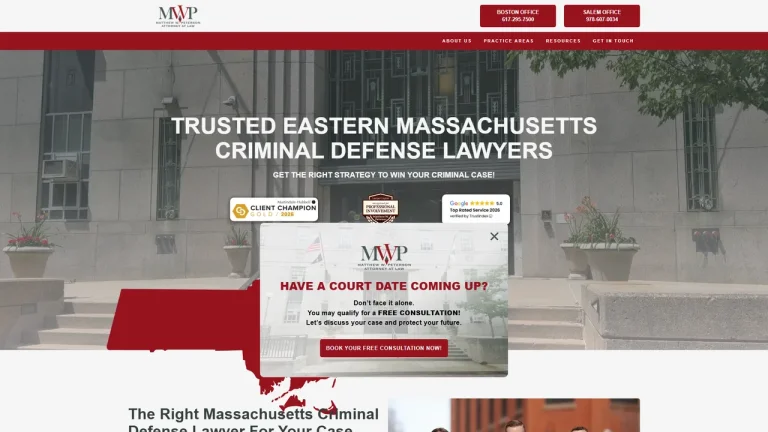
Law Office of Matthew W Peterson - Boston, MA

Rubin and Rudman LLP - Boston, MA
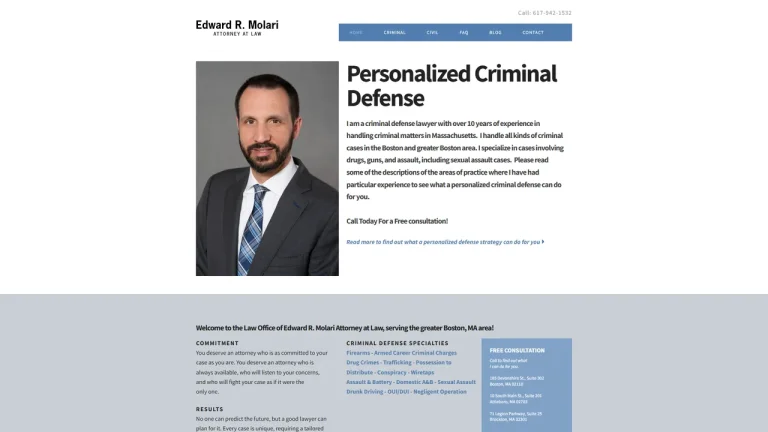
Attorney Edward R. Molari - Boston, MA

Gilman, McLaughlin & Hanrahan, LLP - Boston, MA

Koufman Law Group, LLC - Boston, MA
Carlson Law Offices - Boston, MA

Dakota Martin Law - Boston, MA

Cutler Law - Boston, MA

Yannetti Criminal Defense Law Firm - Boston, MA

Mintz - Boston, MA

Dechert LLP - Boston, MA

Bellotti Law Group, P.C. - Boston, MA

James E. Neyman and Associates

Haddad Law Firm - Boston, MA
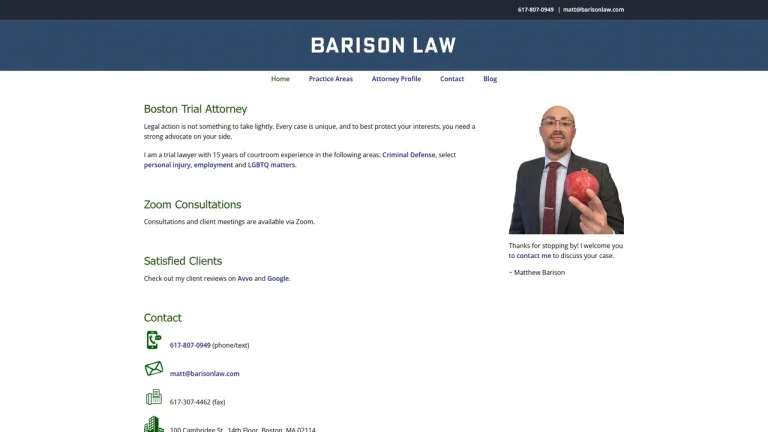
Matthew K. Barison, Attorney at Law - Boston, MA

Law Office of Daniel B. Capobianco - Boston, MA

Rose Law Partners - Boston, MA
Law Office of Amy M. Wax, P.C. - Boston, MA

The Boston Criminal Defense System & Suffolk County Courthouses
Being charged with a crime in Boston initiates an aggressive prosecution led by the Suffolk County District Attorney's Office or the Massachusetts Attorney General. Criminal charges originate from arrests conducted by the Boston Police Department, Massachusetts State Police, or regional transit authorities. Accused individuals are processed through municipal court booking or transported to detention facilities such as the Nashua Street Jail (Suffolk County Jail) or the South Bay House of Correction.
Misdemeanor charges and initial felony arraignments occur across the eight localized divisions of the Boston Municipal Court (BMC), including the Central Division at the Edward W. Brooke Courthouse on New Chardon Street, as well as community divisions in Dorchester, Roxbury, South Boston, Charlestown, Brighton, West Roxbury, and East Boston. Major felony indictments, violent offenses, and large-scale drug trafficking prosecutions are bound over to the Suffolk County Superior Court, located in Pemberton Square. Securing a Boston defense lawyer with daily courtroom exposure across these specific divisions ensures rigorous defense from the initial bail argument to the final trial verdict.
Estimated Legal Costs for Boston Criminal Defense
| Case Scenario | Fee Structure | Estimated Cost (USD) | Key Cost Determinants |
|---|---|---|---|
| First-Offense OUI / Driving Under the Influence | Flat Fee | $2,500 - $6,500 | Breathalyzer refusal hearings at the RMV, field sobriety video evaluation, pre-trial motion to suppress. |
| Domestic Assault & Battery / Restraining Order Defense | Flat / Retainer | $3,500 - $9,000 | Section 58A dangerousness hearing advocacy, 209A restraining order challenges, witness interviews. |
| Felony Drug Possession, Distribution, or Firearms Charges | Retainer + Hourly | $7,500 - $20,000+ ($350 - $600/hr) | Mandatory minimum sentencing factors, search warrant suppression hearings, ballistic reports analysis. |
| Complex White-Collar Fraud / Major Violent Felonies | Retainer + Hourly | $15,000 - $50,000+ ($450 - $750/hr) | Grand jury investigation response, forensic financial audits, expert witness retention, jury trial duration. |
Critical Legal Deadlines & Statutes in Massachusetts
Navigating the Massachusetts criminal justice system requires strict adherence to procedural timelines. General criminal statutes of limitations are codified under Mass. Gen. Laws ch. 277, § 63, which establishes a 6-year limit for most felony prosecutions, while certain major violent crimes possess extended statutory windows or no limitation period whatsoever. For misdemeanor offenses, formal complaints must generally be filed within 6 years unless otherwise specified by statutory exceptions.
Defendants are entitled to a speedy trial under Mass. R. Crim. P. 36, requiring the Commonwealth to bring a defendant to trial within 12 months from the return day, excluding legitimate defense continuances. Following an arrest, the Commonwealth may move for pretrial detention without bail under Mass. Gen. Laws ch. 276, § 58A. A dangerousness hearing must be conducted immediately upon the defendant's initial appearance, although the defense may request a continuance not to exceed 3 business days to prepare vital exculpatory evidence. Should an adverse verdict occur at trial, a notice of appeal must be filed within 30 days pursuant to Mass. R. App. P. 4.
Self-Representation Risks vs. Retaining Dedicated Defense Counsel
Civil disputes under $7,000 are resolved in the Small Claims session of the Boston Municipal Court pursuant to Mass. Gen. Laws ch. 218, § 21, where citizens often handle matters without attorneys. Criminal cases, however, cannot be heard in small claims and involve life-altering stakes, including permanent criminal records, loss of employment, and detention at the Nashua Street Jail or state correctional institutions.
Attempting pro se representation in criminal sessions leaves defendants vulnerable to complex evidentiary rules, aggressive cross-examination by assistant district attorneys, and missed procedural rights. An experienced Boston criminal defense attorney can negotiate a Continuance Without a Finding (CWOF) under Mass. Gen. Laws ch. 278, § 18, challenge unlawful searches under Article 14 of the Massachusetts Declaration of Rights, and petition the court for the exclusion of involuntary statements, frequently securing case dismissals without the uncertainty of a public jury trial.
Red Flags When Hiring a Boston Criminal Defense Attorney
- Guaranteed Case Outcomes: Any attorney promising a complete dismissal or guarantee of no jail time violates the Massachusetts Rules of Professional Conduct and lacks professional credibility.
- Immediate Guilty Plea Recommendations: Be cautious of defense lawyers who advise pleading guilty at the initial arraignment without first inspecting police reports, 911 audio recordings, and discovery materials.
- Unfamiliarity with Local BMC Divisions: Avoid practitioners who do not regularly litigate in the specific Boston Municipal Court division where your case is docketed, as local procedures vary significantly between courts like Dorchester and Central.
- Vague Fee Retainer Agreements: Steer clear of law firms that quote a low initial fee but conceal hidden charges for pretrial motion hearings, trial preparation per diems, and investigator fees.
Frequently Asked Questions
What happens during a criminal arraignment in Boston?
At arraignment in the Boston Municipal Court or Suffolk Superior Court, the formal charges are read aloud, a plea of not guilty is entered on your behalf, and bail conditions are set under state law. The judge determines whether you will be released on personal recognizance, required to post cash bail, or held for a dangerousness hearing.
What is a Continuance Without a Finding (CWOF) in Massachusetts?
A CWOF is an alternative disposition under state law where a defendant admits that the prosecution has sufficient facts to prove guilt, but the judge defers an actual finding of guilt. If the defendant successfully finishes a designated period of probation, the criminal charges are dismissed without a formal conviction on their record.
Can a Boston defense lawyer help me regain my driver's license after an OUI arrest?
Yes. If your license was suspended for an alleged chemical test refusal under state law, your attorney can schedule an administrative appeal at the Massachusetts Registry of Motor Vehicles (RMV) within 15 days of arrest and contest the suspension in court.
What is a Section 58A dangerousness hearing in Boston?
Under state statute, prosecutors can request a hearing to hold an individual without bail for up to 120 days if charged with specific violent crimes, domestic offenses, or firearms violations. The Commonwealth must prove by clear and convincing evidence that no release conditions can reasonably assure public safety.
Can criminal charges in Boston be sealed from public background checks?
Yes. Under Massachusetts law, individuals may petition the court or the Commissioner of Probation to seal criminal records. Misdemeanor charges may generally be sealed after 3 years, and felony offenses after 7 years, provided no subsequent criminal offenses have occurred during that window.