
Business & Work Visa Lawyers in Massachusetts
Consult top Massachusetts business and work visa lawyers to navigate corporate immigration, PERM filings, H-1B petitions, and employment green card strategies. Seasoned immigration attorneys guide startups, universities, and established enterprises across the Commonwealth through complex federal compliance and petition audits. Explore our directory to connect with trusted Massachusetts corporate immigration counsel today.

Dalkis D. Muir Law Office - Boston, MA
Law Office of M.J. Lee - Boston, MA

Hope Immigration PLLC - Cambridge, MA
Clark Lau LLC - Boston, MA

Crnilovic Law Office - Lawrence, MA
Mintz - Boston, MA

Champagne Law Group - Quincy, MA
Anthony Drago, Jr. - Boston, MA
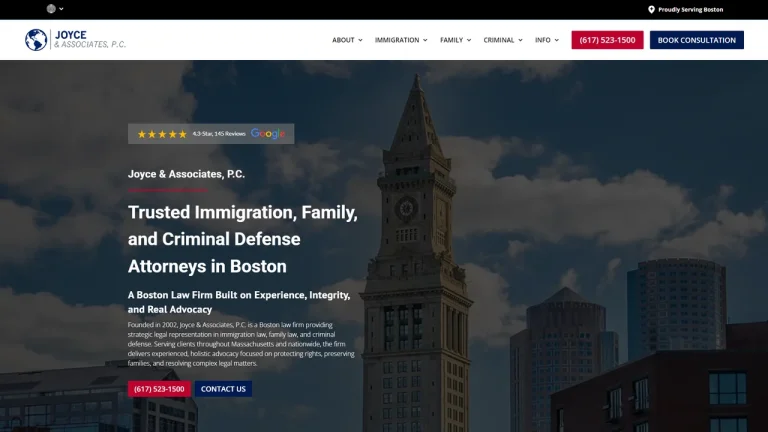
Joyce & Associates, P.C. - Boston, MA
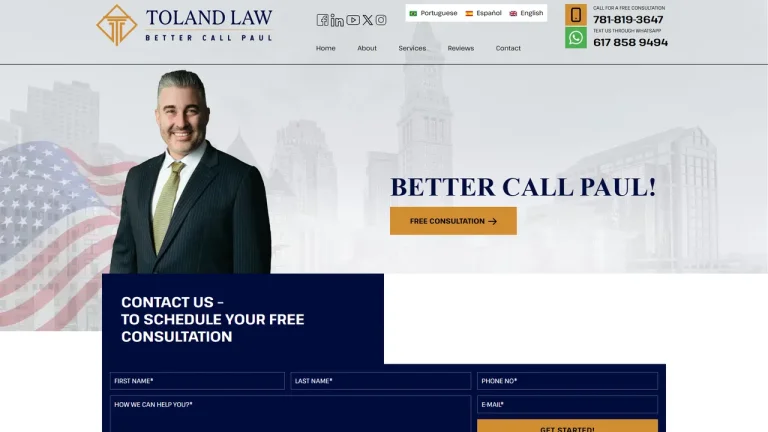
Toland Law, LLC - Boston, MA
Duane Morris LLP - Boston, MA
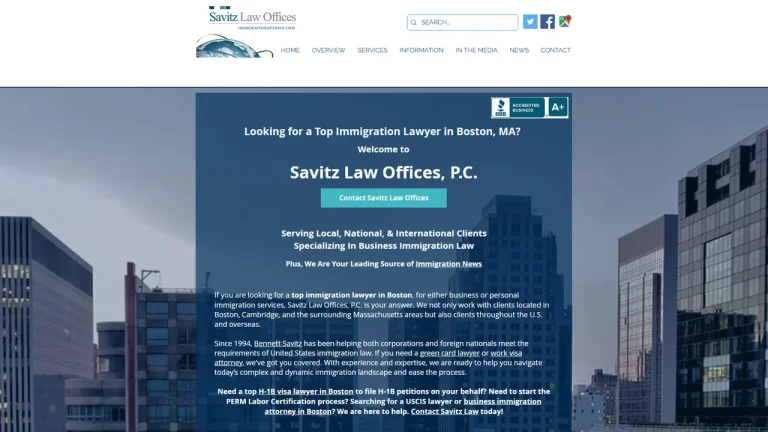
Savitz Law Offices, P.C. - Boston, MA
Gómez & Martinez Law, LLC - Lawrence, MA

Law Office of Joy A. Cahaly - Boston, MA
Law Offices of William Soo Hoo, P.C. - Boston, MA
Ogletree Deakins - Boston, MA
Immigration Solutions, LLC - Boston, MA
Tadmor & Tadmor, LLP - Worcester, MA
Araujo & Fisher, LLC - Boston, MA
International Institute of New England - Boston, MA
Cameron Micheroni & Silvia - Boston, MA
Law Offices of Frederic C. Hite - Boston, MA
Maiona Ward, Attorney at Law - Boston, MA
Navigating Employment Immigration Across Massachusetts
Massachusetts is a world-renowned center for biotechnology, software engineering, robotics, higher education, and financial services. From research facilities in Kendall Square in Cambridge and corporate headquarters in downtown Boston to tech enterprises along the Route 128 and Route 495 innovation corridors, organizations rely extensively on specialized international professionals to maintain their competitive advantage.
Sponsoring foreign talent requires precise compliance with complex federal regulations administered by the United States Citizenship and Immigration Services (USCIS) and the United States Department of Labor (DOL). A knowledgeable Massachusetts business visa attorney ensures petitions for nonimmigrant visas-such as H-1B, L-1, O-1, TN, and E-2-and immigrant petitions like EB-1, EB-2 National Interest Waivers (NIW), and EB-3 permanent labor certifications are structured to satisfy heightened agency scrutiny.
Retaining experienced corporate immigration counsel located in Massachusetts provides employers with proactive guidance during every phase of talent onboarding. Dedicated attorneys handle prevailing wage requests, draft persuasive employer support letters, prepare for potential USCIS site visits, and defend against extensive Requests for Evidence (RFEs), preventing costly staffing disruptions.
Massachusetts Business Visa Legal Fee Estimates
| Case Scenario | Fee Structure | Estimated Cost (USD) | Key Cost Determinants |
|---|---|---|---|
| H-1B Specialty Occupation Petition | Flat Fee | $2,500 - $5,500 | Degree relevancy analysis, prevailing wage determination, cap-subject lottery vs. cap-exempt filing. |
| O-1 Extraordinary Ability Visa | Flat Fee / Retainer | $4,500 - $9,500 | Peer advisory opinion coordination, citation metrics in scientific fields, expert testimonial letters. |
| PERM Labor Certification Process | Flat Fee (Staged Milestones) | $4,000 - $8,500 | Prevailing wage processing, recruitment ad placements, audit response preparation for the DOL. |
| EB-1 / EB-2 NIW Permanent Residence | Flat Fee / Retainer | $5,000 - $12,000 | Substantial merit and national importance briefs, commercial impact of research in Massachusetts. |
Critical Legal Deadlines & Statutes in Massachusetts
Nonimmigrant employment classifications are established under federal law pursuant to 8 U.S. Code § 1101(a)(15)(H) for specialty occupations and 8 U.S. Code § 1101(a)(15)(O) for individuals of extraordinary ability. Cap-subject H-1B petitions are governed by strict annual registration deadlines managed by USCIS each March under 8 C.F.R. § 214.2(h), requiring employers to submit formal petitions within a non-negotiable 90-day filing window upon lottery selection.
Employers pursuing permanent residence for international workers must follow the Program Electronic Review Management (PERM) labor certification rules set forth in 20 C.F.R. § 656.10 and 20 C.F.R. § 656.17. These regulations require mandatory recruitment advertisements to occur between 30 and 180 days prior to filing Form ETA-9089 with the Department of Labor. In addition, prevailing wage determinations issued by the National Prevailing Wage Center have explicit validity dates ranging from 90 days to one year.
Corporate compliance requirements under 8 U.S. Code § 1324a mandate that Massachusetts employers verify the work authorization of every new hire using Form I-9 within three business days of employment commencement. Furthermore, employers must establish and maintain Public Access Files for H-1B workers within one working day of filing the Labor Condition Application (LCA) pursuant to 20 C.F.R. § 655.760.
Direct Corporate Filing vs. Immigration Counsel
While standard agency forms are accessible, attempting to process corporate visas without legal representation poses grave risks for Massachusetts companies. Errors in wage level selection, job requirement descriptions, or educational equivalency evaluations frequently trigger severe Requests for Evidence, petition revocations, or costly Department of Labor investigations.
Corporate immigration attorneys perform rigorous audits before petitions are submitted. Counsel ensures that job descriptions match Department of Labor standard occupational classifications, that all recruitment efforts comply with strict federal evidentiary guidelines, and that companies maintain ironclad Public Access Files to withstand unexpected audits by the DOL Wage and Hour Division.
Red Flags When Hiring a Massachusetts Business Visa Lawyer
- Non-lawyer visa consultants or recruitment agencies promising guaranteed H-1B lottery selection or expedited green card approvals.
- Firms advising employers to shift mandatory PERM recruitment or legal costs onto the international employee, which violates federal regulations and risks DOL sanctions.
- Attorneys lacking specific experience with the research, biotech, clinical, or academic visa hurdles common in the Massachusetts innovation economy.
- Failure to implement or review mandatory I-9 compliance protocols and Public Access File procedures for sponsoring corporate clients.
Frequently Asked Questions
Can Massachusetts universities and nonprofit research institutions sponsor H-1B visas year-round?
Yes. Under 8 U.S. Code § 1184(g)(5), institutions of higher education, nonprofit entities related to or affiliated with higher education institutions, and nonprofit or governmental research organizations are exempt from the annual statutory H-1B cap. Massachusetts research hospitals, colleges, and affiliated research centers can submit H-1B petitions at any time throughout the year without entering the lottery.
What is the EB-2 National Interest Waiver (NIW), and why is it popular in Massachusetts?
The EB-2 National Interest Waiver allows exceptional researchers, entrepreneurs, and advanced-degree professionals to bypass the lengthy PERM labor certification process and employer sponsorship requirements under 8 U.S. Code § 1153(b)(2)(B). Given the vast biotechnology, artificial intelligence, and life sciences clusters in Cambridge and Boston, many international scientists qualify by demonstrating that their proposed endeavor has both substantial merit and national importance.
Who is legally required to pay the costs of a PERM labor certification?
Under 20 C.F.R. § 656.12, the sponsoring employer is strictly required to pay all attorney fees and advertising costs associated with the PERM labor certification process. The foreign national employee cannot pay, reimburse, or contribute to these expenses under any circumstance.
How does an O-1 visa differ from an H-1B visa for Massachusetts professionals?
An O-1 visa under 8 C.F.R. § 214.2(o) is reserved for individuals who possess extraordinary ability in the sciences, education, business, or athletics, demonstrated by sustained national or international acclaim. Unlike the H-1B visa, the O-1 is not subject to an annual statutory lottery cap, requires no prevailing wage determination from the DOL, and has no statutory maximum limit on renewals, making it a viable alternative for top-tier researchers and startup founders.