
Employment & Labor Lawyers in Minnesota
Navigating workplace discrimination, wage disputes, or wrongful termination in Minnesota requires dedicated legal counsel to enforce your statutory rights. An experienced Minnesota employment lawyer can negotiate severance packages, file charges with administrative agencies, and resolve disputes prior to trial. Explore our verified directory below to consult an accomplished employment attorney in your area.

Fryberger Law Firm - Duluth, MN

Meier, Kennedy & Quinn - St. Paul, MN
Atticus Family Law, S. C. - Minneapolis, MN
Hage Law Office - St. Paul, MN

Littler Mendelson P.C. - Minneapolis, MN

Heinlein Law, PLLC - Minneapolis, MN

myHRgenius - St. Paul, MN

Seiler Law, PLLC - St. Paul, MN
Wanta Thome - Minneapolis, MN
Law Office of Tim Phillips - Minneapolis, MN

Fellowship Law Group, PLLC - Minneapolis, MN

Schaefer Halleen, LLC - Minneapolis, MN

Pruvent PLLC - Minneapolis, MN

Collins, Buckley, Sauntry & Haugh, PLLP - St Paul, MN
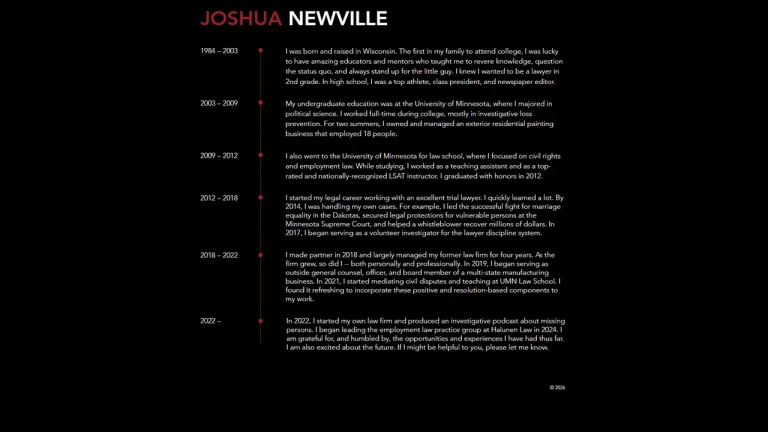
Newville PLC - Minneapolis, MN

William L. French - Rochester, MN
Dressen Janel M - Minneapolis, MN

Geraghty O'Loughlin & Kenney, P.A. - Duluth, MN
Madia Law LLC | Employment Lawyers Serving Minneapolis - Minneapolis, MN

Greeman Toomey PLLC - Minneapolis, MN

Paul Lelii Law Office - Bloomington, MN
Heley, Duncan & Melander, PLLP - Bloomington, MN

Meyer, Njus, Tanick, Linder and Robbins, PA - Minneapolis, MN
The Role of Employment and Labor Counsel in Minnesota
Workplace disputes in Minnesota are governed by comprehensive state and federal statutes designed to protect employee rights, fair compensation, and equal treatment. Employment claims are investigated administratively by the Minnesota Department of Human Rights (MDHR) and the Minnesota Department of Labor and Industry (DLI) in Saint Paul before escalating to trial courts.
When disputes cannot be resolved through administrative channels, lawsuits proceed in Minnesota District Courts-such as Hennepin County in Minneapolis or Ramsey County in Saint Paul-or in the U.S. District Court for the District of Minnesota. State law provides strong protections under the Minnesota Human Rights Act (MHRA), the Minnesota Whistleblower Act, and statutory wage theft protections.
Retaining an experienced Minnesota employment attorney levels the playing field against corporate legal teams. Counsel evaluates severance agreements, conducts pre-suit negotiations, preserves electronic correspondence, and represents employees in mediation, seeking maximum compensation for lost wages, emotional distress, and statutory penalties.
Minnesota Employment Law Legal Fees and Dispute Scenarios
| Case Scenario | Fee Structure | Estimated Cost (USD) | Key Cost Determinants |
|---|---|---|---|
| Severance Package Review & Negotiation | Flat Fee / Contingency | $750 - $2,500 (or 15-30% of increase) | Executive tenure, release terms analysis, non-compete enforceability review. |
| Workplace Discrimination & Harassment (MHRA) | Contingency (33.3% - 40%) | $0 Out-of-Pocket ($25,000 - $250,000+ recovered) | MDHR investigation findings, comparator employee evidence, punitive damage viability. |
| Wage Theft & Unpaid Overtime (MFLSA) | Contingency / Statutory Fee-Shifting | $0 Out-of-Pocket ($5,000 - $75,000+ recovered) | Payroll record audits, statutory liquidated damages under Section 181.101. |
| Whistleblower Retaliation Litigation | Contingency / Hourly ($300 - $550/hr) | $0 Out-of-Pocket ($50,000 - $500,000+ recovered) | Direct causation documentation, corporate retaliation timeline, jury trial duration. |
Critical Legal Deadlines & Statutes in Minnesota
Employees in Minnesota must act promptly to preserve their legal rights. Under the Minnesota Human Rights Act, specifically Minn. Stat. § 363A.28, a charge of discrimination must be filed with the MDHR or brought directly as a civil lawsuit in District Court within one year of the occurrence of the discriminatory practice. Missing this one-year deadline permanently bars your claims under state law.
Whistleblower claims are protected under the Minnesota Whistleblower Act, codified in Minn. Stat. § 181.932, which prohibits employers from discharging, disciplining, or penalizing an employee who reports a suspected violation of federal or state law in good faith. These claims are governed by civil limitation periods set forth in Minn. Stat. § 541.05.
Wage payments are strictly regulated by Minnesota statutes. Under Minn. Stat. § 181.13, a discharged employee must be paid all earned wages within 24 hours of demand. Furthermore, Minnesota enacted a comprehensive statutory ban on employee non-compete agreements under Minn. Stat. § 181.988, rendering covenants not to compete entered into on or after July 1, 2023, void and unenforceable against workers.
Conciliation Court Limitations vs. District Court Employment Advocacy
The Conciliation Court division of Minnesota District Courts is restricted to monetary claims up to $15,000 under Minn. Stat. § 491A.01. Conciliation Court serves as an accessible venue for simple unpaid wage demands, but it cannot issue equitable remedies, order job reinstatement, or award statutory attorney fees.
Substantive employment actions involve complex damages, including front pay, lost benefits, emotional distress, and treble damages under Minn. Stat. § 363A.33. These claims require formal litigation in Minnesota District Courts or federal court, where procedural discovery allows attorneys to subpoena internal emails, personnel files, and financial records.
A dedicated Minnesota employment lawyer coordinates discovery, deposes corporate managers, and utilizes statutory fee-shifting provisions to hold employers accountable while negotiating favorable severance or settlement terms.
Red Flags to Avoid When Selecting a Minnesota Employment Lawyer
- Missing the one-year MHRA deadline: Incompetent counsel who treats discrimination claims under general personal injury timelines will forfeit your rights under Minn. Stat. § 363A.28.
- Failure to challenge void non-competes: Ensure your attorney is fully versed in Minn. Stat. § 181.988, which voids post-employment non-compete agreements executed after July 1, 2023.
- Lack of trial courtroom experience: Many lawyers negotiate severance packages but refuse to file formal lawsuits in District Court, weakening your settlement leverage.
- Unclear litigation expense terms: Your contingency agreement must explicitly state whether deposition transcript costs and filing fees are deducted before or after the fee calculation.
Frequently Asked Questions
What is the deadline to file a workplace discrimination lawsuit in Minnesota?
Under Minn. Stat. § 363A.28, you must file a charge with the Minnesota Department of Human Rights or initiate a civil lawsuit in District Court within one year of the discriminatory act.
Are non-compete agreements legal in Minnesota?
Under Minn. Stat. § 181.988, non-compete agreements entered into on or after July 1, 2023, are void and unenforceable against Minnesota employees and independent contractors, except in narrow circumstances involving the sale or dissolution of a business.
How quickly must an employer pay final wages after termination in Minnesota?
Under Minn. Stat. § 181.13, when an employee is discharged, earned wages must be paid within 24 hours of the employee's demand. Failure to pay triggers statutory penalty wages under Minn. Stat. § 181.101.
What protections exist for whistleblowers under Minnesota law?
The Minnesota Whistleblower Act (Minn. Stat. § 181.932) protects employees from retaliation, demotion, or termination for reporting suspected violations of state or federal law to an employer or government authority.
Does Minnesota require employers to provide paid sick leave?
Yes. Under Minn. Stat. § 181.9445, Minnesota's Earned Sick and Safe Time (ESST) law requires employers to provide qualifying employees with accrued paid leave for medical care, illness recovery, or domestic safety needs.