
Divorce & Family Law Lawyers in New Mexico
Retaining a compassionate New Mexico divorce and family law attorney safeguards your parental rights and community property assets during marital dissolution. Experienced legal counsel guides you through statutory property division, parenting plans, and mediation to minimize courtroom conflict. Explore our statewide directory below to schedule an initial consultation with trusted local advocates.

Mark Keller - Law Office - Albuquerque, NM

Ramon Hernandez Law - Las Cruces, NM

The Law Office of Cristy J. Carbón-Gaul - Albuquerque, NM
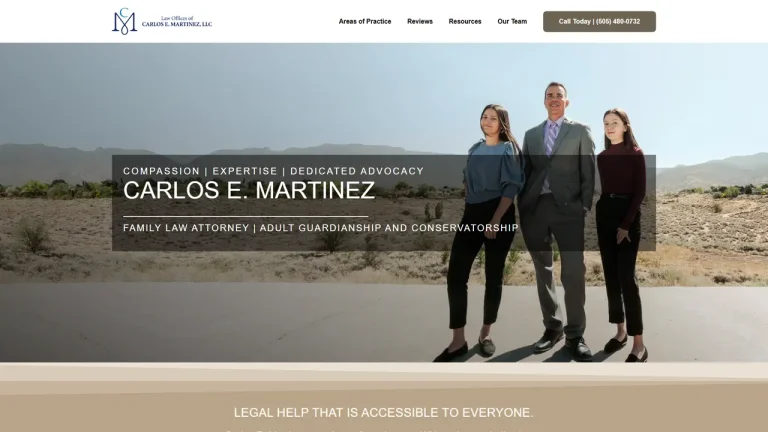
Law Offices of Carlos E. Martinez LLC - Albuquerque, NM

New Mexico Legal Aid - Albuquerque, NM

Angela Arellanes Attorney At Law - Albuquerque, NM

Enchantment Legal - Albuquerque, NM

Catholic Charities Santa Fe - Santa Fe, NM

Duran and McDonald - Albuquerque, NM
Roberta Yurcic Legal Services, LLC - Albuquerque, NM

Barnett Law Firm - Albuquerque, NM

Law Offices of Darlene Gomez - Albuquerque, NM

Genus Law Group - Albuquerque, NM

Adelante Legal Services, LLC - Las Cruces, NM

New Mexico Legal Aid - Las Cruces, NM
Sutherland Law Firm - Las Cruces, NM
Law Office of Jill V. Johnson Vigil, LLC - Las Cruces, NM

New Mexico Criminal Law Offices - Albuquerque, NM

Kelly O'Connell Law | DUI Attorney Las Cruces NM
New Mexico Legal Group, P.C. Las Cruces - NM
The Justice Legal Team, LLC - Las Cruces, NM

Kitren Fischer Law, LLC Santa Fe, NM

The Law Office of Anthony Griego, LLC - Albuquerque, NM
Family Law Practice in New Mexico District Courts
Family law proceedings in New Mexico are adjudicated exclusively within the Domestic Relations Division of the New Mexico District Courts. Whether filing in the Second Judicial District Court in Bernalillo County, the First Judicial District Court in Santa Fe, or the Third Judicial District Court in Las Cruces, domestic disputes involve specialized administrative pathways. Initial conferences, child support calculations, and interim spousal support requests are frequently conducted before court-appointed Domestic Relations Hearing Officers before advancing to district judges.
New Mexico is a pure community property state, which establishes that all assets and debts acquired by either spouse during the marriage belong equally to both parties. Navigating equitable division demands deep familiarity with local judicial procedures, particularly when valuing private business interests, residential real estate, or public retirement systems like the Public Employees Retirement Association (PERA) and Educational Retirement Board (ERB).
Retaining an attorney admitted by the Disciplinary Board of the New Mexico Supreme Court provides critical protection during child custody negotiations and asset division. Experienced practitioners craft detailed Marital Settlement Agreements (MSAs) and Parenting Plans that protect parental rights and minimize family disruption.
Estimated Legal Fees for New Mexico Divorce and Family Law
| Case Scenario | Fee Structure | Estimated Cost (USD) | Key Cost Determinants |
|---|---|---|---|
| Uncontested Divorce with Signed Settlement Agreement | Flat Fee | $1,500 - $3,500 | Consensus on community asset distribution, agreed parenting plan, court appearance waivers. |
| Contested Custody & Child Support Dispute | Retainer & Hourly | $4,000 - $10,000 | Guardian ad Litem involvement, psychological custody evaluations, evidentiary hearings. |
| Complex Community Property & Business Valuation | Retainer & Hourly | $8,000 - $25,000+ | Forensic financial tracing, commercial appraisals, PERA/ERB pension division orders. |
| Post-Decree Custody or Support Modification | Retainer & Hourly | $2,500 - $6,500 | Proving substantial material change in circumstances, formal motion discovery. |
Critical Legal Deadlines & Statutes in New Mexico
Divorce and domestic relations matters are strictly codified under Chapter 40 of the New Mexico Statutes Annotated. Under NMSA 1978, § 40-4-5, the court requires that at least one spouse must have continuously maintained an actual residence in New Mexico for at least six months immediately preceding the filing of the divorce petition to satisfy statutory jurisdiction.
New Mexico is a no-fault divorce jurisdiction, permitting dissolution on the grounds of incompatibility pursuant to NMSA 1978, § 40-4-1. The identification and division of marital property are governed by NMSA 1978, § 40-3-8, establishing a legal presumption that all property acquired during marriage is community property owned in equal 50/50 shares. In custody disputes, NMSA 1978, § 40-4-9.1 creates a statutory presumption that joint legal custody is in the best interests of minor children. Spousal support and alimony awards are determined using the equitable guidelines set forth in NMSA 1978, § 40-4-7.
Self-Representation Hazards vs. Family Law Representation
While small claims disputes under $10,000 are processed in Metropolitan or Magistrate Courts, those courts have no legal jurisdiction over family law or marital property. All domestic relations matters must be initiated in the New Mexico District Court.
Attempting to represent oneself pro se in a New Mexico divorce introduces substantial financial and parental risks. Unrepresented parties frequently miscalculate community property reimbursement claims, omit essential survivorship provisions for state pensions, or overlook the tax consequences of real estate buyouts. In addition, drafting ambiguous custody schedules can lead to ongoing jurisdictional conflicts. Retaining dedicated counsel ensures child support complies with statutory guidelines under NMSA 1978, § 40-4-11.1 and secures legally enforceable marital settlement agreements.
Red Flags When Hiring a New Mexico Family Lawyer
- Promising a guaranteed sole custody outcome without demonstrating statutory grounds of severe child endangerment.
- Failing to provide a written retainer agreement clearly detailing hourly billing rates for attorneys, paralegals, and court time.
- Encouraging high-conflict litigation tactics that undermine the statutory joint custody presumption under NMSA 1978, § 40-4-9.1.
- Inexperience in preparing Qualified Domestic Relations Orders (QDROs) for New Mexico public employee retirement plans.
Frequently Asked Questions
How is property divided in a New Mexico divorce?
Under NMSA 1978, § 40-3-8, New Mexico is a community property state where all assets and debts acquired during the marriage are presumed community property and divided equally (50/50) between spouses.
What is the residency requirement to file for divorce in New Mexico?
Pursuant to NMSA 1978, § 40-4-5, at least one of the spouses must have resided in New Mexico for at least six consecutive months immediately prior to filing the divorce petition.
Does New Mexico presume joint legal custody for children?
Yes. Under NMSA 1978, § 40-4-9.1, New Mexico law establishes a statutory presumption that joint legal custody is in the child's best interests, allowing both parents equal decision-making authority.
How is spousal support or alimony calculated in New Mexico?
Under NMSA 1978, § 40-4-7, judges consider factors such as the duration of the marriage, earning capacities, age, health, and standard of living to determine fair spousal support awards.
What role do Domestic Relations Hearing Officers serve in New Mexico?
Domestic Relations Hearing Officers conduct preliminary hearings on interim child support, temporary spousal support, and procedural motions, issuing recommendations that can be adopted as orders by district judges.