
Divorce Lawyers in New Mexico
Retaining an experienced New Mexico divorce lawyer protects your financial future and community property rights throughout the marital dissolution process. Knowledgeable legal counsel works to resolve complex asset division, spousal support, and custody issues through structured negotiation and mediation. Explore our statewide directory below to consult with qualified family law attorneys today.
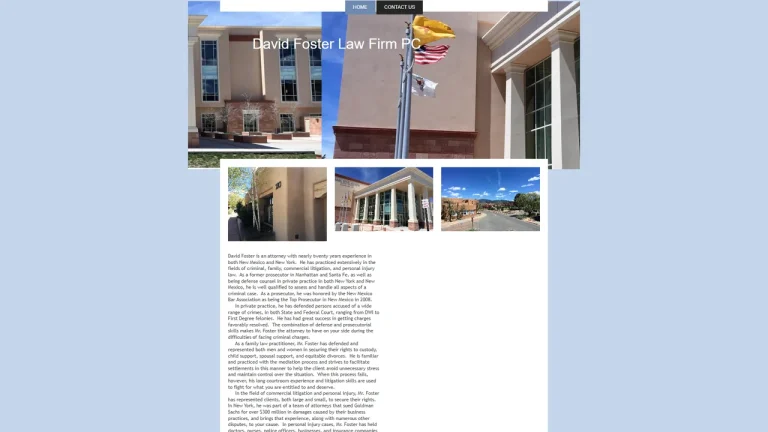
David Foster Law Firm, PC - Santa Fe, NM

Pacheco Law Office, LLC - Las Cruces, NM

New Mexico Legal Aid - Santa Fe, NM
Martin & Lutz, P.C. - Las Cruces, NM

Advanced Legal Resolutions - Las Cruces, NM

Pegasus Legal Services For Children - Albuquerque, NM

Kelley Family Law, P.C. - Albuquerque, NM

Jay Goodman and Associates Law Firm PC Santa Fe, NM

Shaharazad McDowell Booth, Attorney at Law - Las Cruces, NM

C. J. McElhinney Attorney at Law (McElhinney Law Firm LLC) - Las Cruces, NM

Boyle Law Office Santa Fe, NM

Coleman Law - Santa Fe, NM

Sutherland Law Firm - Las Cruces, NM

Law Offices of Carlos E. Martinez LLC - Albuquerque, NM

Egolf + Ferlic + Martinez, LLC - Santa Fe, NM

Walther Family Law - Santa Fe, NM
Genus Law Group - Las Cruces, NM

And Justice Law - Albuquerque, NM

Terry & deGraauw, P.C. - Albuquerque, NM

Enchantment Legal - Albuquerque, NM
Mark Keller - Law Office - Albuquerque, NM
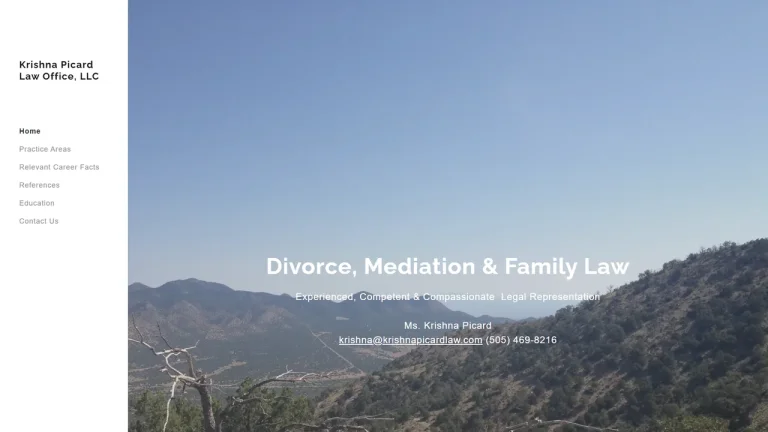
Krishna Picard Law Office, LLC - Santa Fe, NM

Matteucci Family Law - Albuquerque, NM
Dissolution Proceedings in New Mexico District Courts
Filing for marital dissolution in New Mexico requires navigating the specialized procedures of the New Mexico District Courts. Distributed across thirteen judicial districts, family law filings-including petitions for dissolution, interim support motions, and property division disputes-are managed within the Domestic Relations Division. In metropolitan centers such as Albuquerque (Second Judicial District Court), Santa Fe (First Judicial District Court), and Las Cruces (Third Judicial District Court), court-appointed Domestic Relations Hearing Officers routinely manage preliminary proceedings before cases advance to district judges.
New Mexico is one of a select group of states operating under pure community property jurisprudence. Under state statutes, all assets and obligations accumulated by either spouse during the marriage are legally presumed to belong equally to both spouses. This equitable baseline necessitates seasoned legal oversight, particularly when classifying separate versus community property, assessing business ownership, or dividing state pensions.
Attorneys admitted to practice by the Supreme Court of New Mexico provide essential advocacy during the preparation of comprehensive Marital Settlement Agreements (MSAs). Local counsel protects clients against unfair asset valuations, navigates mandatory financial disclosure rules, and structures enforceable spousal support arrangements tailored to local district court practices.
Estimated Legal Investment for New Mexico Divorce Proceedings
| Case Scenario | Fee Structure | Estimated Cost (USD) | Key Cost Determinants |
|---|---|---|---|
| Uncontested Dissolution with Signed Marital Agreement | Flat Fee | $1,400 - $3,200 | Full financial disclosure compliance, mutual agreement on assets, absence of court hearings. |
| Contested Property Division & Alimony Dispute | Retainer & Hourly | $4,500 - $11,000 | Separate asset tracing, vocational earning evaluations, interim support hearings. |
| High-Net-Worth Estate & Corporate Valuation | Hourly Retainer | $9,000 - $28,000+ | Forensic financial auditing, commercial appraisals, PERA or ERB pension division orders. |
| Post-Decree Enforcement or Modification Hearing | Retainer & Hourly | $2,500 - $6,500 | Demonstrating substantial material changes in circumstances, formal motion discovery. |
Critical Legal Deadlines & Statutes in New Mexico
Marital dissolution in New Mexico is governed by Title 40 of the New Mexico Statutes Annotated. A foundational statutory requirement is established in NMSA 1978, § 40-4-5, which dictates that at least one spouse must have maintained an actual domicile and continuous residence in New Mexico for at least six months immediately preceding the filing of the divorce petition.
New Mexico functions as a no-fault divorce jurisdiction, permitting dissolution on the grounds of incompatibility under NMSA 1978, § 40-4-1. The identification and division of marital assets and liabilities are controlled by NMSA 1978, § 40-3-8, establishing a 50/50 division presumption for all community property. Spousal support and transitional alimony awards are determined using the factors detailed in NMSA 1978, § 40-4-7, including the length of the marriage, age, health, and earning capabilities of each party. Crucially, in real estate transactions, NMSA 1978, § 40-3-13 requires both spouses to sign any conveyance or deed involving community real property, rendering unilateral transfers during divorce void as a matter of law.
Small Claims Jurisdiction vs. Dedicated Divorce Representation
In New Mexico, small claims actions in the Bernalillo County Metropolitan Court and county Magistrate Courts are limited to monetary disputes up to $10,000 under NMSA 1978, § 34-8A-3 and NMSA 1978, § 35-3-3. These lower courts have no statutory jurisdiction to grant divorces, order property distributions, or award alimony. All dissolution matters belong exclusively to the District Court.
Attempting to manage a divorce pro se carries immense financial risk. Unrepresented spouses frequently fail to identify community interests in public retirement systems like the Public Employees Retirement Association (PERA) or Educational Retirement Board (ERB), which require specialized domestic relations orders. Furthermore, improper drafting of property division clauses can trigger unintended capital gains taxes or result in the forfeiture of separate property reimbursements. Retaining an attorney guarantees accurate financial disclosures and safeguards valuable marital assets.
Red Flags When Hiring a New Mexico Divorce Lawyer
- Promising a guaranteed alimony duration or amount prior to reviewing comprehensive financial affidavits and tax returns.
- Advising a spouse to transfer, conceal, or encumber community bank accounts prior to filing, violating preliminary domestic court injunctions.
- Failing to provide transparent fee agreements that itemize hourly rates, paralegal billings, and court filing expenses.
- Lack of courtroom experience before Domestic Relations judges and hearing officers in the specific judicial district handling your petition.
Frequently Asked Questions
What is the residency requirement for filing for divorce in New Mexico?
Under NMSA 1978, § 40-4-5, at least one of the spouses must have resided continuously in New Mexico for a minimum of six consecutive months immediately prior to filing the divorce petition.
How does New Mexico law divide property in a divorce?
New Mexico is a community property state under NMSA 1978, § 40-3-8, meaning all property and debts acquired during the marriage are presumed community property and subject to equal (50/50) division between spouses.
What factors determine spousal support (alimony) in New Mexico?
Pursuant to NMSA 1978, § 40-4-7, judges evaluate the duration of the marriage, current and future earning capacities, age, health, and standard of living established during the marriage to determine fair alimony awards.
How are state public pensions divided during a divorce in New Mexico?
Retirement benefits accumulated during the marriage under PERA or ERB are community property, divided through court-approved Qualified Domestic Relations Orders (QDROs) using statutory coverture formulas.
Can a spouse sell marital real estate while a divorce is pending?
No. Under NMSA 1978, § 40-3-13, any conveyance, mortgage, or transfer of community real estate is void unless signed by both spouses, preventing unilateral property liquidation during litigation.