
Deportation Defense Lawyers in Oregon
Facing removal proceedings in Oregon requires immediate legal intervention to protect your constitutional rights and prevent permanent separation from family. Dedicated deportation defense attorneys navigate the Portland Immigration Court, argue bond redeterminations, and file crucial relief applications. Explore our directory below to consult with an experienced Oregon removal defense attorney.

The Immigration Law Office of Bryan McGowan, PC - Portland, OR
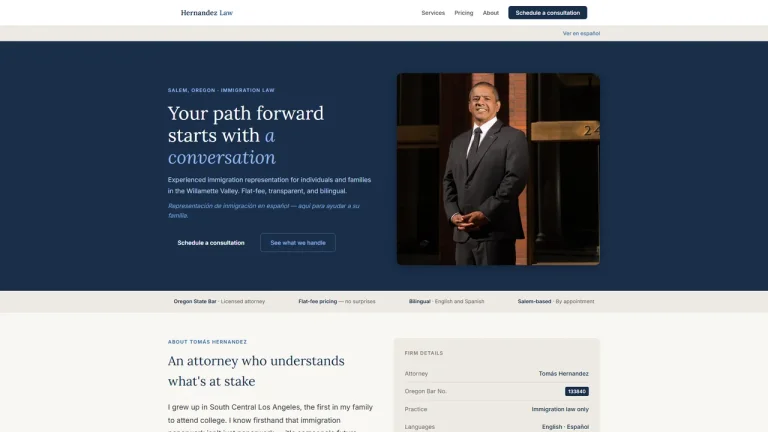
Hernandez Law Office LLC - Salem, OR

Navigate Legal Services LLC - Salem, OR

Nelson Smith LLP - Portland, OR

White & Shepherd, LLP - Portland, OR

Passage Immigration Law - Portland, OR

Terrence Green Law LLC - Salem, OR

N David Shamloo - Hillsboro, OR

Loftin & Masri, APC - Hillsboro, OR

Hornik, Philip - Portland, OR

Immigration Law Group, LLC - Portland, OR

Parrilli Renison LLC - Portland, OR

Affordable Immigration, Salem, OR

Law Office of Ashley Ross White, LLC - Eugene, OR

The Law Offices of Meneleo Jose Luna II, PC - Hillsboro, OR

Bennett & Harker - Portland, OR

PACIFIC IMMIGRATION LAW, LLC - Salem, OR

Vanderwall Immigration Salem, OR

Metropolitan Public Defender - Hillsboro, OR

Immigration Counseling Service - Portland, OR
Alliance Legal-Raquel Hecht, Attorney - Eugene, OR

Ginsburg & Perez, LLC - Hillsboro, OR

Oregon Immigration Group, PC - Portland, OR

Removal Defense Practice in the Portland Immigration Court
Facing deportation proceedings before the Executive Office for Immigration Review (EOIR) is an overwhelming legal crisis for noncitizens and their families. All formal removal proceedings in Oregon fall under the direct jurisdiction of the Portland Immigration Court, located in downtown Portland at 1220 SW 3rd Avenue, which adjudicates cases for respondents residing across Multnomah, Washington, Clackamas, Marion, and Lane counties.
Oregon maintains a comprehensive statutory sanctuary framework under Or. Rev. Stat. § 181A.820, which strictly prohibits state and local law enforcement agencies and public bodies from using public funds, equipment, or personnel to detect or apprehend individuals whose only violation of law is being present in the United States in violation of federal immigration statutes. Despite these state protections, federal authorities continue to initiate removal proceedings through civil Notices to Appear (NTAs) and targeted civil enforcement.
Securing legal representation from an attorney licensed by the Oregon State Bar and admitted to practice before the EOIR is vital to defending against removal. Experienced defense counsel challenges the legal sufficiency of the government's charges, gathers documentary evidence to support bond eligibility, cross-examines government witnesses, and presents formal statutory defenses to deportation before an immigration judge.
Removal Defense Fee Structures and Court Representation Costs
| Case Scenario | Fee Structure | Estimated Cost (USD) | Key Cost Determinants |
|---|---|---|---|
| Immigration Bond Hearing & Custody Redetermination | Flat Legal Fee | $2,000 - $4,500 | Flight risk evidence, ties to the Oregon community, criminal background history, and ICE custody status. |
| Defensive Asylum, Withholding of Removal & CAT Hearing | Staged Flat Fee | $5,000 - $10,000 | Country conditions research, expert witness testimony, psychological evaluations, and individual merits hearing trial days. |
| Cancellation of Removal for Non-Permanent Residents (EOIR-42B) | Staged Flat Fee | $5,500 - $9,500 | Ten-year physical presence records, qualifying U.S. citizen relative hardship documentation, and Good Moral Character proof. |
| Board of Immigration Appeals (BIA) Appeal or Ninth Circuit Review | Hourly / Fixed Retainer | $4,000 - $8,500 + transcript/court fees | Trial transcript review, legal error briefing, appellate motions for stay of removal, and federal oral argument. |
Critical Legal Deadlines & Statutes in Oregon
Removal proceedings are governed by strict federal procedural deadlines under the Immigration and Nationality Act. A removal proceeding formally commences with the filing of a Notice to Appear under 8 U.S. Code § 1229(a), and individual hearings are conducted pursuant to 8 U.S. Code § 1229a. Detained respondents have the right to request a bond redetermination hearing before the immigration judge under 8 U.S. Code § 1226(a), provided they are not subject to mandatory detention based on specific criminal convictions.
For respondents seeking humanitarian protection through defensive asylum, federal law enforces a strict one-year filing deadline under 8 U.S. Code § 1158(a)(2)(B). An application for asylum must be lodged with the court within one year of the individual's arrival in the United States, unless the respondent can prove changed country conditions or extraordinary circumstances causing the delay. Non-permanent residents with long-standing community roots may apply for cancellation of removal under 8 U.S. Code § 1229b(b), requiring proof of ten years of continuous physical presence, continuous Good Moral Character, and evidence that deportation would cause exceptional and extremely unusual hardship to a qualifying U.S. citizen or lawful permanent resident spouse, parent, or child. Lawful permanent residents facing removal may seek relief under 8 U.S. Code § 1229b(a), provided they have been an LPR for at least five years, have resided continuously for seven years, and have no aggravated felony convictions.
If the Portland Immigration Judge issues an adverse removal order, strict appellate deadlines apply. Under 8 C.F.R. § 1003.38, the respondent has exactly thirty calendar days from the date of the decision to file a Notice of Appeal with the Board of Immigration Appeals (BIA) in Falls Church, Virginia. The appeal must be physically received by the BIA on or before the thirtieth day. If the BIA dismisses the appeal, a Petition for Review must be filed within thirty calendar days with the U.S. Court of Appeals for the Ninth Circuit pursuant to 8 U.S. Code § 1252(b)(1), which is a jurisdictional deadline that cannot be extended.
Small Claims Limits vs. Professional Representation in Oregon
Oregon Circuit Courts feature a Small Claims Department with a maximum jurisdictional monetary limit of $10,000 under Or. Rev. Stat. § 46.405. Small claims proceedings are strictly limited to informal monetary controversies and property damage claims. Furthermore, under Or. Rev. Stat. § 46.415, lawyers are barred from appearing in small claims actions without formal leave of court.
Removal defense is exclusively an administrative and judicial process within the federal government, leaving state small claims courts completely without jurisdiction. Facing deportation without qualified legal representation carries catastrophic consequences, as government trial attorneys from the Department of Homeland Security actively seek orders of removal. Unrepresented respondents routinely fail to submit evidentiary exhibits in accordance with the Immigration Court Practice Manual, fail to reserve appeal rights on the court record, or mistakenly concede alienage and deportability. Retaining an experienced Oregon deportation defense attorney ensures that your procedural rights are vigorously guarded, legal applications for relief are properly submitted, and immediate stays of removal are requested to prevent unlawful expulsion.
Red Flags to Avoid When Hiring Removal Defense Legal Counsel
- Non-Attorney Notarios and Document Consultants: Under Oregon law, only attorneys licensed by the Oregon State Bar or representatives accredited by the Department of Justice are legally authorized to represent you in immigration court; non-attorney notaries cannot appear before an immigration judge.
- Guarantees of Courtroom Victory or Bond Release: No ethical defense lawyer can guarantee that an immigration judge will grant bond or cancellation of removal; promises of guaranteed results violate professional ethics rules.
- Failure to Analyze the Immigration Impact of Criminal Pleas: Criminal defense pleas in Oregon state courts must be vetted by an immigration specialist; accepting a plea without assessing aggravated felony or moral turpitude triggers can make deportation mandatory.
- Missing the 30-Day BIA Appeal Window: An attorney who fails to ensure that a Notice of Appeal is physically delivered to the BIA within thirty calendar days under 8 C.F.R. § 1003.38 permanently waives your appellate rights.
Frequently Asked Questions
Where are immigration court hearings held in Oregon?
Removal proceedings and master calendar hearings for Oregon residents are conducted at the Portland Immigration Court, located at 1220 SW 3rd Avenue, Suite 500, in downtown Portland, operating under the federal Executive Office for Immigration Review.
How does Oregon's sanctuary policy protect individuals facing deportation?
Under Or. Rev. Stat. § 181A.820, Oregon state and local law enforcement agencies are prohibited from using public resources or personnel to enforce federal civil immigration laws, preventing local jails from honoring warrantless ICE detainer requests.
What is the one-year deadline for applying for asylum in removal proceedings?
Under 8 U.S. Code § 1158(a)(2)(B), an individual must file Form I-589 within one year of entering the United States. Missing this deadline bars asylum eligibility unless the respondent proves extraordinary circumstances or changed conditions in their home country.
How long do I have to appeal an adverse removal decision by an immigration judge?
Pursuant to 8 C.F.R. § 1003.38, you have exactly thirty calendar days from the date of the immigration judge's oral or written decision to have your Notice of Appeal physically delivered to the Board of Immigration Appeals (BIA).
What is the difference between LPR and non-LPR cancellation of removal?
LPR cancellation under 8 U.S. Code § 1229b(a) requires five years of permanent residency and seven years of continuous residence. Non-LPR cancellation under 8 U.S. Code § 1229b(b) requires ten years of physical presence and proof of exceptional and extremely unusual hardship to a qualifying U.S. citizen or LPR family member.