
Wrongful Termination Lawyers in Philadelphia
Consult a top-rated Philadelphia wrongful termination lawyer to challenge unlawful discharge, secure severance, and safeguard your workplace rights. Experienced advocates determine statutory exceptions to at-will employment and negotiate pre-trial settlements. Explore our directory below to schedule an initial consultation with a qualified Philadelphia attorney.
The Igwe Law Firm - Philadelphia, PA

Folkman Law Offices P.C. - Philadelphia, PA
Joseph R. Viola, P.C. - Philadelphia, PA

Conrad O'Brien PC - Philadelphia, PA

Berney & Sang - Philadelphia, PA

Markowitz & Richman - Philadelphia, PA
Post & Schell, P.C. - Philadelphia, PA

O'Brien, Belland & Bushinsky, LLC - Philadelphia, PA
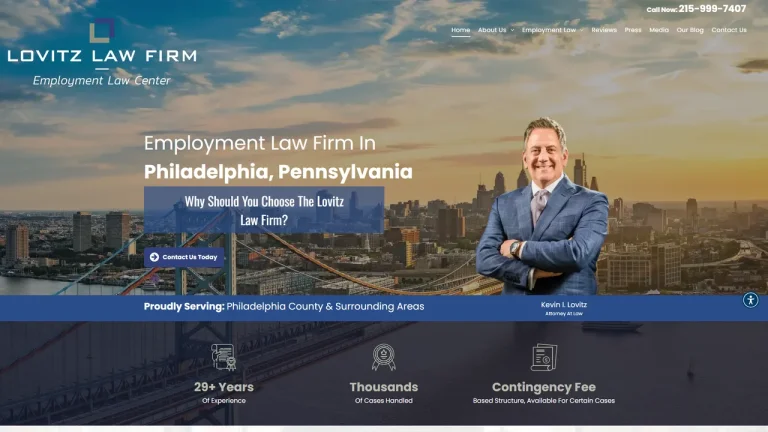
The Lovitz Law Firm - Philadelphia, PA

Sweeney & Sheehan, P.C. - Philadelphia, PA

Leonard, Sciolla, Leonard & Tinari, LLP - Philadelphia, PA

McOmber McOmber & Luber, P.C. - Philadelphia, PA
Stradley Ronon Stevens & Young, LLP - Philadelphia, PA

HKM Employment Attorneys LLP - Philadelphia, PA
The Gold Law Firm P.C. - Philadelphia, PA

Griesing Mazzeo Law - Philadelphia, PA
Flaster Greenberg PC - Philadelphia, PA
Law Offices Of Howard Bruce Klein, PC - Philadelphia, PA
Jefferson Law, LLC - Philadelphia, PA

Kinchloe Law - Philadelphia, PA

Steve Harvey Law LLC - Philadelphia, PA

Klaproth Law - Philadelphia, PA

The Johnson Firm, LLC - Philadelphia, PA

Justice at Work Pennsylvania - Philadelphia, PA
Philadelphia Employment Jurisdiction & Wrongful Discharge Law
While Pennsylvania is an established at-will employment jurisdiction, employers cannot terminate workers for unlawful, retaliatory, or discriminatory reasons. Disputed discharges in Philadelphia County fall under a distinct matrix of municipal ordinances, Commonwealth labor statutes, and federal protections. Contested employment termination suits are actively litigated within the First Judicial District of Pennsylvania at the Philadelphia Court of Common Pleas, as well as the United States District Court for the Eastern District of Pennsylvania on Market Street.
Wrongful termination claims originating across Center City corporate offices, University City healthcare networks, and industrial centers in South and Northeast Philadelphia often require administrative exhaustion before formal civil complaints can proceed. Regional workplace claims are routinely investigated by the Philadelphia Commission on Human Relations (PCHR) at 601 Walnut Street, the Pennsylvania Human Relations Commission (PHRC), and the Equal Employment Opportunity Commission (EEOC) Philadelphia District Office at 801 Market Street.
Retaining a seasoned Philadelphia employment lawyer ensures immediate preservation of vital employment records, performance evaluations, and internal communications. Skilled counsel identifies whether a termination violated statutory anti-retaliation provisions, breached an express or implied employment contract, or ran counter to established Pennsylvania public policy exceptions.
Wrongful Termination Legal Fee Benchmarks & Case Scenarios
| Case Scenario | Fee Structure | Estimated Cost (USD) | Key Cost Determinants |
|---|---|---|---|
| Severance Agreement Review & Separation Negotiation | Flat Fee / Hourly ($350 - $600/hr) | $1,000 - $3,500 | Complexity of non-compete clauses, release terms, equity compensation, and severance enhancement. |
| Public Policy Discharge (Workers Comp Retaliation) | Contingency (33.3% - 40%) / Hybrid | No Upfront Legal Fee ($0) | Direct proof of causal nexus, temporal proximity between injury filing and firing, and lost wage total. |
| Statutory Whistleblower Lawsuit (Public / Municipal Worker) | Contingency or Hourly Retainer | $5,000 - $25,000+ | Documentation of waste or wrongdoing reporting, agency investigation results, and court motion practice. |
| Executive Breach of Contract & Wage Payment Litigation | Hourly Retainer ($400 - $750/hr) | $10,000 - $35,000+ | Contractual good cause provisions, unvested stock options, deferred bonuses, and Commerce Court litigation. |
Critical Legal Deadlines & Statutes in Pennsylvania
Navigating wrongful termination in Philadelphia requires strict compliance with accelerated filing windows. Under the Pennsylvania Whistleblower Law, 43 P.S. § 1424(a), employees of public bodies or covered contractors must file a civil action in court within strictly 180 days of the retaliatory occurrence. Common-law wrongful discharge tort claims founded on clear public policy violations carry a 2-year statute of limitations under 42 Pa. C.S. § 5524.
Discharges in retaliation for asserting statutory rights under the Pennsylvania Workers Compensation Act are governed by common-law public policy doctrines recognized by the Pennsylvania Supreme Court. If the termination involves breach of a formal written employment contract or severance provision, plaintiffs have 4 years to commence litigation pursuant to 42 Pa. C.S. § 5525. Retaliation claims invoking federal family leave protections must be initiated within 2 years (or 3 years for willful violations) under 29 U.S. Code § 2617.
Small Claims Limits vs. Professional Representation
The Philadelphia Municipal Court handles civil money disputes up to a ceiling of $12,000, which can accommodate modest unpaid wage claims or small final paycheck disputes brought under the Pennsylvania Wage Payment and Collection Law. A former employee may choose to pursue an isolated final paycheck claim without counsel in the Municipal Court or file a wage complaint through the Pennsylvania Department of Labor and Industry.
However, substantive wrongful termination claims involving back pay, lost benefits, front pay, emotional distress damages, and statutory attorney fees should never be initiated pro se in small claims court. Proving unlawful motive requires deposing human resources personnel, issuing subpoenas for corporate electronic mail records, and overcoming dispositive motions for summary judgment in the Philadelphia Court of Common Pleas or federal district court. Professional legal counsel ensures that complex administrative prerequisites are met without forfeiting valuable claims.
Red Flags When Hiring a Philadelphia Wrongful Termination Lawyer
- Attorneys claiming that any unfair firing is automatically illegal without evaluating at-will employment exceptions under Pennsylvania law.
- Failure to identify urgent administrative deadlines, such as the 180-day state statutory window for whistleblower actions.
- Lawyers who refuse to offer contingency or hybrid fee arrangements for substantiated retaliation and statutory discrimination terminations.
- Lack of documented courtroom litigation experience inside the Eastern District of Pennsylvania and the First Judicial District.
Frequently Asked Questions
What qualifies as wrongful termination in Philadelphia?
Because Pennsylvania is an at-will employment state, wrongful termination occurs only when a discharge violates an explicit statute (such as anti-discrimination or whistleblower protections), breaches a valid employment contract, or violates a clearly mandated public policy, such as terminating a worker for filing a workers compensation claim.
Can I be fired for reporting illegal activity by my employer in Pennsylvania?
Under the Pennsylvania Whistleblower Law, 43 P.S. § 1423, employers receiving public funding cannot discharge or retaliate against an employee who makes a good-faith report of wrongdoing or waste. Private sector whistleblowers may also be protected under specific federal or state safety statutes.
What is the deadline to sue for wrongful discharge under Pennsylvania law?
Deadlines vary widely: statutory whistleblower lawsuits must be filed within 180 days under 43 P.S. § 1424(a), common-law tort actions must be brought within 2 years under 42 Pa. C.S. § 5524, and contract breaches within 4 years under 42 Pa. C.S. § 5525.
Should I sign a severance agreement before speaking with an attorney?
No. Signing a severance agreement generally waives all legal claims against the employer, including wrongful termination, retaliation, and wage claims. A Philadelphia employment attorney can review the release and often negotiate higher severance compensation or extended benefits.
Can an employer fire me for taking medical leave in Philadelphia?
Under the federal Family and Medical Leave Act, 29 U.S. Code § 2615, covered employers are prohibited from terminating or retaliating against eligible employees for taking protected medical leave. Terminations resulting from lawful FMLA leave constitute unlawful retaliation.