
Wrongful Termination Lawyers in Nashville
Connect with dedicated Nashville wrongful termination lawyers to challenge illegal firings, negotiate severance agreements, and protect your workplace rights. Retaining local legal counsel ensures strict adherence to Tennessee statutory filing deadlines while resolving disputes through negotiated settlements whenever possible. Explore our directory below to schedule a confidential consultation with experienced Nashville employment attorneys.

Manier & Herod - Nashville, TN
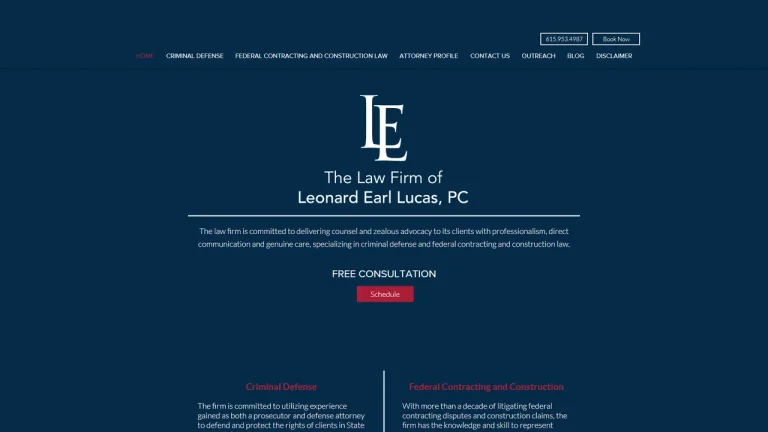
The Law Firm of Leonard Earl Lucas, PC - Nashville, TN

Bass, Berry & Sims PLC - Nashville, TN
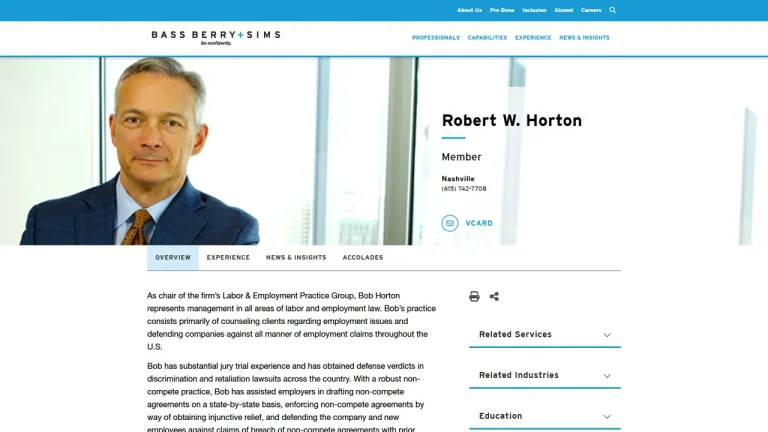
Robert W. Horton (Bass, Berry & Sims) - Nashville, TN

Beth E. Vessel - Nashville, TN

Wade B. Cowan Attorney at Law - Nashville, TN
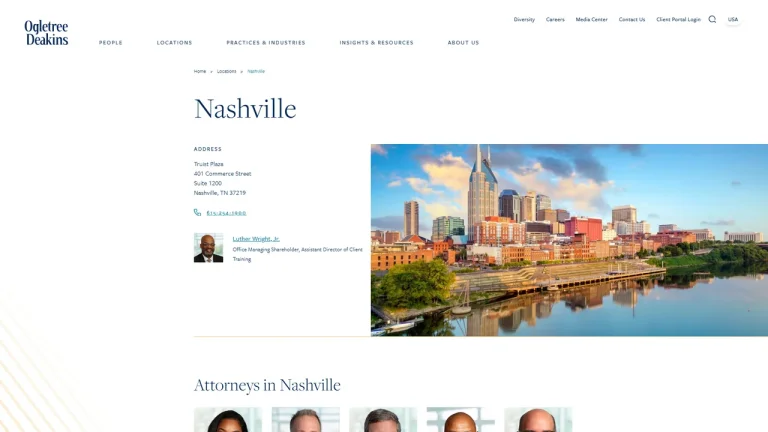
Ogletree Deakins - Nashville, TN

Bahou Law, PLLC - Nashville, TN

The Cassell Firm - Nashville, TN

Disability Rights Tennessee - Nashville, TN

Watson Law Group PLLC - Nashville, TN
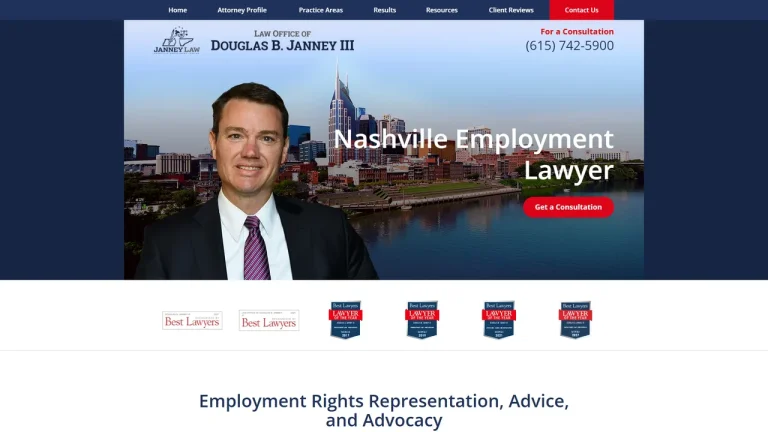
Law Office of Douglas B. Janney III - Nashville, TN

Rickard Masker, PLC - Nashville, TN

Barrett Johnston Martin & Garrison, PLLC - Nashville, TN

EmployLegal - Nashville, TN

The Higgins Firm - Nashville, TN
The Blackburn Firm, PLLC - Nashville, TN

Tennessee Law Group - Nashville, TN
Baker Donelson - Nashville, TN

Law Office of Roland T. Hairston, II & Associates - Nashville, TN
Stranch, Jennings & Garvey, PLLC - Nashville, TN
Employment and Commerce Law Group - Nashville, TN

Frank Steiner Law, PC - Nashville, TN
Challenging Unlawful Discharge in Davidson County Courts
Losing a job under suspect circumstances creates immediate financial instability and professional uncertainty. While Tennessee operates under an employment-at-will standard, employers across Nashville cannot terminate workers for reasons that violate state statutes or fundamental public policies. From major healthcare networks in the Midtown and West End corridors to hospitality enterprises along Lower Broadway and corporate headquarters in MetroCenter, local companies must abide by state and federal employment laws.
Wrongful termination disputes in Davidson County are litigated within the 20th Judicial District at the Historic Metro Courthouse, located at 1 Public Square in Downtown Nashville. Retaliation and statutory discharge actions seeking damages proceed through the Davidson County Circuit Court, while matters seeking equitable relief or administrative review are presented before Chancellors in the Davidson County Chancery Court. Claims involving federal statutory questions proceed before the U.S. District Court for the Middle District of Tennessee at the Fred D. Thompson U.S. Courthouse on Church Street.
An experienced Nashville wrongful termination attorney evaluates separation documents, investigates employer pretext, and determines whether your firing stems from protected whistleblower activity, workers' compensation claims, or illegal discrimination. Engaging local counsel ensures rapid intervention, positioning terminated employees for favorable severance negotiations or assertive litigation in Davidson County courts.
Nashville Wrongful Termination Legal Fee Structures
| Case Scenario | Fee Structure | Estimated Cost (USD) | Key Cost Determinants |
|---|---|---|---|
| Severance Agreement Review & Negotiation | Flat Fee / Hourly | $750 - $2,500 | Review turnaround urgency, non-compete release terms, waiver breadth, and direct executive negotiation rounds. |
| Whistleblower Retaliation Claim (Pre-Suit) | Contingency (33.3% - 40%) | $0 Upfront ($3,000 - $8,500 if Hourly) | Documentation strength, internal compliance report records, employer size, and private mediation readiness. |
| Contested Wrongful Discharge Litigation | Contingency / Hybrid Retainer | 33% - 40% Contingency ($10,000 - $35,000 if Hourly) | Volume of depositions, summary judgment motion practice, e-discovery processing, and trial length at 1 Public Square. |
| Metro Civil Service & Public Employee Appeal | Hourly Retainer | $3,500 - $12,000 | Administrative hearings before the Metro Civil Service Commission, administrative transcripts, and Chancery Court certiorari petitions. |
Critical Legal Deadlines & Statutes in Tennessee
Pursuing a wrongful termination claim in Nashville demands prompt action due to compressed filing deadlines established under Tennessee statutory law. Employees discharged for refusing to participate in, or refusing to remain silent about, illegal corporate conduct are protected under the Tennessee Public Protection Act codified at Tenn. Code Ann. § 50-1-304. Lawsuits brought under this statute must be filed within one year from the date of termination.
Common law claims for retaliatory discharge-such as terminations resulting from filing a workers' compensation claim under Tenn. Code Ann. § 50-6-101-are classified as personal tort actions subject to a strict one-year statute of limitations under Tenn. Code Ann. § 28-3-104. When wrongful termination involves discriminatory motives under the Tennessee Human Rights Act, plaintiffs must file suit in Circuit or Chancery Court within one year of the discriminatory act pursuant to Tenn. Code Ann. § 4-21-311, or submit an administrative complaint to the Tennessee Human Rights Commission within 180 days under Tenn. Code Ann. § 4-21-302. Missing these statutory dates results in a complete forfeiture of your legal claims.
Nashville Small Claims Limits vs. Retaining Employment Counsel
The Davidson County General Sessions Court Civil Division, housed within the Justice A.A. Birch Building at 408 2nd Avenue North, handles small claims actions for monetary damages up to $25,000 under Tenn. Code Ann. § 16-15-501. While General Sessions provides an accessible forum for collecting unpaid wages or unreimbursed business expenses, it is fundamentally ill-suited for wrongful termination claims.
The General Sessions Court lacks equitable jurisdiction to grant injunctive relief, compel personnel file expungement, or issue reinstatement orders. Wrongful termination disputes require proving complex legal standards-such as establishing the employer's sole motivation under the Tennessee Public Protection Act or rebutting pretextual justifications. Corporate employers in Nashville defend these claims through experienced defense firms in the Davidson County Circuit or Chancery Court. Attempting to navigate discovery, depositions, and dispositive motions without counsel places terminated employees at a severe disadvantage.
Red Flags When Hiring a Nashville Wrongful Termination Lawyer
- Guaranteeing specific dollar recoveries or promising immediate settlements before examining your personnel file and termination notice.
- Demanding substantial upfront non-refundable retainers for strong statutory retaliation claims that standardly qualify for contingency representation.
- Misinterpreting the difference between Tennessee's strict one-year statute of limitations and the 180-day administrative exhaustion windows.
- Lacking courtroom trial experience in the 20th Judicial District or before the federal judges of the Middle District of Tennessee.
Frequently Asked Questions
Is Tennessee an at-will employment state?
Yes, Tennessee is an employment-at-will state, meaning employers can discharge an employee for any reason or no reason at all. However, an employer cannot terminate an employee for illegal reasons, such as violating anti-discrimination laws under Tenn. Code Ann. § 4-21-401, retaliating against protected whistleblowers under Tenn. Code Ann. § 50-1-304, or firing an employee for asserting workers' compensation rights.
What is the deadline to file a wrongful termination lawsuit in Nashville?
In Tennessee, wrongful termination lawsuits must generally be filed within one year from the effective date of discharge. This applies to whistleblower claims under Tenn. Code Ann. § 50-1-304, common law retaliation claims under Tenn. Code Ann. § 28-3-104, and statutory claims under Tenn. Code Ann. § 4-21-311. Administrative filings with the Tennessee Human Rights Commission carry an even shorter 180-day deadline.
What must I prove under the Tennessee Public Protection Act (TPPA)?
Under the Tennessee Public Protection Act codified at Tenn. Code Ann. § 50-1-304, an employee must prove that they were an employee of the defendant, that they refused to participate in or remain silent about illegal activity, that they were discharged, and that their refusal was the sole reason for their termination.
Can I sue my employer if I was fired after reporting an on-the-job injury?
Yes. Terminating an employee for asserting a workers' compensation claim under Tenn. Code Ann. § 50-6-101 constitutes actionable retaliatory discharge under Tennessee common law. Employees must initiate legal action within one year under Tenn. Code Ann. § 28-3-104 to recover lost wages, future earnings, and potential punitive damages.
What financial compensation is available in a Nashville wrongful termination case?
Recoverable remedies may include back pay (lost wages and benefits from termination to trial), front pay (future lost compensation), emotional distress damages, attorney's fees under specific statutes, and punitive damages if the employer acted maliciously or intentionally violated Tennessee statutory protections.