
Residential Real Estate Lawyers in Salt Lake City
Connect with top Salt Lake City residential real estate lawyers to resolve property disputes, review purchase contracts, and protect your homeownership rights. Navigating Utah residential property transactions, HOA disagreements, and boundary conflicts requires meticulous local legal guidance. Experienced real estate attorneys assist buyers, sellers, and property owners through title defects, REPC disputes, and construction defect claims. Explore our verified directory below to schedule an authoritative property law consultation.
Crippen and Cline LC - Salt Lake City, UT

Richards Law, PC - Salt Lake City, UT
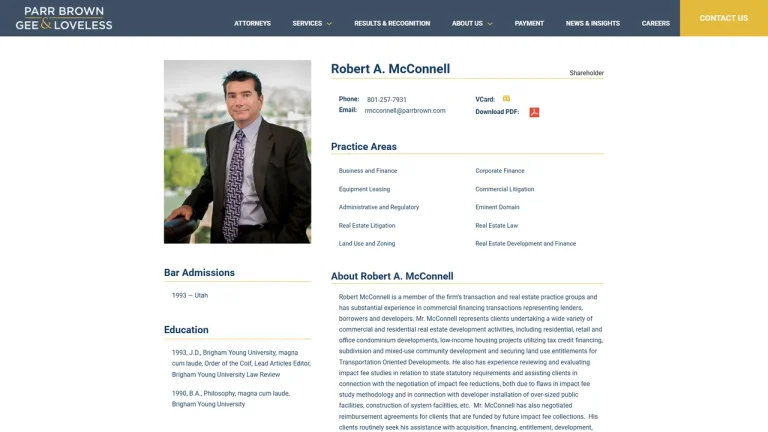
Robert A. McConnell - Transaction Attorney - Salt Lake City, UT

Hirschi Baer and Clayton, PLLC - Salt Lake City, UT

Heather Thuet, Attorney/Real Estate Broker - Salt Lake City, UT

Nonprofit Legal Services of Utah Salt Lake City, UT

Whiting Business and Real Estate Law, LLC - Salt Lake City, UT
Utah Legal Services - Salt Lake City, UT

Residential Property Law & Title Advocacy in Salt Lake County
The Salt Lake City residential property market is among the most competitive in the Mountain West, encompassing historic homes in the Avenues and Sugar House, modern hillside builds in Federal Heights, and rapid suburban residential developments across Salt Lake County. Purchasing, financing, and protecting residential property involves substantial financial stakes and strict regulatory requirements.
Real estate disputes in Salt Lake City-ranging from contested Real Estate Purchase Contracts (REPC) to boundary encroachments and title defects-are adjudicated in the Third Judicial District Court at the Matheson Courthouse on State Street. Deed filings, easements, and property encumbrances are recorded directly with the Salt Lake County Recorder's Office.
Retaining an experienced Salt Lake City residential real estate lawyer protects homeowners from costly disclosure failures, unlawful homeowners association (HOA) fines, and complex property line disputes. Dedicated legal counsel ensures property titles remain clear and homeownership rights are defended in state court.
Residential Real Estate Legal Services & Fee Schedules in Salt Lake City
| Case Scenario | Fee Structure | Estimated Cost (USD) | Key Cost Determinants |
|---|---|---|---|
| Residential Purchase Agreement (REPC) Review | Flat Fee | $500 - $1,500 | Custom addenda, earnest money provisions, seller financing terms |
| Quiet Title & Boundary Line Dispute Litigation | Hourly / Retainer ($300-$500/hr) | $5,000 - $15,000+ | Survey analysis, adverse possession evidence, easement documentation |
| Seller Non-Disclosure & Fraud Lawsuit | Hourly ($325-$525/hr) | $7,500 - $25,000+ | Foundation/water intrusion reports, repair estimates, proof of prior knowledge |
| HOA Fine Dispute & CC&R Enforcement Defense | Hourly ($275-$450/hr) | $1,500 - $5,000 | Community association bylaws, statutory notice compliance, board hearing |
Critical Legal Deadlines & Statutes in Utah
Adverse possession and boundary claims in Utah require seven years of continuous possession combined with the mandatory payment of all county property taxes under Utah Code § 78B-2-208 and Utah Code § 78B-2-214.
Construction defect actions against builders, contractors, or designers must be brought within two years of discovery, subject to a six-year statute of repose under Utah Code § 78B-2-225. Homeowners association operations, rule enforcement, and assessment collections are strictly governed by the Utah Community Association Act under Utah Code § 57-8a-101, with limits on fine imposition codified at Utah Code § 57-8a-212.
Real estate transfers and recording requirements are regulated under Utah Code § 57-3-101, which establishes that unrecorded conveyances are void against subsequent purchasers in good faith. Actions on written residential real estate contracts must be brought within six years under Utah Code § 78B-2-309.
Small Claims Limitations vs. District Court Property Litigation
In Salt Lake County, the Justice Courts handle small monetary claims up to $20,000 pursuant to Utah Code § 78A-8-102. While a tenant or buyer might seek the return of a modest earnest money deposit or small landscaping bill in justice court, small claims judges have no legal authority to determine real property title or grant quiet title relief.
Quiet title actions, boundary line adjustments, structural non-disclosure lawsuits, and easement disputes affect real estate worth hundreds of thousands of dollars and fall within the exclusive jurisdiction of the Third Judicial District Court. Defending property rights without legal counsel can result in permanent loss of land access or cloud on title that prevents refinancing or sale.
Red Flags When Hiring a Residential Real Estate Lawyer
- Overlooking Utah's Adverse Possession Tax Requirement: In Utah, establishing adverse possession is impossible without paying all assessed property taxes for seven continuous years; counsel who fails to verify county tax records will file defective claims.
- Relying on Real Estate Agent Advice for Legal Disputes: While licensed real estate agents handle standard transactions, they are legally prohibited from providing legal advice or drafting non-standard contract addenda. Always consult a licensed attorney when legal disputes arise.
- Ignoring HOA Dispute Escalation Procedures: The Utah Community Association Act establishes specific hearing rights and notice periods before HOAs can record assessment liens; ensure your lawyer understands statutory association procedures.
- Non-Transparent Title Review Billing: Experienced real estate attorneys provide clear flat or capped hourly rates for document review and title clearance, avoiding unexpected invoice escalations.
Frequently Asked Questions
What is the standard Real Estate Purchase Contract (REPC) in Utah?
The Utah Real Estate Purchase Contract (REPC) is the state-mandated standard form approved by the Utah Real Estate Commission for residential property transactions, establishing contingency deadlines and earnest money terms.
What can a homeowner do if a seller failed to disclose severe property defects in Salt Lake City?
Under Utah common law, sellers are obligated to disclose known material latent defects. Buyers can file an action for fraudulent non-disclosure or breach of contract in the Third District Court to recover repair damages or rescind the sale.
How are boundary line disputes resolved between neighbors in Salt Lake County?
Boundary disputes are resolved through legal doctrines such as boundary by acquiescence or boundary by agreement, requiring evidence of a long-standing physical marker treated as the boundary for at least 20 continuous years.
Can a homeowners association (HOA) in Utah foreclose on a home for unpaid fines?
Under the Utah Community Association Act, HOAs can file assessment liens and initiate non-judicial foreclosure for unpaid common expense assessments, though strict statutory notice procedures must be followed.
What is a quiet title action and when is it necessary in Utah?
A quiet title lawsuit is a formal district court action brought under Utah law to establish clear ownership and eliminate competing claims, adverse liens, or ambiguities on real property title.