
Tax Lawyers in Richmond
Retaining a skilled Richmond tax attorney provides decisive representation during IRS examinations and Virginia Department of Taxation assessments. Experienced tax counsel negotiates penalty abatements, offers in compromise, and appeals before state and federal taxing authorities. Explore our directory below to consult verified tax litigators serving Richmond and Central Virginia.

Harry Jernigan CPA Attorney, P.C. - Richmond, VA
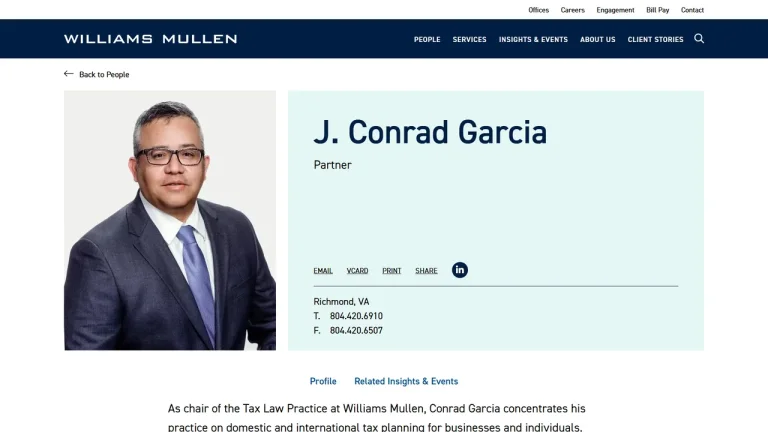
J. Conrad Garcia (Williams Mullen) - Richmond, VA

Douglas L. Sbertoli (Williams Mullen) - Richmond, VA

Trevor Wind - Richmond, VA

Farhad Aghdami - Richmond, VA

Marc Purintun - Richmond, VA

Anna Derewenda - Richmond, VA

Freed & Shepherd, P.C. - Richmond, VA

Nancy Griffin Chambliss - Richmond, VA

Defense Tax Partners - Richmond, VA

Accelerated Tax Solutions - Richmond, VA

Quinn Law Centers - Richmond, VA

Crowgey and Associates - Richmond, VA

Heather H. Szajda - Virginia Estate and Trust Law PLC - Richmond, VA

Nona Massengill - Richmond, VA
William J. Seidel - Durrette, Arkema, Gerson & Gill PC - Richmond, VA

The Community Tax Law Project - Richmond, VA

Williams Mullen - Richmond, VA

Tarpley Ashworth - Richmond, VA

Marston & McNally, P.C. - Richmond, VA

Kaufman & Canoles, P.C. - Richmond, VA

Mary Katherine McGetrick - Williams Mullen - Richmond, VA

Tom Narvaez (Williams Mullen) - Richmond, VA

Navigating Federal and Virginia State Tax Controversy in Richmond
As the capital of the Commonwealth, Richmond serves as the administrative headquarters of Virginia's taxation system. Businesses and individual taxpayers across Richmond, Henrico, and Chesterfield counties face tax compliance and controversy issues involving both federal IRS audits and state tax enforcement administered by the Virginia Department of Taxation, headquartered in downtown Richmond.
While federal tax disputes involve IRS examination divisions and may be litigated before the United States Tax Court or the U.S. District Court for the Eastern District of Virginia (EDVA) on East Broad Street, state tax assessments follow a distinct Virginia administrative pipeline. State tax assessment challenges begin with an Application for Correction to the State Tax Commissioner under Va. Code § 58.1-1821. If administrative remedies are unsuccessful, judicial appeals are litigated in the Richmond Circuit Court (13th Judicial Circuit of Virginia) at the John Marshall Courts Building pursuant to Va. Code § 58.1-1825.
Furthermore, commercial and residential property owners disputing municipal real estate assessments in Richmond must navigate administrative reviews before the Richmond Board of Review of Real Estate Assessments under Va. Code § 58.1-3378. Retaining an experienced Richmond tax lawyer ensures procedural appeal rights are preserved across all municipal, state, and federal forums.
Richmond Tax Controversy Legal Fees & Dispute Tiers
| Case Scenario | Fee Structure | Estimated Cost (USD) | Key Cost Determinants |
|---|---|---|---|
| IRS & Virginia State Audit Defense | Retainer + Hourly ($300 - $600/hr) | $2,500 - $6,500 | Scope of audit years, Schedule C expense substantiation, pass-through entity issues. |
| Offer in Compromise (OIC) & Tax Debt Relief | Flat Fee or Hourly | $3,500 - $8,000 | Dual IRS and Virginia Department of Taxation filings under Va. Code § 58.1-105, reasonable collection potential calculations. |
| State Tax Assessment Correction Appeal | Hourly ($325 - $575/hr) | $3,000 - $9,000 | Administrative petition to Tax Commissioner under Va. Code § 58.1-1821, sales and use tax or pass-through withholding audits. |
| Richmond Circuit Court Tax Litigation | Retainer + Hourly ($400 - $750/hr) | $10,000 - $35,000+ | Formal complaint under Va. Code § 58.1-1825, expert valuation testimony, summary judgment motions. |
Critical Legal Deadlines & Statutes in Virginia
State and federal tax controversies operate under strict procedural limitation periods. Under Va. Code § 58.1-1821, a taxpayer seeking administrative correction of an erroneous state assessment must file an application with the State Tax Commissioner within 90 days from the date of the assessment notice. The Department of Taxation will typically suspend involuntary collection actions while a timely application is pending.
If the Tax Commissioner issues an unfavorable determination, or as an alternative direct remedy, the taxpayer has 3 years from the date of the assessment to file a formal application for relief in the Richmond Circuit Court under Va. Code § 58.1-1825.
For federal disputes, receiving an IRS statutory Notice of Deficiency grants exactly 90 days from the mailing date to file a petition in the United States Tax Court pursuant to 26 U.S. Code § 6213(a). Missing this deadline forfeits the opportunity to contest the tax liability prior to payment. Additionally, the IRS generally has 3 years from the return filing date to assess additional taxes under 26 U.S. Code § 6501(a), expanding to 6 years for substantial omissions exceeding 25% of gross income.
CPA/Tax Preparer vs. Licensed Tax Attorney
CPAs and enrolled agents provide valuable tax return preparation, bookkeeping, and routine accounting services. However, when a tax controversy turns adversarial, involves suspected civil fraud, or requires courtroom litigation, non-attorney accountants face critical legal limits.
Under federal law, the tax practitioner privilege in 26 U.S. Code § 7525 has strict limitations. It does not apply to criminal tax investigations, state administrative actions, or state court proceedings. CPAs can be compelled by subpoena to testify against their clients.
Only a licensed tax attorney provides absolute attorney-client privilege, protecting sensitive communications and internal financial audits. Furthermore, non-lawyers are legally barred from representing taxpayers in the Richmond Circuit Court or filing judicial appeals under Va. Code § 58.1-1825.
Red Flags When Hiring a Tax Attorney
- National television and radio advertisers guaranteeing "pennies on the dollar" tax settlements without conducting an in-depth asset and equity review.
- Failing to identify the specific attorney licensed by the Virginia State Bar or admitted to the U.S. Tax Court handling your matter.
- Advising you to ignore notices from the Virginia Department of Taxation, letting the strict 90-day administrative appeal window under Va. Code § 58.1-1821 lapse.
- Failing to explain the vital distinction between state tax remedies in Richmond and federal IRS procedures.
Frequently Asked Questions
What is the 90-day deadline for Virginia tax appeals?
Under Va. Code § 58.1-1821, you must file an administrative appeal with the State Tax Commissioner within 90 days of the date printed on the notice of assessment. Filing a complete application suspends collection actions while your appeal is reviewed.
Can the Virginia Department of Taxation seize bank accounts or wages?
Yes. The Virginia Department of Taxation possesses statutory authority to issue tax liens, bank levies, and wage deductions directly without prior judicial approval. A tax lawyer can intervene to establish an installment payment agreement or submit an Offer in Compromise under Va. Code § 58.1-105.
How does an Offer in Compromise work in Virginia?
Under Va. Code § 58.1-105, the Tax Commissioner can compromise and settle state tax assessments where there is doubt as to liability or doubt as to collectibility. A formal financial statement must demonstrate that the offered sum equals or exceeds your reasonable collection equity.
What is the difference between a CPA and a tax attorney?
CPAs handle routine tax preparation and accounting audits but cannot invoke full attorney-client privilege and cannot represent you in the Richmond Circuit Court or federal court. Tax attorneys are litigators who protect sensitive disclosures under attorney-client privilege and defend cases in judicial forums.
How do I appeal a municipal real estate assessment in Richmond?
Property owners must first file an appeal with the City of Richmond Assessor's Office. If unresolved, you appeal to the Richmond Board of Review of Real Estate Assessments under Va. Code § 58.1-3378. Final adverse decisions may be appealed to the Richmond Circuit Court.