
Wrongful Termination Lawyers in Richmond
Retaining an experienced wrongful termination lawyer in Richmond protects your legal rights under the Virginia Values Act and state whistleblower statutes. Dedicated local counsel investigates employer misconduct, reviews severance agreements, and negotiates fair settlements without stressful courtroom trials. Browse our verified directory below to schedule a confidential legal review.
Shelley Cupp Schulte, PC - Richmond, VA

Miles and Stockbridge - Richmond, VA

Pierce Jewett, PLLC - Richmond, VA
The disAbility Law Center of Virginia - Richmond, VA

PJB Law, PLLC - Richmond, VA

Ogletree Deakins - Richmond, VA

Kaufman & Canoles, P.C. - Richmond, VA
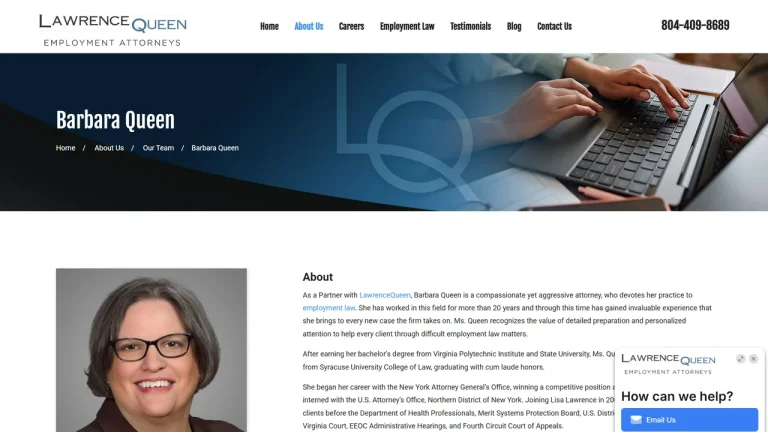
Barbara Queen - Richmond, VA

Morgan & Morgan - Richmond, VA
The Spiggle Law Firm - Richmond, VA

O'Hagan Meyer - Richmond, VA
Butler Curwood PLC - Richmond, VA
Law Office of Nichole Buck Vanderslice, PLLC - Richmond, VA

LawrenceQueen - Richmond, VA
Jackson Lewis PC - Richmond, VA

Conway Law Group - Richmond, VA
Challenging Unlawful Discharge in Richmond
Experiencing an unexpected termination in the City of Richmond can create serious professional and personal disruption. While Virginia adheres to the at-will employment doctrine, employers are strictly prohibited from discharging workers for reasons that violate state statutory protections, public policies, or contractual obligations. From corporate offices in Downtown Richmond and financial services firms to healthcare networks like VCU Health and commercial hubs in Scott's Addition, employees are shielded against unlawful terminations.
Wrongful termination claims in Richmond are determined by the underlying legal violation. State statutory claims, such as discharge under the Virginia Values Act or common law public policy violations, are litigated in the Richmond Circuit Court, 13th Judicial Circuit of Virginia, at the John Marshall Courts Building at 400 North 9th Street. Claims arising under federal employment statutes-such as Title VII, the Americans with Disabilities Act, or the Family and Medical Leave Act-are heard in the U.S. District Court for the Eastern District of Virginia, Richmond Division, located on East Broad Street.
An adept Richmond wrongful termination lawyer reviews personnel files, performance evaluations, and internal communications to identify retaliatory or discriminatory motives. Experienced counsel routinely handles disputes before formal litigation through severance agreement negotiations, dual-filed complaints with the Virginia Office of Civil Rights and the EEOC, and structured mediation, helping clients obtain fair financial compensation while avoiding public courtroom battles.
Richmond Wrongful Termination Legal Fee Structures
| Case Scenario | Fee Structure | Estimated Cost (USD) | Key Cost Determinants |
|---|---|---|---|
| Severance Agreement Review & Negotiation | Flat Fee or Hourly | $750 - $2,500 | Release terms, non-compete covenants, accrued bonuses, severance enhancement targets. |
| Whistleblower Retaliation Discharge | Contingency or Hybrid | 33.3% - 40% ($2,500 - $5,000 retainer) | Retaliation timeline, internal compliance records, statutory damages under state law. |
| Virginia Values Act Discrimination Discharge | Contingency Fee | 33.3% - 40% of recovery | Administrative exhaustion, back-pay calculations, compensatory and punitive damage proof. |
| Executive Employment Contract Breach | Hourly Rate | $300 - $525/hr ($7,500 - $20,000+) | For-cause definition disputes, equity vesting rights, Circuit Court litigation. |
Critical Legal Deadlines & Statutes in Virginia
Under the Virginia Values Act codified at Va. Code § 2.2-3905, employers with five or more employees are prohibited from discharging an employee on the basis of race, color, religion, sex, pregnancy, childbirth, age, marital status, sexual orientation, gender identity, or disability.
Whistleblower retaliation claims are governed by Va. Code § 40.1-27.3, which prohibits an employer from discharging an employee who reports a violation of federal or state law, subject to a strict one-year statute of limitations.
Virginia common law recognizes a public policy exception to the at-will doctrine known as a Bowman claim, allowing an employee to sue for wrongful discharge when the termination violates a specific public policy established in a Virginia statute.
Retaliatory discharge for filing a workers' compensation claim or testifying in a workers' compensation hearing is unlawful under Va. Code § 65.2-308.
Administrative charges under the Virginia Human Rights Act must be filed with the Virginia Office of Civil Rights within 300 days of the unlawful discharge pursuant to Va. Code § 2.2-3907.
Small Claims Limitations vs. Wrongful Termination Representation
The Small Claims Division of the Richmond General District Court is strictly limited to monetary controversies of $5,000 or less under Va. Code § 16.1-122.1. Small claims court handles simple contract debts and minor property disputes without formal discovery.
Small claims court has zero legal authority to adjudicate wrongful termination lawsuits, order job reinstatement, award emotional distress damages, or enforce public policy exceptions. A small claims judge cannot evaluate civil rights claims or interpret federal statutory protections.
Wrongful termination actions involve substantial monetary recovery-including back pay, front pay, liquidated damages, and statutory attorney fees-that easily surpass the small claims limit. Claims must be brought before the Richmond Circuit Court or federal court. Retaining dedicated counsel ensures proper administrative filings with the Virginia Office of Civil Rights, preservation of electronic evidence, and assertive negotiation against corporate defense firms.
Red Flags When Hiring a Richmond Wrongful Termination Attorney
- Promising automatic six-figure settlements: Any attorney who promises large financial recoveries before examining personnel records, employer size, and documented legitimate reasons for discharge.
- Failure to exhaust administrative remedies: Attempting to file statutory discrimination lawsuits in court without first obtaining a right-to-sue notice from the Virginia Office of Civil Rights or EEOC.
- Inexperience with Virginia's employment statutes: Attorneys unfamiliar with the expanded employee remedies under the Virginia Values Act or the whistleblower protections of Va. Code § 40.1-27.3.
- Overlooking severance deadlines: Failing to act quickly when an employee has limited time (such as 21 or 45 days under federal law) to review and execute a release agreement.
Frequently Asked Questions
Is Virginia an at-will employment state?
Yes, Virginia is an at-will state, meaning employers can generally terminate employment at any time. However, terminations that violate statutory anti-discrimination laws, whistleblower protections, or public policy exceptions are illegal.
What is a Bowman claim in Virginia wrongful termination law?
A Bowman claim is a Virginia common law exception to at-will employment that permits a lawsuit when an employee is discharged in direct violation of a public policy articulated in an explicit Virginia statute.
What protections do whistleblowers have in Richmond?
Under Va. Code § 40.1-27.3, employers cannot fire, discipline, or penalize an employee who in good faith reports a violation of federal or state law or regulation to an employer or governmental authority.
What is the deadline to file a wrongful discharge claim under the Virginia Values Act?
Under Va. Code § 2.2-3907, an employee must file an administrative charge with the Virginia Office of Civil Rights within 300 days of the termination, followed by a court filing within 90 days of receiving a right-to-sue notice.
Should I sign my severance agreement before consulting an attorney?
No. Signing a severance agreement generally waives all legal rights to sue for wrongful discharge or discrimination; an attorney can review the agreement to ensure fair compensation and negotiate enhanced severance terms.