
Business Litigation Lawyers in Washington
Find experienced business litigation lawyers in Washington to protect commercial assets, enforce contract rights, and resolve complex corporate disputes. Skilled trial attorneys frequently resolve business conflicts through strategic negotiation and arbitration to avoid prolonged courtroom exposure. Explore our verified statewide catalog to consult top Washington commercial litigators.
Law Offices of Blake Fulton Quackenbush - Vancouver, WA

Washington Debt Law, PLLC - Tacoma, WA
Nelson Boyd Attorneys - Seattle, WA
Seattle Litigation Group, PLLC - Seattle, WA

Dickson Frohlich Phillips Burgess - Seattle, WA

Lukins & Annis P.S. Attorneys at Law - Spokane, WA
Admon Law - Seattle, WA

Joseph Wagner Law Office - Vancouver, WA
Rylander & Associates PC - Vancouver, WA
Law Offices of Maxim Lissak, PLLC - Bellevue, WA

Ryan, Swanson & Cleveland, PLLC - Seattle, WA
Dunn & Black - Spokane, WA
Moultray Law, P.S. - Bellevue, WA

Dority & Manning, P.A. - Seattle, WA
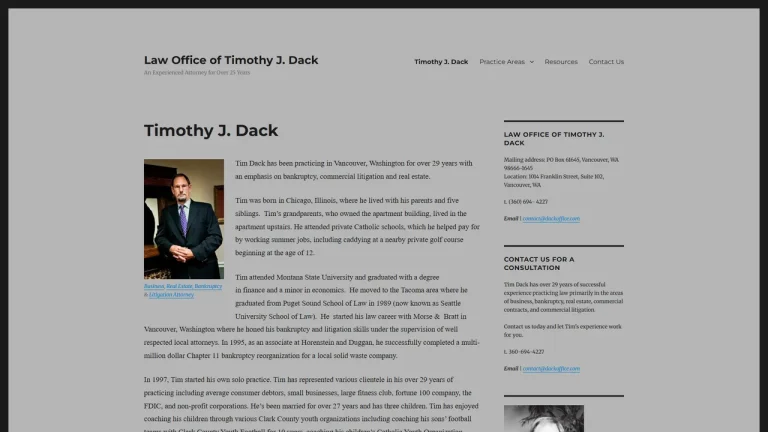
Law Office of Timothy J. Dack - Vancouver, WA

Fox Rothschild LLP - Seattle, WA
LAKE LAW, PLLC - Seattle, WA

Sunder Legal PLLC - Seattle, WA

Helsell Fetterman LLP - Seattle, WA
Randall / Danskin - Spokane, WA
Owens Davies, P.S. - Olympia, WA
Sullivan Law Firm, LLC - Seattle, WA
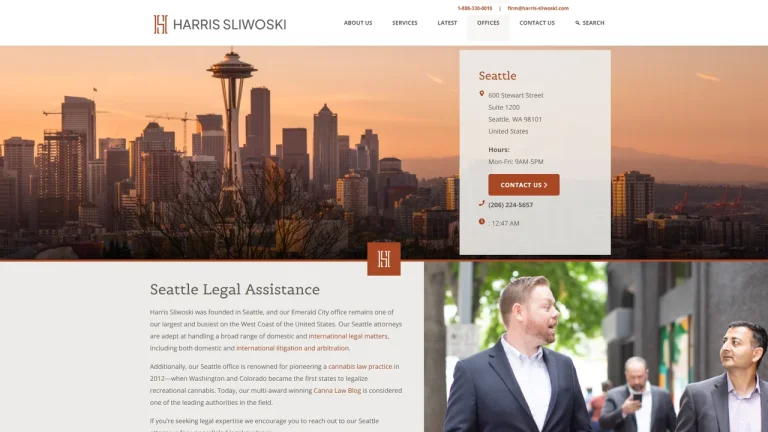
Harris Sliwoski LLP - Seattle, WA

Washington Commercial Litigation and Court Framework
Commercial and corporate disputes in Washington are adjudicated within the Washington Superior Courts across all thirty-nine counties. High-volume business litigation frequently centers in major metropolitan divisions, including the King County Superior Court commercial docket in Seattle and Kent, the Pierce County Superior Court in Tacoma, and the Spokane County Superior Court.
Washington's commercial legal environment is defined by robust statutory business laws and specialized civil procedure rules. Pretrial motions, electronic discovery exchanges, and case scheduling are coordinated through the Washington Odyssey Portal and local county electronic court records systems, holding litigators to rigorous evidentiary standards.
Attorneys admitted to the Washington State Bar Association (WSBA) represent enterprise clients through high-stakes controversies, including shareholder freeze-outs, breach of contract claims, and restrictive covenant enforcement. Seasoned trial lawyers guide businesses through settlement conferences, private arbitrations, and appellate reviews before the Washington Court of Appeals and the Washington Supreme Court in Olympia.
Washington Business Litigation Legal Fees and Cost Overview
| Case Scenario | Fee Structure | Estimated Cost (USD) | Key Cost Determinants |
|---|---|---|---|
| Breach of Contract & Commercial Debt Recovery | Hourly Retainer ($325 - $550/hr) | $5,000 - $20,000 | Contract ambiguity, volume of electronic communications, summary judgment filings under civil rules, and pre-judgment attachment motions. |
| Shareholder, LLC Member & Partnership Disputes | Hourly Retainer ($350 - $650/hr) | $15,000 - $60,000+ | Forensic accounting audits, judicial dissolution claims under RCW 25.15.274, valuation of equity buyouts, and fiduciary duty breaches. |
| Trade Secret Misappropriation & Injunctions | Hourly Retainer ($400 - $750/hr) | $20,000 - $100,000+ | Emergency temporary restraining order (TRO) hearings, forensic data discovery, and injunctive relief under RCW 19.108.020. |
| Consumer Protection Act (CPA) Defense or Claim | Hourly or Hybrid Retainer | $10,000 - $45,000 | Proving public interest impact under RCW 19.86.020, exposure to treble damages under RCW 19.86.090, and statutory attorney fee awards. |
Critical Legal Deadlines & Statutes in Washington
Commercial litigation in Washington operates under rigid statutes of limitations established by the state legislature. Under RCW 4.16.040, an action upon a contract in writing, or liability express or implied arising out of a written agreement, must be commenced within six years. Conversely, actions on oral or unwritten agreements are subject to a three-year limitation period pursuant to RCW 4.16.080.
Claims involving corporate deceptive practices fall under the Washington Consumer Protection Act (CPA) codified at RCW 19.86.020. Under RCW 19.86.120, actions brought under the CPA must be filed within four years after the cause of action accrues. Prevailing claimants may recover actual damages, statutory costs, attorney fees, and discretionary treble damages capped at $25,000 under RCW 19.86.090.
Trade secret protections are governed by the Uniform Trade Secrets Act in RCW 19.108.010. Pursuant to RCW 19.108.060, an action for misappropriation must be brought within three years after the misappropriation is discovered or reasonably should have been discovered. Furthermore, restrictive covenants face strict scrutiny under RCW 49.62.020, which imposes statutory employee earnings thresholds and establishes a rebuttable presumption that non-compete agreements exceeding eighteen months are unreasonable and void.
Small Claims Court Restrictions vs. Superior Court Litigation
The Small Claims Division of Washington District Courts operates under RCW 12.40.010, limiting jurisdiction to monetary recovery up to $10,000 for natural persons and $5,000 for business entities. Furthermore, under RCW 12.40.080, attorneys are barred from participating in small claims hearings without prior permission from the court. Small claims courts have zero authority to issue preliminary injunctions, order corporate dissolutions, or resolve complex trade secret controversies.
Substantive commercial actions fall within the general jurisdiction of the Washington Superior Courts under RCW 2.08.010. Managing complex business litigation without specialized counsel exposes companies to severe financial exposure, including entry of default judgments, waiver of mandatory counterclaims, and exposure to adverse fee-shifting awards under contractual prevailing-party clauses.
An experienced Washington business litigation attorney manages comprehensive electronic discovery, crafts dispositive summary judgment motions under Civil Rule 56, and conducts settlement mediation under the Uniform Arbitration Act (RCW 7.04A.010). Qualified commercial counsel protects enterprise value and limits corporate disruption during trial proceedings.
Red Flags When Hiring a Washington Business Litigation Lawyer
- Promising Early Summary Judgment Dismissals: A lawyer who guarantees a dismissal before reviewing opposing discovery and deposition evidence disregards the demanding standards enforced under Washington Civil Rule 56.
- Unfamiliarity with Washington Non-Compete Statutes: Non-compete covenants are strictly limited by earnings thresholds under RCW 49.62.020; hiring counsel who fails to analyze these statutory caps can result in mandatory statutory penalties and attorney fee assessments.
- Opaque E-Discovery Billing Schedules: Commercial disputes generate substantial digital records; ensure your fee agreement clearly defines document processing rates and outside forensic vendor costs.
- Lack of Local Superior Court Trial Experience: Local judicial assignment systems and commercial court customs differ between King, Pierce, Snohomish, and Spokane counties; choose counsel with substantial local trial practice.
Frequently Asked Questions
What is the statute of limitations for breach of contract in Washington?
Under RCW 4.16.040, the statute of limitations for breach of a written contract is six years, whereas claims based on oral or unwritten agreements must be filed within three years under RCW 4.16.080.
What remedies are available under the Washington Consumer Protection Act?
Pursuant to RCW 19.86.090, a prevailing party in a CPA claim can recover actual damages, court costs, reasonable attorney fees, and discretionary treble damages up to a statutory maximum of $25,000.
Are non-compete agreements enforceable against employees in Washington?
Under RCW 49.62.020, non-compete agreements are enforceable only if the employee meets statutory annual wage thresholds, the terms are disclosed prior to hire, and the covenant duration does not exceed eighteen months.
How can a deadlock among LLC owners be resolved in Washington?
If members cannot resolve an operational deadlock, an interested party can petition the Superior Court for judicial dissolution under RCW 25.15.274, or invoke contractual buyout and mediation mechanisms defined in the company operating agreement.
Can a corporation be represented by a non-attorney in Washington Superior Court?
No. Under Washington court rules and Supreme Court precedent, business entities such as corporations and LLCs cannot appear pro se and must be represented by an attorney admitted to the Washington State Bar Association.