
Wills, Estate Planning & Probate Lawyers in Washington
Creating a comprehensive estate plan in Washington protects your family assets, clarifies healthcare directives, and ensures smooth wealth transfer after death. Experienced probate and estate planning attorneys resolve beneficiary disputes and minimize tax liability through trusts, powers of attorney, and statutory nonintervention administration. Explore our verified directory below to schedule an initial consultation with a trusted Washington estate planning lawyer today.

Law Offices of Blake Fulton Quackenbush - Vancouver, WA

Cooney Law Offices, P.S. - Spokane, WA
Inland Empire Legal Aid - Spokane, WA

V. Freitas Law, PLLC - Seattle, WA

Adams & Duncan, Inc PS - Everett, WA
Dickson Frohlich Phillips Burgess Olympia, WA

ELG Estate Planning - Spokane, WA

Kjersti T. Stroup Attorney at Law PLLC - Seattle, WA

Terrence Clayton Posey, P.S. - Tacoma, WA

Dickson Frohlich Phillips Burgess - Tacoma, WA

Stacey Romberg, Attorney at Law - Seattle, WA

Law Office of John S. Palmer - Bellevue, WA
Pacific Northwest Family Law - Bellevue, WA
Skelton Law Firm - Everett, WA

Pinnacle Estate Planning - Spokane, WA

Washington Legal Services PLLC - Tacoma, WA
Evergreen Estate & Elder Law - Spokane, WA
Law Offices of Vortman & Feinstein - Bellevue, WA

Plan Smart Law Group - Bellevue, WA

Floyd Personal Injury Law Group - Kent, WA
Lukins & Annis P.S. Attorneys at Law - Spokane, WA

McKinnie Law PLLC - Seattle, WA
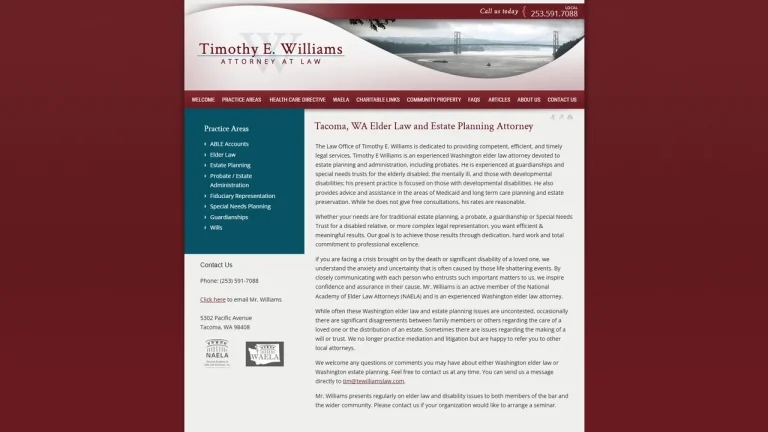
Timothy E Williams, Attorney at Law - Tacoma, WA

Safeguarding Family Wealth & Streamlining Probate Across Washington
Estate planning and probate administration in Washington operate under distinct statutory frameworks shaped by the state's community property system and independent state estate tax. Whether organizing revocable living trusts in Seattle, Bellevue, and Kirkland, drafting wills in Tacoma and Olympia, or probating complex agricultural estates across Yakima and Spokane Counties, precision is essential to prevent costly family conflicts.
Probate proceedings in Washington are administered through the Washington Superior Courts within the county where the decedent was a resident at the time of death, such as King County Superior Court or Pierce County Superior Court. When testamentary challenges or fiduciary disputes arise, they are governed by the Washington Trust and Estate Dispute Resolution Act (TEDRA). State estate tax filings are supervised and audited directly by the Washington State Department of Revenue in Olympia.
Enlisting a skilled Washington estate planning and probate attorney ensures your legacy is protected against avoidable administrative friction. Local counsel guides personal representatives through nonintervention probate, coordinates Community Property Agreements to pass title automatically between spouses, and prepares durable powers of attorney and advance healthcare directives tailored to Washington statutory standards.
Estimated Costs & Fee Arrangements for Washington Estate Planning & Probate
Estate planning and probate costs across Washington reflect estate size, tax planning needs, and the degree of fiduciary conflict. The table below outlines standard legal fee benchmarks across the state.
| Case Scenario | Fee Structure | Estimated Cost (USD) | Key Cost Determinants |
|---|---|---|---|
| Comprehensive Estate Plan (Will, DPOA, Healthcare Directive) | Flat Fee | $1,500 - $3,500 | Individual vs. married couple, community property agreements, and minor children trust provisions. |
| Revocable Living Trust Package & Asset Funding | Flat Fee | $2,800 - $6,500 | Real property deeds across multiple counties, business entity assignments, and tax mitigation trusts. |
| Nonintervention Probate Administration (Uncontested) | Flat Fee or Hourly ($325 - $500/hr) | $3,500 - $8,000 | Creditor claim volume, asset inventory complexity, real estate liquidation, and Department of Revenue clearance. |
| TEDRA Litigation & Contested Will Proceedings | Hourly Retainer ($375 - $650/hr) | $10,000 - $35,000+ | Undue influence claims, testamentary capacity evaluations, fiduciary accounting audits, and trial days. |
Critical Legal Deadlines & Statutes in Washington
Probate administration and estate litigation in Washington require strict compliance with statutory notice windows, execution rules, and tax deadlines.
Under RCW 11.12.020, a valid last will and testament must be in writing, signed by the testator, and attested to by two competent witnesses in the presence of the testator. If an heir or beneficiary intends to contest a will admitted to probate, a petition must be filed in Superior Court within four months pursuant to RCW 11.24.010.
Creditor claims are governed by RCW 11.40.051. If the personal representative publishes a formal notice to creditors, potential claimants must present their claims within four months of first publication or within 30 days of receiving actual notice; otherwise, claims are barred for two full years from the date of death under RCW 11.40.011. Estates with personal property valued under $100,000 and no real estate may utilize the small estate affidavit process after 40 days have elapsed under RCW 11.62.010. Furthermore, for taxable estates, Washington State estate tax returns and payments must be remitted to the Department of Revenue within nine months of death pursuant to RCW 83.100.050.
Small Claims Inapplicability vs. Superior Court Probate Jurisdiction
While the Small Claims Department of Washington District Courts resolves minor debt disputes up to $10,000 under RCW 12.40.010, small claims courts possess zero subject matter jurisdiction over wills, trusts, or probate administration.
Under RCW 11.96A.040 and RCW 2.08.010, original and exclusive jurisdiction over probate proceedings, trust administration, and testamentary dispute resolution is vested in the Washington Superior Courts. Small claims courts have no authority to grant Letters Testamentary, oversee fiduciary accounting, interpret testamentary instruments, or grant nonintervention administration powers under RCW 11.68.010.
Although small estates lacking real property may collect personal assets using a statutory affidavit under RCW 11.62.010, this administrative shortcut cannot transfer title to real estate. If the deceased owned residential or commercial property in Washington, initiating formal probate in Superior Court is necessary to convey marketable title and bar outstanding creditor claims.
Red Flags When Hiring a Washington Estate Planning & Probate Attorney
Protect your family's financial future by evaluating estate planning counsel against these critical warning signs:
- Promoting generic trust kits that ignore community property rules: Standard out-of-state trust templates frequently fail to account for Washington's community property laws under RCW 26.16.030, creating severe tax issues and clouding property titles.
- Failing to advise on Washington State's standalone estate tax: Washington levies an independent state estate tax with its own exemption thresholds under RCW 83.100.050. An attorney who plans only for federal tax thresholds risks leaving heirs with significant state tax bills.
- Skipping creditor notice publication in probate: Failing to publish notice to creditors under RCW 11.40.020 leaves the estate open to creditor claims for two full years rather than closing the window after four months.
- Failing to execute real estate deeds into trusts: Creating a revocable trust without drafting and recording corresponding quitclaim or bargain-and-sale deeds for Washington real property leaves the real estate trapped in probate.
Frequently Asked Questions
Is probate mandatory when someone dies in Washington?
Probate is not legally mandatory in every case. If an estate consists solely of personal property valued at $100,000 or less with no real estate, successors can transfer assets using a Small Estate Affidavit under RCW 11.62.010.
What are nonintervention powers in Washington probate?
Under RCW 11.68.010, a personal representative granted nonintervention powers by the Superior Court can administer and close the estate, sell real property, and distribute assets without ongoing court hearings.
How does Washington's community property law affect estate planning?
Under RCW 26.16.030, each spouse owns an undivided one-half interest in all community property acquired during the marriage. A spouse can dispose of their one-half share through a will, or spouses can sign a Community Property Agreement to pass assets automatically upon death.
What is the deadline to contest a will in Washington?
Under RCW 11.24.010, any person wishing to contest the validity of a will must file a formal petition in the Superior Court within four months of the date the will was admitted to probate.
Does Washington levy an estate tax on inheritances?
Yes. Washington enforces a graduated state estate tax under RCW 83.100.050 on estates exceeding the state statutory exemption threshold, requiring a return and payment to the Department of Revenue within nine months of death.