
Bankruptcy Lawyers in Madison
Retaining an experienced Madison bankruptcy lawyer invokes the automatic stay, halts wage garnishment, and protects your assets under Wisconsin exemption laws. Dedicated legal counsel guides you through the federal means test and compares Chapter 7, Chapter 13, and state Chapter 128 relief options. Explore our comprehensive directory below to schedule a debt-relief consultation with a reputable Madison attorney.

Nicolet Law Accident & Injury Lawyers - Madison, WI

Richard B. Jacobson & Associates, LLC - Madison, WI

Krekeler Law, S.C. - Madison, WI

Legal Action of Wisconsin - Madison, WI
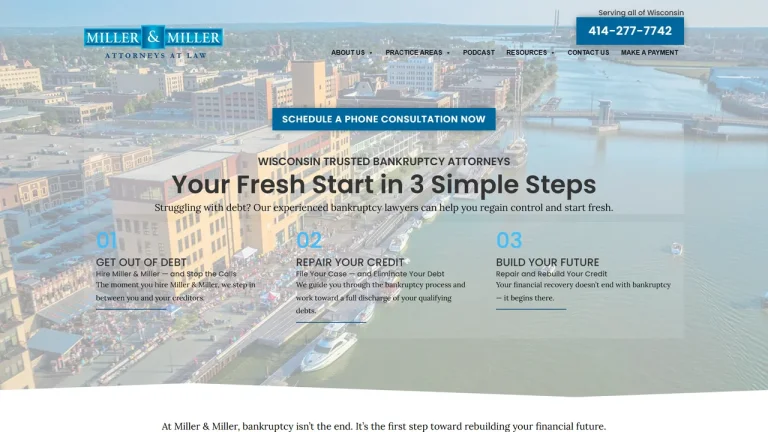
Miller and Miller Law, LLC - Madison, WI

Attorney Roger Sage - Madison, WI

The Zaleski Law Firm - Madison, WI

O'Flaherty Law of Madison - Madison, WI

Burleson Legal Group, LLC - Madison, WI

Murray Law Office - Madison, WI
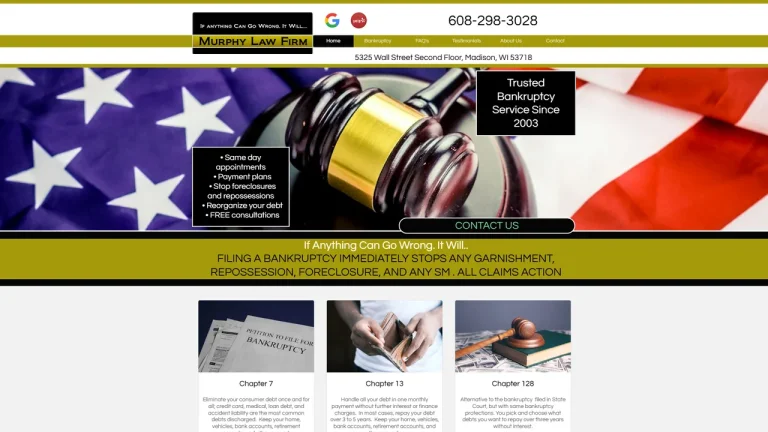
Murphy Law Firm - Madison, WI
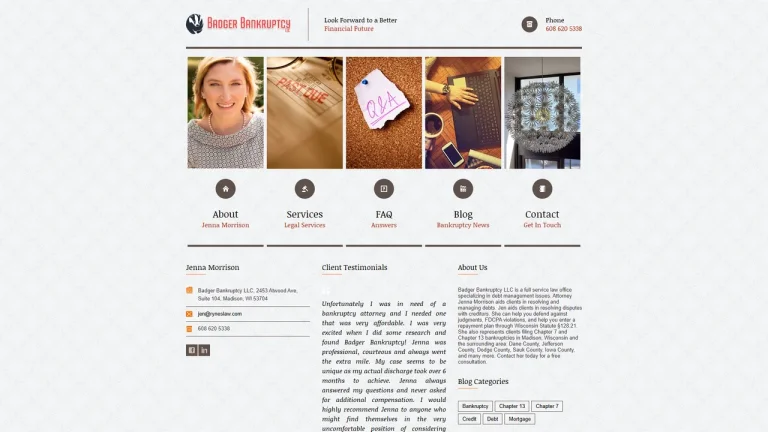
Badger Bankruptcy LLC - Attorney Jenna Morrison - Madison, WI

Richman and Richman - Madison, WI

Capital Law Group, S.C. - Madison, WI
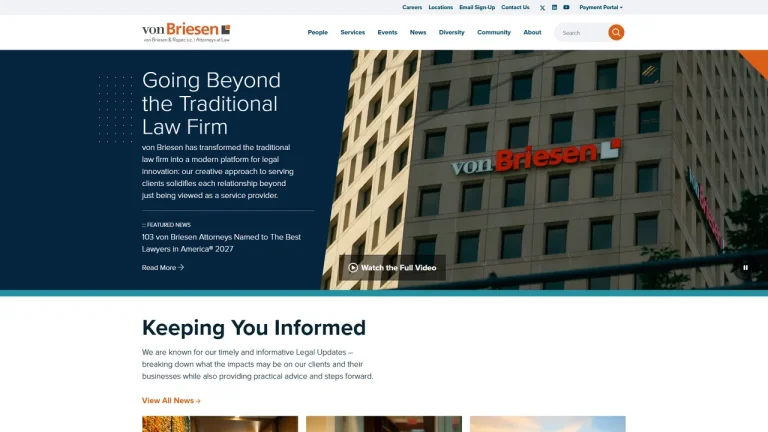
von Briesen & Roper, s.c. - Madison, WI

Claire Ann Richman (Richman & Richman LLC) - Madison, WI
Bankruptcy Law Services - Madison, WI
Peter Francis Geraci Law L.L.C. - Madison, WI
Debt Advisors Law Offices Bankruptcy Attorneys - Madison, WI

Navigating Debt Relief in the Western District of Wisconsin
Mounting medical debt, credit card balances, or unexpected financial hardship in Madison can quickly become overwhelming. For residents across Dane County-including Madison, Sun Prairie, Fitchburg, Middleton, and Waunakee-federal bankruptcy law provides structured avenues to achieve financial fresh starts. Formal federal bankruptcy filings for the region are filed with and adjudicated by the U.S. Bankruptcy Court for the Western District of Wisconsin, located at the Robert W. Kastenmeier U.S. Courthouse on North Henry Street in downtown Madison.
Upon filing a petition, federal law grants immediate relief through the automatic stay, halting all pending debt collection lawsuits, home foreclosures, vehicle repossessions, and collection contacts. Meanwhile, state court collection lawsuits initiated by creditors are handled across the street in the Dane County Courthouse on South Hamilton Street. Working with a skilled Madison bankruptcy attorney ensures that collection lawsuits are stopped in state court and transitioned smoothly into federal protection.
Wisconsin also offers a unique statutory remedy outside of federal bankruptcy known as a Chapter 128 debt amortization plan. A knowledgeable local attorney helps you compare Chapter 7 liquidation, Chapter 13 repayment plans, and Wisconsin state debt amortization to safeguard your property and secure lasting financial relief.
Madison Bankruptcy and Debt Relief Fee Schedules
| Case Scenario | Fee Structure | Estimated Cost (USD) | Key Cost Determinants |
|---|---|---|---|
| Chapter 7 Liquidation (Individual or Joint) | Flat Fee | $1,200 - $2,500 | Household income relative to Wisconsin median, asset complexity, number of unsecured creditors |
| Chapter 13 Debt Reorganization Plan | Court-Approved Structured Fee | $3,000 - $4,500 | Mortgage arrearage resolution, vehicle cramdown terms, plan length (36 to 60 months) |
| Wisconsin Chapter 128 State Debt Plan | Flat Fee | $800 - $1,800 | Number of participating creditors, Dane County Circuit Court filing coordination, trustee fees |
| Adversary Proceeding Litigation Defense | Hourly Retainer ($250 - $400/hr) | $3,500 - $10,000+ | Creditor fraud allegations, preference claims, evidentiary hearings before the bankruptcy judge |
Critical Legal Deadlines & Statutes in Wisconsin
Bankruptcy procedure operates under strict statutory requirements. The moment a petition is filed, 11 U.S. Code § 362 automatically halts all creditor actions, garnishments, and collection lawsuits. To qualify for Chapter 7 liquidation, debtors must pass the statutory means test under 11 U.S. Code § 707(b), which evaluates average monthly income over the prior six months against the median income for comparable Wisconsin households.
Under 11 U.S. Code § 522(b), Wisconsin filers have the strategic advantage of choosing between federal bankruptcy exemptions and Wisconsin state exemptions. Under Wisconsin state exemptions, filers can protect their home using the Wisconsin homestead exemption codified in Wis. Stat. § 815.20, which exempts up to $75,000 of equity for an individual or $150,000 for a married couple filing jointly. Additional personal property protections are codified in Wis. Stat. § 815.18.
For those seeking debt relief without filing federal bankruptcy, Wisconsin provides an alternative under Wis. Stat. § 128.21. This state debt amortization plan allows individuals to repay unsecured debts without interest over a 36-month period through the Dane County Circuit Court while legally enjoining wage garnishments. In federal Chapter 7 cases, creditors have strictly 60 days following the first date set for the Section 341 Meeting of Creditors under Fed. R. Bankr. P. 4004 to object to the debtor's discharge.
Small Claims Limitations vs. Federal Bankruptcy Protection
In Wisconsin, small claims proceedings are codified under Wis. Stat. § 799.01, which restricts jurisdiction to claims not exceeding $10,000. Debt collection agencies routinely file small claims actions in the Dane County Courthouse to obtain rapid default judgments and garnish up to 20% of disposable wages. Small claims courts cannot discharge debt or grant long-term financial relief.
Attempting to handle severe insolvency pro se or negotiating piecemeal with aggressive collection agencies frequently results in depleted savings and frozen bank accounts. Hiring a skilled Madison bankruptcy attorney allows you to invoke federal jurisdiction, permanently discharge qualifying unsecured debts, and protect retirement assets and home equity under applicable exemption statutes.
Red Flags When Hiring a Madison Bankruptcy Lawyer
- Unaccredited out-of-state debt settlement companies that claim to eliminate debt without formal statutory protections or court supervision.
- Attorneys who guarantee a Chapter 7 discharge before conducting a detailed means test and reviewing recent tax returns.
- Law firms that fail to evaluate the strategic difference between federal exemptions and Wisconsin state exemptions under Wis. Stat. § 815.18.
- Practices offering deceptive zero-down bankruptcy filings that bundle representation into high-interest third-party financing contracts.
Frequently Asked Questions
What is the Wisconsin homestead exemption in bankruptcy?
Under Wis. Stat. § 815.20, Wisconsin filers who select state exemptions can protect up to $75,000 in home equity as an individual, or up to $150,000 for married couples filing jointly.
What is the difference between Chapter 7 and Chapter 13 bankruptcy?
Chapter 7 liquidates eligible unsecured debt for qualifying filers under 11 U.S. Code § 707(b), while Chapter 13 establishes a 3- to 5-year repayment plan under 11 U.S. Code § 1325 to catch up on mortgages and retain assets.
What is a Wisconsin Chapter 128 debt amortization plan?
Authorized by Wis. Stat. § 128.21, Chapter 128 is a state court procedure that allows Wisconsin debtors to stop wage garnishments and pay off unsecured debts over 36 months without interest or filing federal bankruptcy.
Where are bankruptcy hearings held in Madison?
Hearings and creditor meetings are administered through the U.S. Bankruptcy Court for the Western District of Wisconsin, situated at 120 North Henry Street in Madison.
How does filing bankruptcy stop wage garnishments in Dane County?
Upon filing, 11 U.S. Code § 362 activates the automatic stay, which legally mandates creditors to immediately halt wage garnishments and ongoing collection lawsuits in Dane County Circuit Court.