
Courts in Bridgeport
Navigating courts in Bridgeport connects Fairfield County residents with trial courtrooms, judicial clerks, and specialized family and housing dockets. Understanding courthouse division protocols, appearance schedules, and electronic filing guidelines ensures proper adherence to Connecticut legal rules. Explore our verified judicial directory below to locate courthouse addresses, clerk contacts, and operational guidelines.

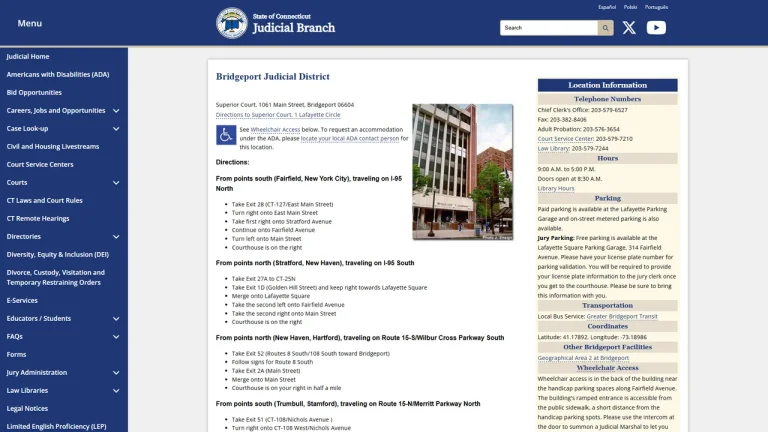
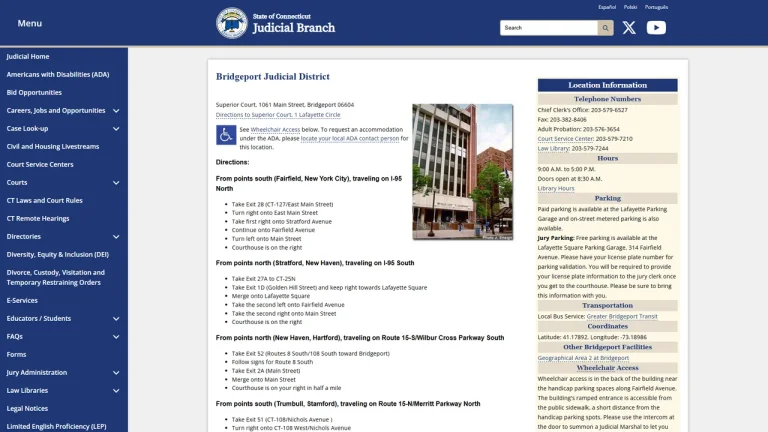
Bridgeport Superior Court - Geographical Area 2 - Bridgeport, CT
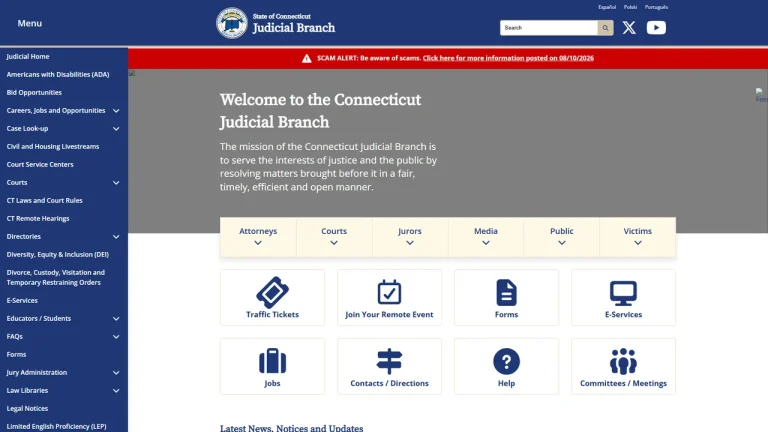
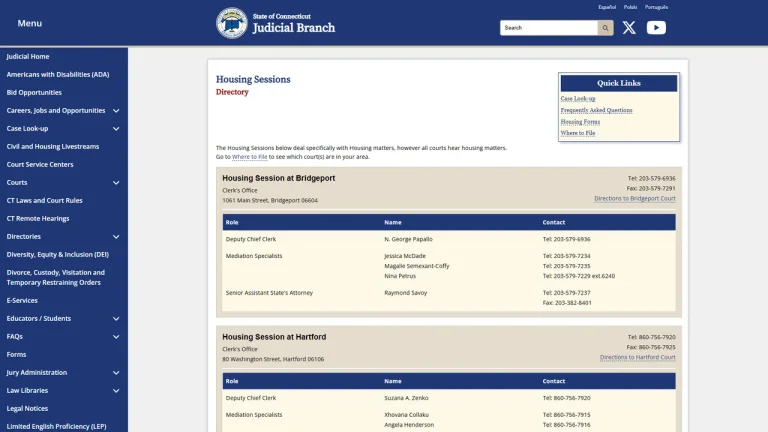

Fairfield Judicial District Court Framework & Bridgeport Benches
Bridgeport serves as the judicial core of the Fairfield Judicial District, housing the principal trial court facilities of the Connecticut Judicial Branch. Major legal proceedings are conducted at the Fairfield Judicial District Courthouse at 1061 Main Street in downtown Bridgeport. This historic bench possesses general jurisdiction over major civil disputes, Part A felony criminal prosecutions, and family court proceedings including divorce and child custody.
Complementing the general trial court, the Geographical Area No. 2 (GA 2) Courthouse at 172 Golden Hill Street oversees motor vehicle infractions, misdemeanor arraignments, preliminary hearings, and small claims actions. Specialized matters are divided among designated court facilities, including Juvenile Matters at 60 Housatonic Avenue, the Bridgeport Housing Session for summary process evictions, and the Bridgeport Probate Court housed at 999 Broad Street.
Litigants across diverse Bridgeport neighborhoods, including Downtown, Black Rock, North End, Brooklawn, and Mill Hill, as well as surrounding towns like Fairfield, Trumbull, and Stratford, depend on these facilities for civil redress and docket administration. Knowing which division maintains jurisdiction over your case is essential for meeting filing requirements and preserving procedural rights.
Key Court Services & Statutory Fee Schedules in Bridgeport
Court operations and filing procedures across Bridgeport benches are governed by statutory schedules enacted by the Connecticut General Assembly. Below is a detailed breakdown of standard court filings, prerequisites, and expected turnaround times.
| Service / Matter | Required Documents / Prerequisites | Statutory Fee (USD) | Processing Timeline |
|---|---|---|---|
| Small Claims Writ & Notice of Suit | Form JD-CV-40, itemized accounting of claim, defendant address | $95 filing fee | Notice issued within 2-3 weeks |
| Civil Action Summons & Complaint (Part H) | Summons (Form JD-CV-1), verified complaint, marshal return of service | $360 statutory entry fee | Return date set 2-4 weeks after service |
| Certified Judgment & Docket Transcript | Written request, docket number, participant legal names | $25 per certified record | Same-day at clerk counter |
| Criminal Bond Filing & Bail Administration | Appearance bond form, cash bond or licensed surety bondsman | Discretionary bond set by court | 1-3 hours during court operational sessions |
Critical Legal Deadlines & Statutes in Connecticut
Litigation in Bridgeport requires meticulous attention to statutory limitation periods codified under the Connecticut General Statutes. Civil claims founded upon personal injury, negligence, or medical malpractice must be filed within two years under Conn. Gen. Stat. § 52-584. Claims founded upon formal written contracts must be commenced within six years pursuant to Conn. Gen. Stat. § 52-576, whereas oral contract disputes carry a three-year statute of limitations under Conn. Gen. Stat. § 52-581. Allowing these statutory deadlines to lapse permanently bars recovery in the Fairfield Judicial District.
Small claims rulings in Connecticut operate under distinct finality provisions. Under Conn. Gen. Stat. § 51-197a, judgments entered in small claims sessions are final, and parties do not possess an automatic right of direct appeal. However, an aggrieved litigant may file a motion to open judgment within four months of the decision under Conn. Gen. Stat. § 52-212a upon demonstrating good cause, fraud, or lack of proper notice.
For standard civil judgments rendered in the Superior Court, an appeal must be filed with the Connecticut Appellate Court within twenty days of the judgment notice. In criminal matters, detained individuals arrested without a warrant must be presented for arraignment at the next session of the court having jurisdiction under Conn. Gen. Stat. § 54-1g, with pretrial bail terms evaluated under Conn. Gen. Stat. § 54-64a.
Direct Court Self-Service vs. Retaining Legal Counsel
The Connecticut Judicial Branch provides resources for self-represented litigants to handle basic procedural matters directly. Pro se litigants frequently resolve monetary disputes up to $5,000 in the Small Claims Session of the Superior Court under Conn. Gen. Stat. § 51-15, answer uncontested summary process eviction summonses in the Bridgeport Housing Session, or resolve motor vehicle infractions through the Centralized Infractions Bureau. Public Court Service Centers located within Bridgeport courthouses provide access to computers, official forms, and administrative instructions.
However, when facing complex legal disputes or severe penalties, retaining an attorney admitted to the Connecticut Bar is essential. Professional legal counsel is critical when handling Part A felony defenses at 1061 Main Street, managing contested divorces involving significant marital property and child custody, litigating catastrophic personal injury suits, or executing commercial contract claims. An attorney ensures strict adherence to the Connecticut Practice Book, conducts formal depositions, and provides skilled trial representation.
Common Fraud Warnings & Verification Protocols
Court users in Bridgeport should remain vigilant against deceptive practices targeting litigants and family members:
- Judicial Marshal & Arrest Warrant Phone Scams: Fraudsters frequently telephone residents posing as State Judicial Marshals or clerk officers, claiming an outstanding warrant exists for failure to appear for jury duty. They demand immediate payment via wire transfers, prepaid debit cards, or digital currency. Connecticut judicial officers never solicit fine collections over the phone.
- Predatory Form Purchasing Services: Several third-party websites charge fees to download Connecticut court pleadings. All standardized civil, family, and housing court forms are available free of charge on the Connecticut Judicial Branch official website.
- Unlicensed Legal Advisors: Non-attorneys offering paid document preparation for housing or family court cannot provide legal advice or courtroom advocacy. Engaging uncredentialed individuals can lead to dismissed claims or default judgments.
- Unverified Bail Solicitations: Ensure any bail agent operating around the Golden Hill Street courthouse is properly licensed by the Connecticut Insurance Department. Reject unsolicited offers from unauthorized intermediaries in courthouse corridors.
Frequently Asked Questions
Where is the main civil and criminal courthouse in Bridgeport?
Major civil trials and Part A felony criminal matters are heard at the Fairfield Judicial District Courthouse, located at 1061 Main Street in downtown Bridgeport. Misdemeanors, arraignments, and motor vehicle cases are heard at the GA 2 Courthouse at 172 Golden Hill Street.
What is the financial jurisdictional limit for small claims in Bridgeport?
The statutory jurisdictional limit for small claims matters in the Connecticut Superior Court is $5,000 pursuant to Conn. Gen. Stat. § 51-15. Disputes seeking amounts greater than $5,000 must be initiated as standard civil actions in Superior Court.
Can a small claims judgment be appealed in Bridgeport?
Under Conn. Gen. Stat. § 51-197a, small claims judgments are final and cannot be appealed to the Appellate Court. However, a party may file a motion to open judgment within four months under Conn. Gen. Stat. § 52-212a under specific circumstances such as mistake or lack of notice.
How can I access Bridgeport court records and dockets online?
Civil, family, housing, and criminal dockets can be searched electronically using the Connecticut Judicial Branch Case Look-up portal. Public computers are also available for case inquiries inside the Court Service Center at 1061 Main Street.
Where are housing and eviction disputes heard in Bridgeport?
Summary process eviction actions and housing code matters in Bridgeport are adjudicated through the Bridgeport Housing Session, located within the judicial complex at 1061 Main Street.