
Courts in Maine
Explore the Maine Judicial Branch directory, jurisdictional thresholds, and court filing procedures. Navigating state court dockets requires compliance with local circuit procedures and statutory appeal windows. Browse our verified directory below to locate county courthouses, access case records, and connect with official judicial services across Maine.




The Maine Judicial Branch and Trial Court Jurisdiction
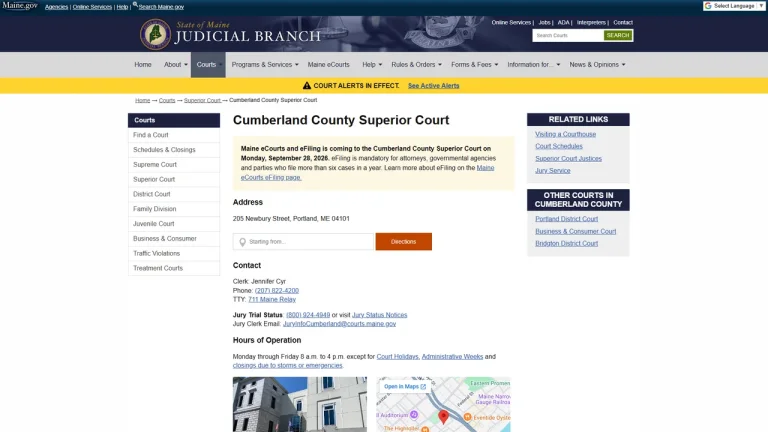
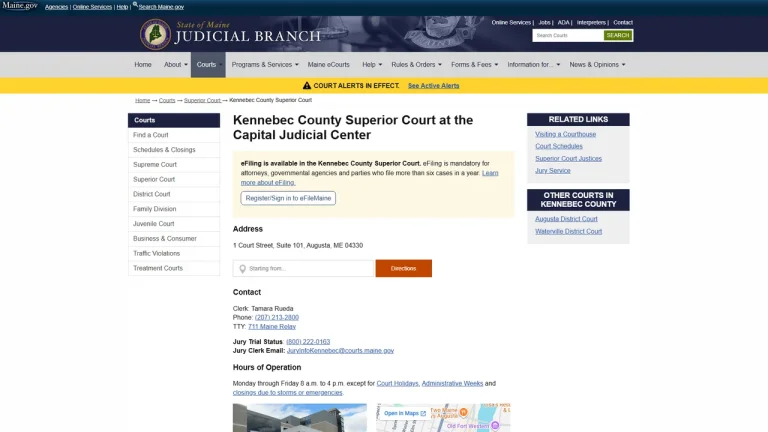
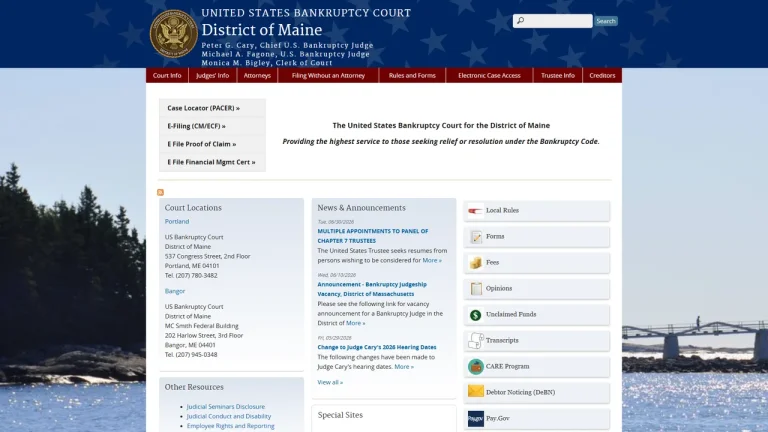
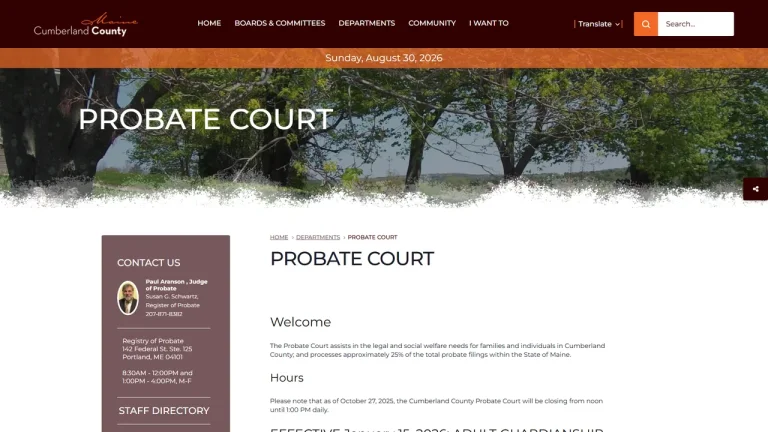
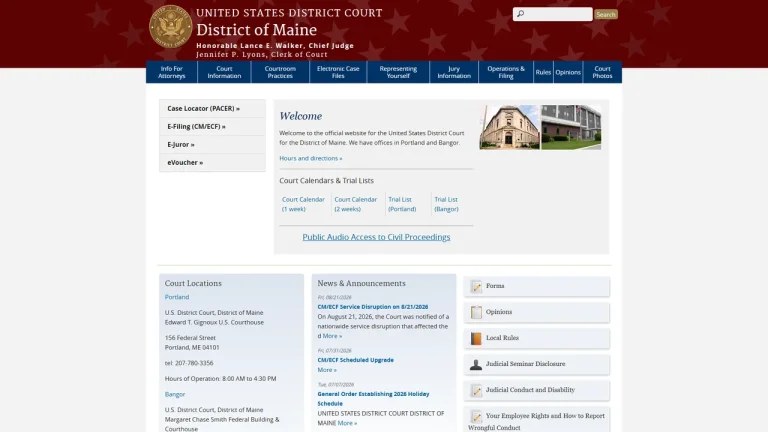
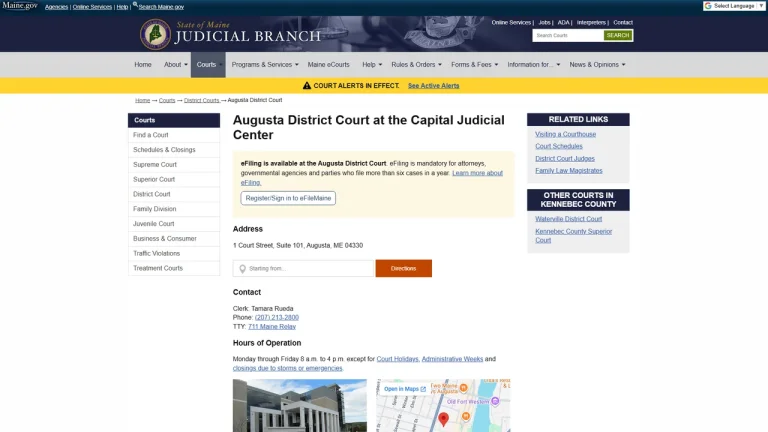
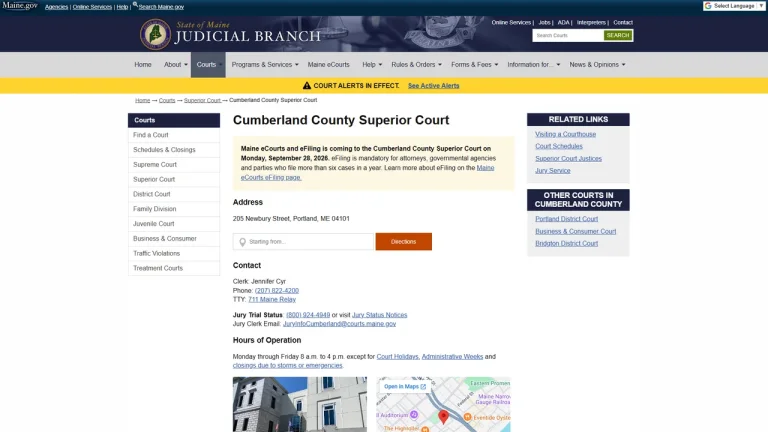
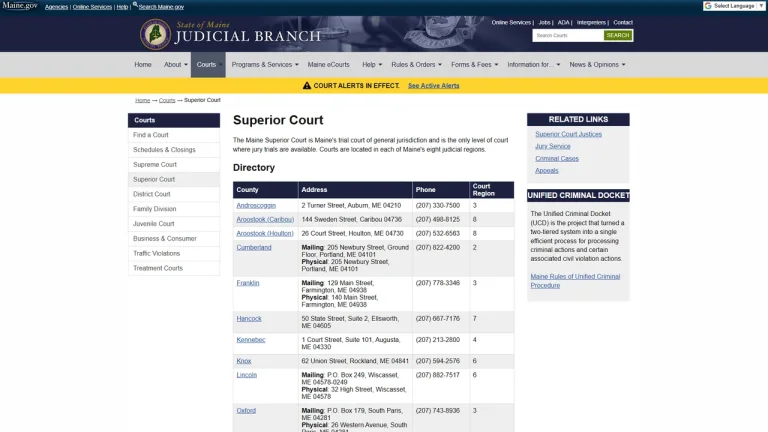
The Maine Judicial Branch is established under Article VI of the Maine Constitution, administering justice through a coordinated trial court system and a centralized appellate bench. Trial proceedings are divided between the Maine District Court and the Maine Superior Court across all sixteen counties, with principal legal hubs located in Portland (Cumberland County), Bangor (Penobscot County), Augusta (Kennebec County), and Alfred (York County).
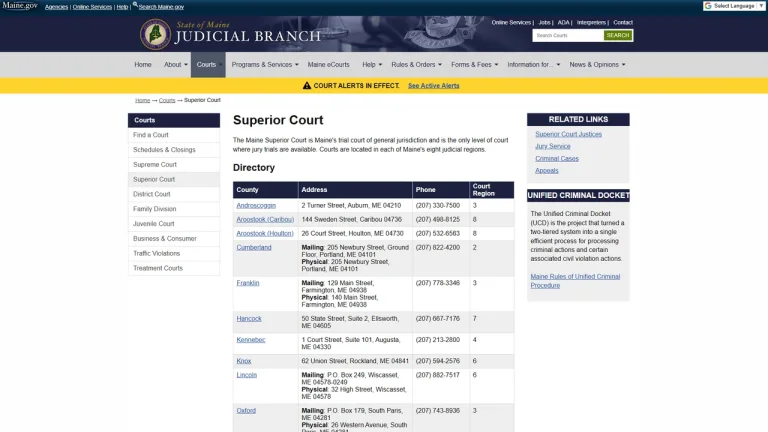
The Maine Superior Court serves as the state trial court of general jurisdiction, maintaining exclusive authority over jury trials, major civil actions where damages exceed thirty thousand dollars, and felony criminal prosecutions. In contrast, the Maine District Court exercises non-jury jurisdiction over family matters, juvenile cases, protection from abuse orders, civil violations, and small claims actions.
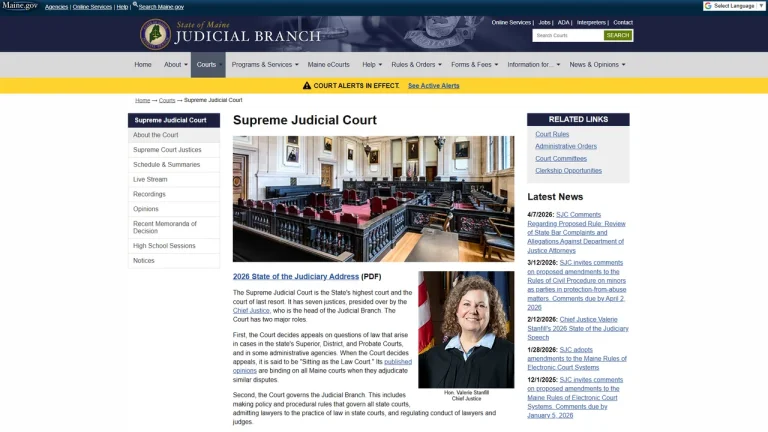
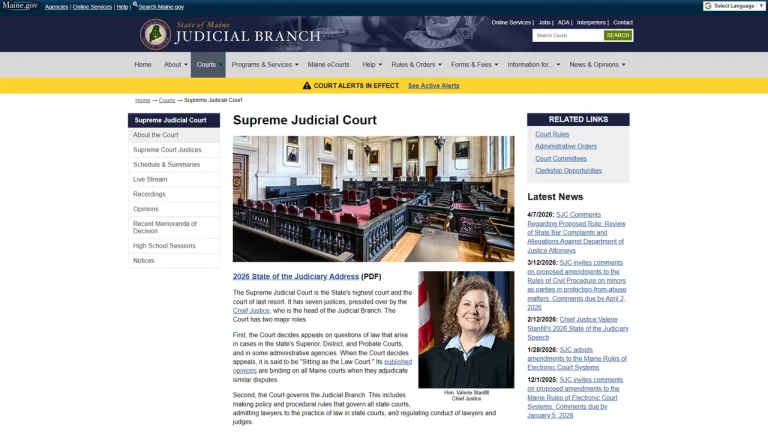
Statewide appellate authority resides in the Maine Supreme Judicial Court, sitting as the Law Court, which convenes in Portland and the state capital of Augusta. In addition, Maine operates the specialized Business and Consumer Court (BDC) in Portland to manage complex commercial actions. Court filings are increasingly processed through the Maine eCourts electronic filing system.
Common Maine Court Filings, Requirements, and Statutory Fees
| Service / Matter | Required Documents / Prerequisites | Statutory Fee (USD) | Processing Timeline |
|---|---|---|---|
| Superior Court Civil Action | Verified Complaint, Summons, Civil Summary Sheet, electronic filing fee | $175 statutory civil filing fee | Immediate electronic docketing via Maine eCourts |
| Small Claims Notice of Claim | Statement of claim, itemized damages, supporting contracts or receipts | $50 filing fee for claims under $6,000 | Hearing set within 30 to 60 calendar days |
| Complaint for Protection from Abuse (PFA) | Sworn complaint, affidavit documenting domestic violence or threats | $0 (Statutorily exempt under Maine law) | Same-day ex parte judicial review |
| Notice of Appeal to the Law Court | Notice of appeal filed in trial court, order for transcript, docket fee | $175 appellate docketing fee | Strict 21-day jurisdictional filing window |
Critical Legal Deadlines & Statutes in Maine
Litigation in Maine courts is governed by strict statutory limitation periods set forth in the Maine Revised Statutes. Under Me. Rev. Stat. tit. 14, § 752, general civil actions-including personal injury, property damage, and breach of contract-are subject to a 6-year statute of limitations, running from the date the cause of action accrued.
However, specific categories of litigation carry significantly shorter timeframes. Medical malpractice claims must be commenced within 3 years from the date of the act or omission giving rise to the injury under Me. Rev. Stat. tit. 24, § 2902. Small commercial disputes and debt claims are capped at a monetary limit of $6,000 under the Maine Small Claims Act codified at Me. Rev. Stat. tit. 14, § 7482.
Appellate deadlines in Maine are exceptionally compressed and strictly jurisdictional. Under Rule 2B of the Maine Rules of Appellate Procedure, a notice of appeal must be filed with the clerk of the trial court within strictly 21 calendar days from the entry of the final judgment or order. In domestic protection actions, an ex parte temporary order issued under Me. Rev. Stat. tit. 19-A, § 4006 remains in effect until a full evidentiary hearing is held within 21 calendar days.
Small Claims and Self-Representation vs. Retaining Licensed Counsel
Self-representation (pro se) is common in the Small Claims Division of the Maine District Court for disputes under $6,000, where individuals represent themselves using standardized court forms in an informal hearing before a judge. Similarly, individuals seeking emergency protection from abuse orders can file directly at district court clerk counters without an attorney, supported by local victim advocates who assist with procedural paperwork.
However, when proceedings involve general civil litigation in the Superior Court, jury trial demands, medical negligence claims, or felony criminal charges, retaining an attorney admitted to the Maine State Bar Association is essential. Furthermore, corporate entities and LLCs are legally prohibited from representing themselves in Superior Court actions. Licensed counsel manages complex discovery, navigates the Maine Rules of Civil Procedure, and ensures evidentiary records are preserved for the Law Court.
Red Flags and Deceptive Practices in Maine Judicial Matters
- Telephone scams where callers impersonate Maine county sheriff deputies or court clerks claiming a bench warrant has been issued for missed jury service, demanding immediate payment via prepaid debit cards or wire transfers.
- Commercial third-party websites charging subscription fees for standard Maine court forms that are published free of charge by the Maine Judicial Branch.
- Unlicensed practitioners or non-attorney legal advocates offering to represent litigants in contested Superior Court or Family Division trials without Maine bar admission.
- Missing the strict 21-day appellate window under Rule 2B of the Maine Rules of Appellate Procedure, which permanently extinguishes the right to appeal a trial judgment to the Law Court.
Frequently Asked Questions
What is the difference between the District Court and Superior Court in Maine?
The Maine District Court handles non-jury matters, including family law, protection from abuse orders, civil violations, and small claims. The Maine Superior Court is the trial court of general jurisdiction handling jury trials, civil claims where damages exceed $30,000, and felony criminal cases.
What is the monetary limit for Small Claims Court in Maine?
Under Me. Rev. Stat. tit. 14, § 7482, the monetary limit for small claims actions in the Maine District Court is $6,000, excluding interest and allowable court costs.
What is the deadline to appeal a court decision to the Maine Law Court?
Under Rule 2B of the Maine Rules of Appellate Procedure, a notice of appeal must be filed with the clerk of the trial court within strictly 21 calendar days from the date the final judgment is officially entered on the court docket.
What is the general statute of limitations for civil lawsuits in Maine?
Under Me. Rev. Stat. tit. 14, § 752, the general statute of limitations for tort, personal injury, and breach of contract actions in Maine is 6 years from the date the claim accrued.
How do I access public court records in Maine?
Public court records can be accessed through the Maine eCourts public access portal or by visiting the clerk office in the specific district or superior courthouse where the matter was filed during regular business hours.