
Recorder of Deeds in New Jersey
Recording real property instruments in New Jersey requires adherence to the Consolidated Recording Act and county-level recording divisions. Real estate titles, mortgages, liens, and deeds are recorded by County Clerks or dedicated County Registers of Deeds and Mortgages across all 21 counties. Consult our verified statewide directory below to access verified recording offices, document prerequisites, and filing portals.
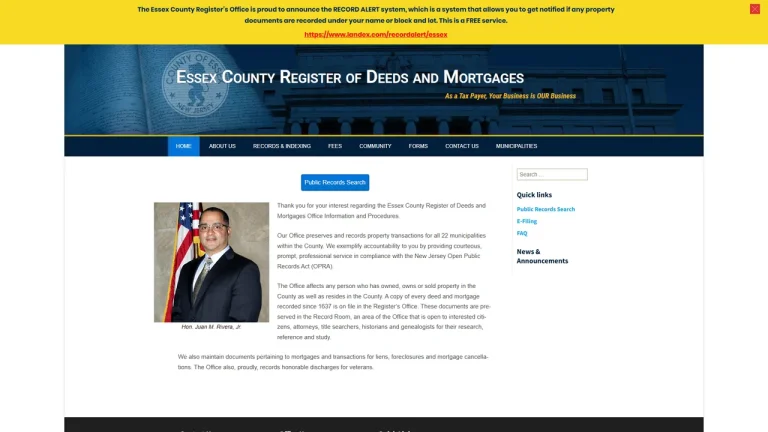
Essex County Register of Deeds and Mortgages - Newark, NJ


The Framework of Real Property Recording in New Jersey
In the State of New Jersey, the preservation and recording of real estate titles, mortgages, and encumbrances is administered at the county level pursuant to statutory authority. Recording offices maintain the public land records across all 21 counties, providing constructive notice of title transfers, liens, and easements to title examiners, financial lenders, and prospective property purchasers.
New Jersey utilizes an administrative division among its recording offices. In 16 of the 21 counties-including Bergen, Middlesex, Monmouth, Ocean, Morris, and Burlington-recording operations are managed by the Recording Division of the elected County Clerk. In five densely populated counties-Camden, Essex, Hudson, Passaic, and Union-statutory recording authority is exercised by an independently elected County Register of Deeds and Mortgages pursuant to N.J. Stat. Ann. § 40A:9-80. Both types of recording offices maintain identical legal authority to accept, index, and archive real property instruments.
Electronic land recording is authorized statewide under the Uniform Real Property Electronic Recording Act, enabling title agencies and legal practitioners to submit documents digitally through approved recording networks. Documents are indexed in county public databases by grantor and grantee name, as well as municipal tax block and lot numbers, establishing priority of legal title under New Jersey jurisprudence.
Real Estate Recording Fees, Taxes & Statutory Requirements
| Service / Matter | Required Documents / Prerequisites | Statutory Fee (USD) | Processing Timeline |
|---|---|---|---|
| Standard Deed Recording | Executed Original Deed, Notary Acknowledgment, Tax Block & Lot, Preparer Clause | $40 First Page + $10 Each Additional Page | Same day to 3 business days |
| Mortgage Recording | Original Mortgage Instrument, Execution Clause, Proper Notarization | $30 First Page + $10 Each Additional Page | Same day to 3 business days |
| Notice of Settlement Filing | Names of Parties, Legal Description, Signatures of Parties or Attorneys | $20 Flat Statutory Fee | Immediate electronic recording |
| Commercial Construction Lien Claim | Form Form-A, Itemized Contract Balance, Proof of Owner Service | $15 Base Recording Fee | 1 to 3 business days |
Critical Legal Deadlines & Statutes in New Jersey
Real property conveyances and lien priority in New Jersey are strictly governed by statutory mandates. The central authority for document recording is the Consolidated New Jersey Recording Act, codified at N.J. Stat. Ann. § 46:26A-1. Document recording prerequisites are defined under N.J. Stat. Ann. § 46:26A-3, requiring every instrument to contain an English text, legible signatures, a formal notary acknowledgment, municipal tax block and lot identifiers, and a preparer identification clause.
New Jersey operates as a race-notice recording jurisdiction under N.J. Stat. Ann. § 46:26A-12. An unrecorded deed, mortgage, or easement is void against subsequent judgment creditors and bona fide purchasers for valuable consideration without notice whose deed or mortgage is first recorded. To protect real estate closings, N.J. Stat. Ann. § 46:26A-11 authorizes the filing of a Notice of Settlement, which shields the purchaser or mortgagee against intervening judgments for a safe-harbor window of 60 days.
For contractors and material suppliers, the New Jersey Construction Lien Law at N.J. Stat. Ann. § 2A:44A-6 requires that commercial construction lien claims be recorded with the County Clerk or Register of Deeds within strictly 90 days following the date the last work, services, or materials were provided. Conveyances of real property are also subject to the New Jersey Realty Transfer Fee under N.J. Stat. Ann. § 46:15-7, which includes a supplemental 1% fee on residential and commercial transfers where consideration exceeds $1,000,000 under N.J. Stat. Ann. § 46:15-7.2.
Direct Registry Recording vs. Professional Legal Counsel
Property owners can perform standard administrative recording functions directly with the County Clerk or Register of Deeds without legal counsel. Recording a mortgage discharge or satisfaction after paying off a residential loan, requesting certified copies of historical deeds, or searching public grantor-grantee indexes can be accomplished directly in county records rooms or via public online portals.
However, when a transaction involves drafting deeds, clearing encumbrances, or structuring commercial property transfers, retaining experienced real estate legal counsel is indispensable. An attorney ensures compliance with the New Jersey Affidavit of Consideration requirements, navigates statutory transfer tax exemptions, and verifies legal property descriptions. If title disputes arise-such as boundary encroachments, unreleased ancient mortgages, or competing claims-an attorney initiates an action to quiet title under N.J. Stat. Ann. § 2A:62-1.
Title litigation and equitable mortgage priorities fall under the exclusive jurisdiction of the Chancery Division (General Equity) of the New Jersey Superior Court. The Small Claims Section of the Special Civil Part under N.J. Ct. R. 6:1-2 is limited to $5,000 and has no authority to alter land records, reform deeds, or quiet title. Engaging legal counsel protects title validity and prevents unmarketable land ownership.
Red Flags & Real Estate Fraud Warnings
- Be alert to misleading direct-mail solicitations demanding $85 to $115 to provide a copy of your recorded deed; an authentic certified copy can be obtained directly from your County Clerk or Register of Deeds for nominal copy fees.
- Register for your county recording office's free Property Fraud Alert service, which notifies property owners by email whenever an instrument is recorded against their name or parcel identifier.
- Do not finalize a real estate acquisition without filing a Notice of Settlement under N.J. Stat. Ann. § 46:26A-11, which locks in title priority during the closing period.
- Ensure documents strictly adhere to the formatting requirements of N.J. Stat. Ann. § 46:26A-3 regarding municipal tax block and lot numbers, as non-conforming documents will be rejected for recording.
Frequently Asked Questions
What is the difference between a County Clerk and a Register of Deeds in New Jersey?
In 16 New Jersey counties, real estate documents are recorded by the County Clerk's Recording Division. In five counties (Camden, Essex, Hudson, Passaic, and Union), recording is administered by an elected Register of Deeds and Mortgages under N.J. Stat. Ann. § 40A:9-80.
What does it mean that New Jersey is a race-notice recording state?
Under N.J. Stat. Ann. § 46:26A-12, an unrecorded instrument is void against subsequent purchasers for value without notice who record their deed or mortgage first, making priority dependent on both lack of notice and prompt recording.
What is a Notice of Settlement in New Jersey?
Pursuant to N.J. Stat. Ann. § 46:26A-11, a Notice of Settlement is an instrument recorded prior to closing that protects prospective buyers and mortgagees by preserving title priority for 60 days against subsequent liens or conveyances.
What is the deadline to record a commercial construction lien in New Jersey?
Under N.J. Stat. Ann. § 2A:44A-6, a commercial construction lien claim must be filed with the County Clerk or Register of Deeds within strictly 90 days of the last date work or materials were supplied.
What is the Realty Transfer Fee (RTF) in New Jersey?
Codified at N.J. Stat. Ann. § 46:15-7, the Realty Transfer Fee is a statutory state and county recording tax collected on real property deeds based on the consideration paid, including a 1% fee on conveyances exceeding $1,000,000 under N.J. Stat. Ann. § 46:15-7.2.