
Legal Resources in New Jersey
Navigating New Jersey legal resources connects individuals and businesses with the state's vicinage court system, municipal dockets, and executive agencies. Engaging official public departments guarantees regulatory compliance, expedites record requests, and protects vital procedural deadlines. Explore our directory below to locate verified New Jersey court facilities, correctional registries, and state offices.

Essex County Division Family Assistance and Benefits - Newark, NJ
Internal Revenue Service (IRS) Taxpayer Assistance Center - Trenton, NJ


New Jersey Division of Taxation - Newark Regional Information Center - Newark, NJ

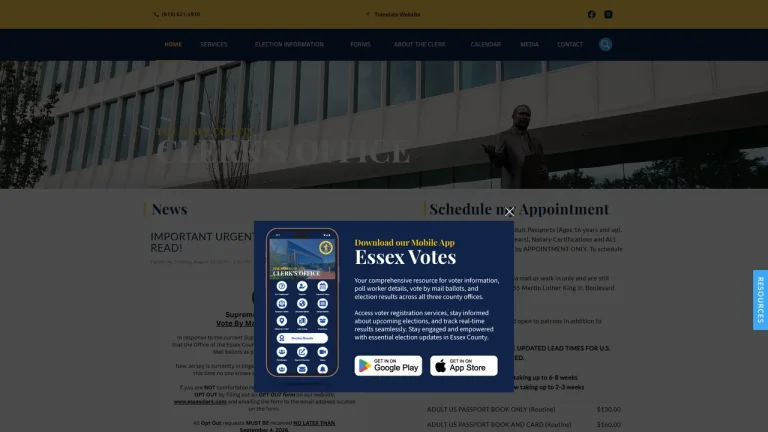
Essex County Clerk - Passport Services - Newark, NJ



New Jersey Judicial System & Administrative Agency Governance
New Jersey operates a highly structured court system headquartered at the Richard J. Hughes Justice Complex in Trenton. The state's judicial hierarchy is led by the Supreme Court of New Jersey, supported by the Superior Court of New Jersey. The Superior Court is organized geographically into 15 Judicial Vicinages serving all 21 counties, comprising trial divisions for Criminal, Civil (Law Division), Family, General Equity, and Probate (Chancery Division).
Appellate review is conducted by the Appellate Division of the Superior Court, which hears appeals from the trial vicinages, the Tax Court, and state administrative agencies. Local Municipal Courts across the state exercise jurisdiction over motor vehicle violations, minor municipal ordinance breaches, and disorderly persons offenses. Correctional facilities and rehabilitative programs are managed statewide by the New Jersey Department of Corrections (NJDOC).
Driver licensing, motor vehicle registrations, and administrative point suspensions are administered by the New Jersey Motor Vehicle Commission (NJ MVC). Statewide vital records, including certified birth, marriage, and death documentation, are maintained by the New Jersey Department of Health Office of Vital Statistics and Registry in Trenton. Court filings are routed electronically through the New Jersey Courts e-Courts and PROMIS/Gavel systems.
Statutory Fees & Processing Timelines for New Jersey Public Services
| Service / Matter | Required Documents / Prerequisites | Statutory Fee (USD) | Processing Timeline |
|---|---|---|---|
| Certified Vital Record (Office of Vital Statistics) | Valid state photo ID, proof of relationship, completed application. | $25.00 ($2.00 each additional copy) | Same-day in person; 4-8 weeks by mail or online. |
| Superior Court Certified Docket or Judgment Copy | Vicinage case docket number, written request to Superior Court Clerk. | $10.00 - $15.00 per certification | Immediate at vicinage counter; 3-5 business days online. |
| Open Public Records Act (OPRA) Request | Specific identification of government records requested from agency. | $0.05 per letter page / $0.07 per legal page | 7 business days from custodian receipt. |
| NJ MVC Certified Driver History Abstract | Driver license number, social security verification, date of birth. | $15.00 | Immediate online download; 7-10 business days by mail. |
Critical Legal Deadlines & Statutes in New Jersey
State transparency in New Jersey is defined under the Open Public Records Act, codified at N.J. Stat. Ann. § 47:1A-5. Records custodians must grant access to government records or provide an explanation of lawful denial within seven business days from receiving the request, provided that immediate access is granted for public budgets, bills, and contracts.
Claimants pursuing tort actions for personal injury or property damage against state, county, or municipal entities must adhere to the New Jersey Tort Claims Act under N.J. Stat. Ann. § 59:8-8. A formal notice of tort claim must be filed with the targeted public entity within 90 days of the accrual of the claim. Failure to serve this notice within the 90-day statutory window forever bars recovery.
Appellate jurisdiction is strictly enforced under New Jersey Court Rule 2:4-1. An appeal from a final judgment of the Superior Court trial divisions or a final state administrative agency decision must be filed with the Appellate Division within 45 days of its entry.
Direct Agency Access vs. Legal Representation
Individuals can navigate specific administrative and judicial tasks pro se using official state resources. Litigants frequently handle straightforward financial disputes in the Small Claims Section of the Special Civil Part under New Jersey Court Rule 6:1-2 up to $5,000, or regular Special Civil Part matters up to $20,000. Ordering driver records from the NJ MVC, requesting certified certificates from the Office of Vital Statistics, and submitting OPRA requests can all be executed directly.
Conversely, retaining an attorney admitted to the New Jersey Bar is critical when involved in indictable criminal charges in the Law Division, complex commercial disputes in General Equity, child custody battles in the Family Part, or formal administrative appeals before the Office of Administrative Law (OAL). The procedural complexity of these courts requires professional knowledge to avoid dismissal or severe legal sanctions.
Red Flags & Public Resource Protections
- Commercial services charging high fees to submit OPRA requests or retrieve standard court forms that are freely accessible via the New Jersey Judiciary portal.
- Non-attorney consultants offering unauthorized legal representation in Municipal Court traffic matters or Chancery Division foreclosure defense.
- Unlicensed bail solicitors misrepresenting New Jersey's bail system, which operates under the Criminal Justice Reform Act as a non-monetary, risk-based pretrial detention framework.
- Impersonation scams claiming outstanding arrest warrants or missed jury duty fines in Essex, Bergen, or Middlesex Vicinages, demanding payment via digital payment apps.
Frequently Asked Questions
What is the monetary limit for Small Claims Court in New Jersey?
Under New Jersey Court Rule 6:1-2, the Small Claims Section of the Special Civil Part handles contract and tort matters up to $5,000, as well as security deposit disputes up to $5,000. Regular Special Civil Part cases handle claims up to $20,000.
How does the Open Public Records Act (OPRA) work in New Jersey?
Under N.J. Stat. Ann. § 47:1A-1, any individual can request public government records from state, county, or municipal custodians. Custodians have seven business days to comply, request an extension, or deny the request based on statutory exemptions.
Does New Jersey utilize commercial money bail?
No. Under the New Jersey Criminal Justice Reform Act (N.J. Stat. Ann. § 2A:162-15), New Jersey largely eliminated traditional cash bail in favor of a risk-based assessment system that evaluates flight risk and public safety to determine pretrial release conditions.
What is a court vicinage in New Jersey?
A court vicinage in New Jersey is a geographic judicial district of the Superior Court. The state is divided into 15 Vicinages, with each vicinage comprising one, two, or three counties operating under an Assignment Judge and Trial Court Administrator.
How do I search for an inmate in the New Jersey state prison system?
Inmate locations, custody status, and facility assignments can be verified through the New Jersey Department of Corrections (NJDOC) online Offender Search engine using the inmate's name or state SBI number.