
Law Enforcement & Corrections in Rhode Island
Navigating law enforcement and correctional institutions in Rhode Island requires understanding the state's unified detention system and municipal police jurisdiction. Knowing official intake procedures, bail guidelines, and defense consultation rights protects individuals facing detention or criminal investigation. Review our verified directory below to find contact details, facility regulations, and legal resources for Rhode Island police and correctional institutions.

The Unified Structure of Rhode Island Law Enforcement and Corrections
Rhode Island operates a centralized, unified correctional system administered by the Rhode Island Department of Corrections (RIDOC). Unlike most states that utilize separate county-operated jails, Rhode Island maintains no county detention centers. All pre-trial detainees awaiting arraignment or trial, along with sentenced individuals, are housed within the Adult Correctional Institutions (ACI) complex located in Cranston.
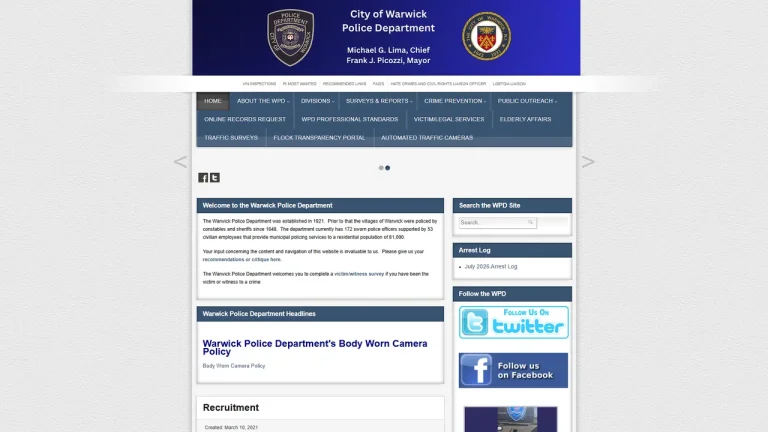
Law enforcement operations across the state's five judicial counties are shared between municipal police departments and the Rhode Island State Police (RISP). Municipal police departments in jurisdictions like Providence, Warwick, Cranston, Pawtucket, and Newport handle local patrol, criminal investigation, and municipal ordinance enforcement. The Rhode Island State Police, headquartered in North Scituate, maintains statewide criminal investigation units and highway patrol coverage across all state travel routes.
Court security and judicial process services are managed by the Rhode Island Division of Sheriffs, which functions under the Department of Public Safety. The Division of Sheriffs oversees prisoner transit between the ACI facilities in Cranston and the various judicial complexes, including the Licht Judicial Complex in Providence, the Noel Judicial Complex in Warwick, the McGrath Judicial Complex in South Kingstown, and the Murray Judicial Complex in Newport.
Common Law Enforcement and Correctional Procedures, Costs, and Timelines
| Service / Matter | Required Documents / Prerequisites | Statutory Fee (USD) | Processing Timeline |
|---|---|---|---|
| Pre-Trial Inmate Intake (ACI Cranston) | Arrest warrant or commitment paper, personal property inventory, medical screening | $0 (Statutory intake fee not applicable) | Processed within 6 to 24 hours prior to initial court arraignment |
| Bail & Surety Bond Deposit | Court-authorized bail order, photo ID of depositor, certified cashier check or cash | Bail amount set by judicial officer under R.I. Gen. Laws § 12-13-1 | Release initiated upon verification of court commitment documents |
| Police Incident Report Retrieval | Incident report number, valid photo ID, written APRA public records request | $0 to $15 depending on municipal department copy schedules | 3 to 10 business days following completion of investigation |
| Inmate Visitation Clearance | Completed RIDOC visitor application, photo ID, background security approval | $0 (Free state administrative service) | 2 to 4 weeks for security processing and approval |
Critical Legal Deadlines & Statutes in Rhode Island
Criminal procedure in Rhode Island establishes precise statutory timelines following an arrest. Under Rhode Island procedural rules, an individual taken into custody must be brought before a District Court judge for arraignment without unnecessary delay, typically within 24 to 48 hours, or on the next court business day if the arrest occurs on a weekend or state holiday. Arraignments evaluate formal charges and determine pretrial release eligibility.
Pretrial release and bail considerations are governed by R.I. Gen. Laws § 12-13-1. In Rhode Island, all persons are bailable by sufficient sureties unless charged with offenses punishable by life imprisonment or capital offenses where the proof of guilt is evident or the presumption great. Furthermore, for individuals on probation or deferred sentence, an arrest triggers notice requirements under R.I. Gen. Laws § 12-19-9, requiring a hearing before the court to determine whether probation has been violated.
Statutes of limitations for criminal prosecutions are established under R.I. Gen. Laws § 12-12-17. General felony prosecutions must be initiated within 3 years of the commission of the offense, while offenses such as murder, arson, burglary, and sexual assault carry no limitations period. Individuals seeking to clear historical records may petition for expungement under R.I. Gen. Laws § 12-1.3-2 after 5 years for a misdemeanor and 10 years for an eligible felony from the completion of the sentence.
Direct Agency Access vs. Legal Counsel
Certain interactions with law enforcement and correctional facilities can be conducted directly by members of the public. Families can deposit commissary funds into an inmate account through approved vendor portals, schedule facility visits at the ACI after receiving security clearance, or request basic accident reports from local municipal police departments through standard public records requests.
However, whenever an individual faces custodial interrogation, formal criminal charges, or correctional disciplinary hearings, securing experienced criminal defense counsel is essential. Retaining an attorney is critical during initial bail hearings, Rule 32.1 probation violation proceedings under R.I. Gen. Laws § 12-19-9, and plea negotiations with the Attorney General. Although the Rhode Island District Court operates a Small Claims division with a monetary threshold of $2,500 under R.I. Gen. Laws § 10-16-1, correctional grievances and criminal prosecutions carry fundamental liberty implications that fall entirely outside small claims jurisdiction.
Red Flags & Detention Center Scam Warnings
- Phone calls from individuals impersonating the Rhode Island State Police or Division of Sheriffs claiming that an active arrest warrant will be executed unless an immediate fine is paid via wire transfer or gift cards.
- Unofficial commercial websites demanding paid subscriptions or processing fees to check inmate custody status; RIDOC offers free online inmate search records directly on its official website.
- Unlicensed bail agents demanding non-refundable cash fees above standard statutory surety limits or promising judicial favors to obtain immediate release without court authorization.
- Third-party services soliciting money from families with promises of expedited visitation approvals or special housing assignments within the Adult Correctional Institutions in Cranston.
Frequently Asked Questions
Where are individuals arrested in Rhode Island held in custody?
Because Rhode Island has a unified state correctional system without county jails, all pre-trial detainees and sentenced prisoners are held at the Adult Correctional Institutions (ACI) facility in Cranston, managed by the Rhode Island Department of Corrections.
How quickly must an arrested person be brought to court for arraignment in Rhode Island?
Under Rhode Island court rules, an arrested individual must be brought before a judicial officer for arraignment without unnecessary delay, typically within 24 to 48 hours of arrest, or on the next regular business day if detained on a weekend.
What legal statute governs the right to bail in Rhode Island?
The right to bail and conditions of pretrial release are codified in R.I. Gen. Laws § 12-13-1, guaranteeing that non-capital defendants are entitled to reasonable bail by sufficient surety or personal recognizance as determined by the court.
How can family members verify whether an inmate is housed at the ACI in Cranston?
Inmate housing and booking status can be verified using the public Inmate Search tool on the official Rhode Island Department of Corrections website, or by contacting the ACI Intake Service Center directly by telephone.
What is the role of the Rhode Island Division of Sheriffs?
The Rhode Island Division of Sheriffs operates under the Department of Public Safety and is responsible for courthouse security, executing court writs and civil process, and transporting inmates between the Adult Correctional Institutions and state courthouses.