
Specialty Courts (Drug, Family, Juvenile) in Rhode Island
Accessing specialized justice and rehabilitation programs in Rhode Island involves navigating dedicated family, drug, and juvenile court divisions. Operating primarily through the Rhode Island Family Court and specialized diversionary dockets, these courts address domestic relations, youth welfare, and substance abuse recovery. Explore our directory below to locate regional family court complexes, treatment programs, and support services.

The Role and Jurisdiction of Specialty and Family Courts in Rhode Island
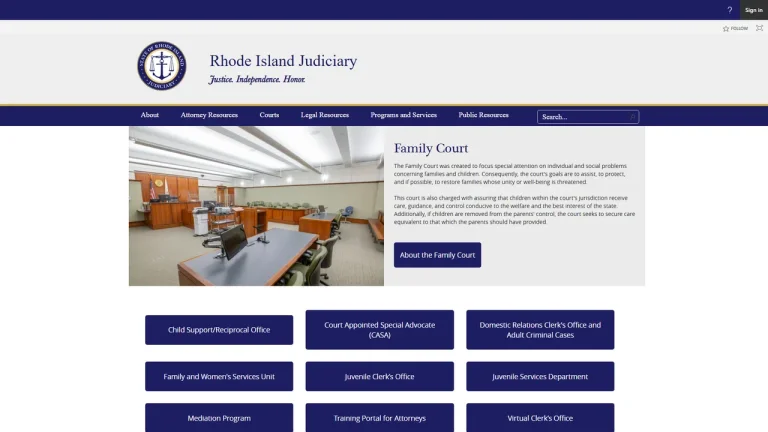
Rhode Island maintains an individualized approach to domestic disputes, youth welfare, and rehabilitative justice through specialized judicial divisions. The central pillar of this framework is the Rhode Island Family Court, established as a dedicated statewide trial court under R.I. Gen. Laws § 8-10-1. The Family Court exercises exclusive jurisdiction over all matters relating to divorce, child custody, visitation, child support, paternity, adoption, and domestic abuse restraining orders.
The Rhode Island Family Court convenes primarily at the J. Joseph Garrahy Judicial Complex in Providence, with additional sessions in Warwick at the Philip W. Noel Judicial Complex, Wakefield at the J. Howard McGrath Judicial Complex, and Newport at the Florence K. Murray Judicial Complex. Under R.I. Gen. Laws § 14-1-5, the court also exercises exclusive authority over juveniles alleged to be delinquent, wayward, dependent, or neglected, working closely with the Rhode Island Department of Children, Youth, and Families (DCYF).
To address underlying behavioral and health challenges, the Rhode Island Judiciary incorporates problem-solving dockets. These programs include the Superior Court Adult Drug Court, the Veterans Treatment Court in the District Court, and the Family Treatment Drug Court. Governed by structured diversionary frameworks, these specialty dockets emphasize clinical treatment, regular judicial supervision, and phased rehabilitation as alternatives to standard punitive sentencing for qualified nonviolent offenders.
Specialty Court Dockets, Entry Requirements, and Timelines
| Service / Matter | Required Documents / Prerequisites | Statutory Fee (USD) | Processing Timeline |
|---|---|---|---|
| Family Court Divorce Complaint | Complaint for divorce, statement of assets (Form DR-6), vital statistics form, marriage certificate | $160.00 base statutory filing fee | Hearing scheduled within 60 to 90 days |
| Domestic Abuse Protective Order | Verified petition for protection, domestic violence affidavit, qualifying relationship proof | $0.00 (exempt by statute) | Ex parte temporary order issued same day |
| Adult Drug Court Diversion Entry | Nonviolent felony charge, clinical substance evaluation, agreement of prosecutor and judge | $0.00 entry fee (program treatment fees may apply) | 12 to 18 month structured rehabilitation track |
| Juvenile Delinquency Proceeding | DCYF or law enforcement petition, juvenile intake assessment, parental notification | $0.00 statutory entry fee | Arraignment within 24 to 48 hours if detained |
Critical Legal Deadlines & Statutes in Rhode Island
Navigating family and specialty court litigation requires precise awareness of jurisdictional prerequisites and statutory deadlines. Under R.I. Gen. Laws § 15-5-12, a petitioner filing for divorce must have been a domiciled inhabitant and resident of Rhode Island for at least one year immediately preceding the filing of the complaint. Following the hearing on an uncontested or contested divorce, a decision pending entry of final judgment is entered, and the final decree cannot be entered until three months have elapsed pursuant to R.I. Gen. Laws § 15-5-23.
For domestic abuse protective orders initiated under R.I. Gen. Laws § 15-15-4, a temporary ex parte order is valid only until a full hearing can be conducted, which must be scheduled within twenty-one days of the order issuance. In juvenile child welfare cases where children are taken into protective custody by DCYF under R.I. Gen. Laws § 14-1-11, a temporary custody hearing must take place expeditiously, and federal and state standards require permanency hearings within twelve months pursuant to R.I. Gen. Laws § 40-11-12.
Self-Representation vs. Retaining Specialized Counsel
Individuals petitioning for emergency protection from domestic violence can access the Family Court pro se without paying filing fees under R.I. Gen. Laws § 15-15-2. The court domestic violence intake units and victim advocates located at the Garrahy Complex in Providence and regional courthouses assist individuals in completing initial paperwork and presenting emergency affidavits directly to a duty judge.
However, substantive family law, complex child custody litigation, and criminal diversion programs involve legal complexities that make qualified legal counsel essential. Self-represented litigants frequently struggle with financial disclosure mandates, child support guidelines, and evidentiary rules governing contested custody or parental rights termination proceedings. Retaining a licensed Rhode Island attorney is vital when negotiating complex marital asset divisions, handling DCYF allegations, or seeking admission into specialized diversionary programs under R.I. Gen. Laws § 12-27-1.
Specialty Court Proceedings: Red Flags and Scam Warnings
- Avoid unauthorized online divorce preparation services that claim to provide quick decrees while omitting required Rhode Island financial disclosures (Form DR-6), which will lead to immediate court rejection.
- Be cautious of private commercial rehabilitation clinics that falsely promise guaranteed dismissal of pending felony charges without formal admission through the official Rhode Island court diversion process.
- Never rely on unverified online child support calculators; all child support calculations must follow the Rhode Island Family Court Child Support Guidelines adopted by administrative order.
- Ensure that any legal representative in juvenile or family matters is fully licensed by the Rhode Island Supreme Court and experienced with Family Court rules.
Frequently Asked Questions
What issues are handled exclusively by the Rhode Island Family Court?
Under R.I. Gen. Laws § 8-10-3, the Rhode Island Family Court has exclusive jurisdiction over divorce, legal separation, child custody, visitation, child support, paternity, adoption, termination of parental rights, domestic abuse restraining orders, and juvenile delinquency proceedings.
What is the residency requirement to file for divorce in Rhode Island?
Pursuant to R.I. Gen. Laws § 15-5-12, the filing party must have been a domiciled inhabitant and resident of Rhode Island for at least one continuous year immediately prior to filing the divorce complaint.
How does the Rhode Island Adult Drug Court program work?
The Adult Drug Court operates within the Rhode Island Superior Court as a voluntary diversion program for eligible nonviolent offenders facing criminal charges rooted in substance use. Participants complete an intensive twelve-to-eighteen-month program involving court supervision, drug testing, and clinical treatment in exchange for potential charge reduction or dismissal.
How do I obtain an emergency restraining order in Rhode Island?
Under R.I. Gen. Laws § 15-15-4, an individual experiencing domestic abuse can file a verified complaint and affidavit at the Family Court clerk office. An emergency ex parte order can be issued the same day, with a full evidentiary hearing scheduled within twenty-one days.
Are juvenile delinquency proceedings open to the public in Rhode Island?
Pursuant to R.I. Gen. Laws § 14-1-30, juvenile delinquency and wayward proceedings in the Rhode Island Family Court are generally closed to the general public to protect the privacy and rehabilitation of minors, except under specific statutory circumstances involving serious offenses.