
Wage & Hour Lawyers in Iowa
Retain experienced Iowa wage and hour lawyers to recover unpaid overtime, disputed commissions, and unlawful paycheck deductions under state labor statutes. Skilled employment attorneys utilize the Iowa Wage Payment Collection Act to secure owed wages along with statutory liquidated damages and attorney fees. Search our comprehensive Iowa legal directory below to schedule a case review with dedicated wage recovery counsel.

Stanley E. Munger - Sioux City, IA

Peters Law Firm P.C. - Council Bluffs, IA

Dennis M. McElwain, Attorney at Law - Sioux City, IA

The Johnson Law Firm - Fort Dodge, IA

Dorothy A. O'Brien, Attorney - Davenport, IA
O'Brien & Marquard, P.L.C. - Davenport, IA

D. Raymond Walton - Waterloo, IA

Earl A. Payson, Attorney at Law - Davenport, IA
Wessels Sherman Joerg Liszka Laverty Seneczko P.C. - Davenport, IA
Parker Law Office PLLC - Fort Dodge, IA

Newkirk Zwagerman, P.L.C. - Des Moines, IA

Hope Law Firm - Sioux City, IA
Swisher & Cohrt, P.L.C. - Waterloo, IA
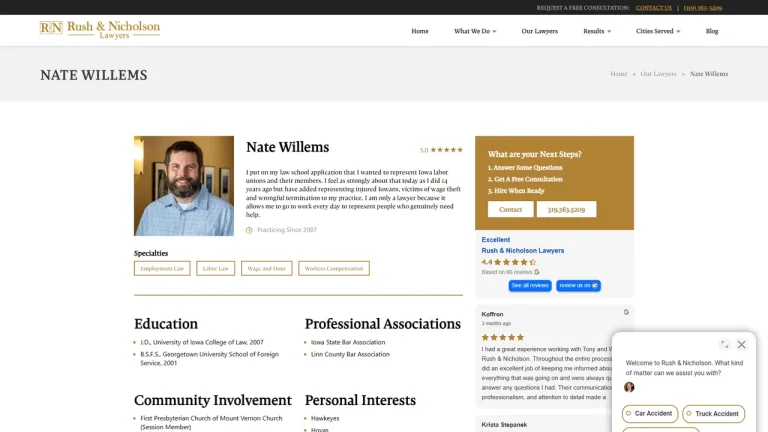
Nate Willems - Cedar Rapids, IA
Iowa Legal Aid - Waterloo, IA
Hugh M. Field, Attorney at Law - Waterloo, IA
Sherinian & Hasso Law Firm - Des Moines, IA
Lane & Waterman LLP - Davenport, IA
Roberts, Stevens & Prendergast P.L.L.C. - Waterloo, IA
Stephen T. Fieweger, P.C. - Davenport, IA

Sinkevich Law Firm PLLC - Des Moines, IA

Iowa Legal Aid - Des Moines, IA

Ahlers & Cooney PC - Des Moines, IA

Wage Dispute Jurisdiction & Enforcement Across Iowa
Recovering unpaid compensation, disputed bonuses, earned commissions, or overtime pay in Iowa is governed primarily by state labor laws and court precedents. Wage claims are litigated within the Iowa District Courts across the eight judicial election districts, including major dockets in Polk County (Des Moines), Linn County (Cedar Rapids), Scott County (Davenport), Black Hawk County (Waterloo), and Woodbury County (Sioux City). Electronic pleadings, discovery requests, and dispositive motions are managed through the Iowa Judicial Branch's Electronic Document Management System (EDMS).
Administrative oversight of wage claims is provided by the Iowa Division of Labor Services within Iowa Workforce Development (IWD). When an employer fails to issue paychecks on designated regular paydays or takes unauthorized wage deductions, workers have a powerful private cause of action under the Iowa Wage Payment Collection Act. Attorneys practicing employment law must be admitted by the Iowa Supreme Court and adhere to the Rules of Professional Conduct maintained by the Iowa State Bar Association (ISBA).
Hiring seasoned Iowa wage and hour counsel is essential to maximizing your financial recovery. Experienced lawyers audit payroll registries, analyze complex employee exemption classifications, and apply statutory fee-shifting rules that require non-compliant employers to pay employee legal fees and liquidated damages.
Iowa Wage & Hour Legal Fee Structures & Recovery Scenarios
| Case Scenario | Fee Structure | Estimated Cost (USD) | Key Cost Determinants |
|---|---|---|---|
| Unpaid Final Wages & Illegal Paycheck Deductions | Contingency / Statutory Fee-Shifting | $0 Upfront ($500 - $1,500 advanced costs) | Pay stub records, lack of written employee authorization, clear violation of Chapter 91A timeline rules. |
| Individual Misclassification & Overtime Wage Claim | Contingency / Fee-Shifting | $0 Upfront ($2,500 - $7,500 advanced costs) | Job duties test under state law, reconstruction of off-the-clock hours, calculation of regular rate of pay. |
| Collective / Class Action Unpaid Time & Meal Breaks | Contingency Fee (33.3% - 40%) | $0 Upfront ($15,000 - $50,000 advanced costs) | Size of employee group, digital time clock audit trails, corporate payroll records discovery via EDMS. |
| Employer Defense in Disputed Commission / Wage Claims | Hourly Retainer ($275 - $475/hr) | $4,000 - $12,500+ | Written commission agreements, bona fide good-faith dispute defense under Chapter 91A, settlement terms. |
Critical Legal Deadlines & Statutes in Iowa
Wage claims in Iowa are bounded by strict statutory filing windows. Under Iowa Code § 614.1(8), actions founded on claims for wages or for a liability or penalty for failure to pay wages must be commenced within two (2) years after the cause of action accrued. Failing to file an action in court or submit an administrative claim within this two-year period forever bars recovery.
Employee wage rights are protected under the Iowa Wage Payment Collection Act, codified at Iowa Code § 91A.1. Under Iowa Code § 91A.3, employers are obligated to pay all wages due at consistent intervals on regular paydays, and final wages must be delivered by the next scheduled payday. Deductions from wages are strictly prohibited by Iowa Code § 91A.5 unless authorized by law or explicitly permitted in writing by the employee for their personal benefit. If an employer intentionally fails to pay wages, Iowa Code § 91A.8 imposes liability for unpaid wages plus statutory liquidated damages of up to an additional 100% of the unpaid balance, together with mandatory payment of the employee's reasonable attorney fees. Minimum wage requirements are established under Iowa Code § 91D.1.
Small Claims Limitations vs. District Court Wage Litigation
Under Iowa Code § 631.1, the Small Claims Division in Iowa has a monetary ceiling of $6,500. While a worker owed a single small wage payment can file pro se in Small Claims, complex claims involving ongoing overtime violations, misclassification, or multiple pay periods rapidly exceed this threshold.
Filing in Small Claims requires waiving any portion of a claim exceeding $6,500. Furthermore, because Iowa Code § 91A.8 provides mandatory attorney fee-shifting, workers do not need to settle for small claims procedures or represent themselves. Experienced wage and hour attorneys handle legitimate wage theft cases on a contingency or fee-shifting basis, meaning the worker pays zero upfront legal fees and the non-compliant employer pays the legal costs upon resolution in the Iowa District Court.
Red Flags to Avoid When Selecting an Iowa Wage & Hour Lawyer
- Law firms demanding upfront hourly payments or retainers from employees for straightforward unpaid wage or overtime claims that carry statutory fee-shifting.
- Attorneys who fail to demand full statutory liquidated damages under Iowa Code § 91A.8, leaving money on the negotiating table.
- Failing to act before the expiration of the strict two-year statute of limitations under Iowa Code § 614.1(8).
- Attorneys who accept employer claims of 'salaried exemption' without evaluating actual day-to-day job duties.
Frequently Asked Questions
What is the statute of limitations for unpaid wages in Iowa?
Under Iowa Code § 614.1(8), an employee has exactly two years from the date wages were earned and unpaid to file a lawsuit in court or submit an administrative claim.
Can an employer in Iowa deduct cash register shortages from paychecks?
No. Pursuant to Iowa Code § 91A.5, an employer cannot deduct cash register shortages, broken equipment costs, or customer unpaid tabs from an employee's wages without voluntary, written authorization from the employee.
What penalties can an employer face for failing to pay wages in Iowa?
Under Iowa Code § 91A.8, if an employer intentionally withholds wages, the court must award the employee the unpaid wages plus liquidated damages up to the full amount of unpaid wages, along with court costs and attorney fees.
Does Iowa law require payment of unused vacation time upon separation?
Under Iowa Code § 91A.3, whether accrued and unused vacation or PTO must be paid upon termination depends on the employer's written employment policy, employee handbook, or employment contract.
When must an Iowa employer issue a final paycheck?
Pursuant to Iowa Code § 91A.3, an employer must issue an employee's final wages no later than the next regularly scheduled payday for the pay period in which the separation occurred.