
Wrongful Termination Lawyers in Kansas
Retaining an experienced Kansas wrongful termination lawyer ensures your rights are protected when unlawful discharge violates state public policy exceptions. Dedicated employment attorneys investigate retaliatory firings, preserve severance rights, and negotiate favorable financial settlements before trial. Explore our verified directory below to schedule a case review with trusted local counsel.

Doyle & Bruce LLC - Kansas City, KS
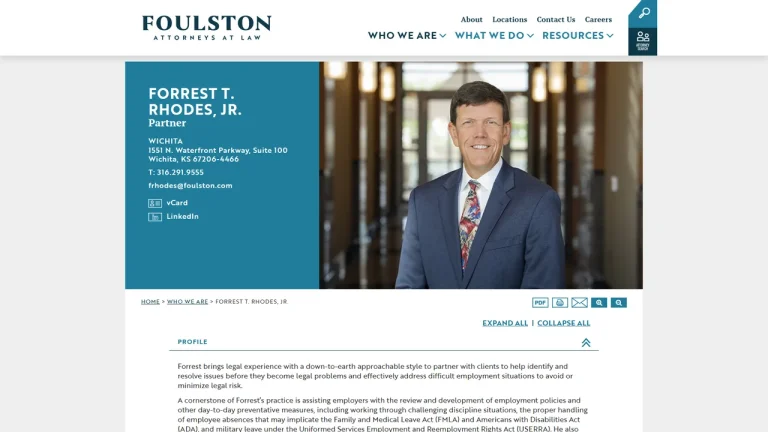
Forrest T. Rhodes Jr. - Wichita, KS

Law Office of Sean M. Dwyer - Wichita, KS

Colantuono Guinn Keppler LLC - Overland Park, KS

Swartz Law, LLC - Overland Park, KS
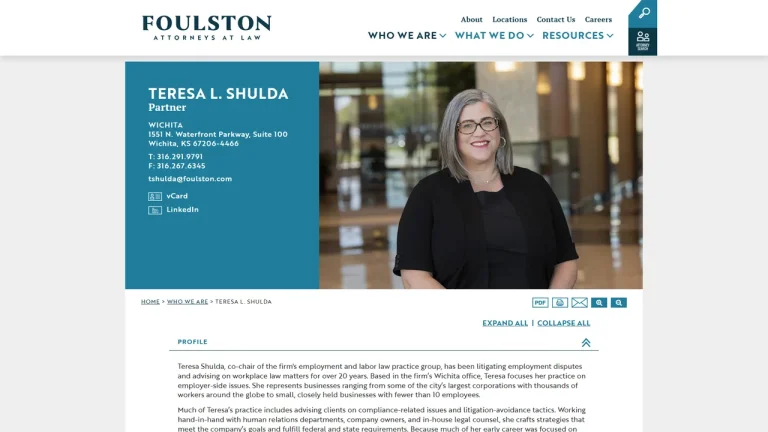
Teresa L. Shulda - Foulston Siefkin LLP - Wichita, KS

Tara Eberline, Attorney at Law - Overland Park, KS

Jackson Lewis PC - Overland Park, KS
Fisher Patterson Sayler Smith - Overland Park, KS
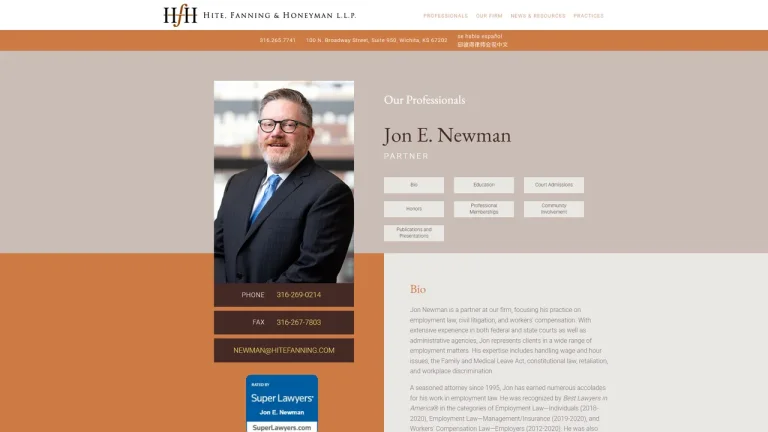
Jon E. Newman - Wichita, KS

Kansas Employee Lawyer - Hite, Fanning & Honeyman, LLP - Wichita, KS
Sean McGivern - Graybill & Hazlewood, L.L.C. - Wichita, KS
Kalberg Law Office L.L.C. - Overland Park, KS
McIntosh Law Offices - Kansas City, KS
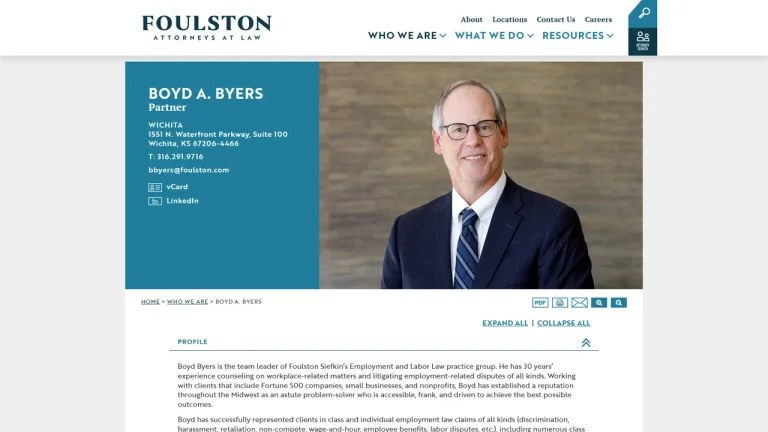
Boyd A. Byers - Wichita, KS

Employee and Labor Law Group of KC - Overland Park, KS
Galdean Law Firm - Wichita, KS
The Law Office of Robert R. Lee II - Wichita, KS

Dugan Schlozman - Overland Park, KS
McAnany, Van Cleave and Phillips, P.A. - Kansas City, KS
Evans & Dixon, LLC - Overland Park, KS
Liesmann Law - Topeka, KS
Snyder Law Firm LLC - Overland Park, KS
Challenging Unlawful Discharge Under Kansas Employment Law
While Kansas operates under the doctrine of at-will employment, employers do not possess an unlimited right to terminate workers for illegal or retaliatory reasons. Kansas courts recognize critical public policy exceptions that protect employees fired for reporting illegal corporate misconduct or exercising statutory rights.
Wrongful termination lawsuits are adjudicated across the state's thirty-one judicial districts in the Kansas District Courts, with high-volume employment dockets handled in Johnson County District Court in Olathe, Sedgwick County District Court in Wichita, Shawnee County District Court in Topeka, and Wyandotte County District Court in Kansas City. In cases involving federal statutory claims or diverse parties, actions are litigated in the United States District Court for the District of Kansas.
State court proceedings utilize the Kansas Courts eFiling system. Retaining an employment lawyer admitted to the Kansas Bar Association ensures proper identification of public policy violations, preservation of severance leverage, and aggressive representation during administrative conciliation and civil trial.
Kansas Wrongful Termination Case Scenarios and Fee Benchmarks
| Case Scenario | Fee Structure | Estimated Cost (USD) | Key Cost Determinants |
|---|---|---|---|
| Workers' Compensation Retaliatory Discharge Settlement | Contingency Fee (33.33% - 40%) | $0 Upfront (Contingency Basis) | Proximity of termination to injury report under K.S.A. 44-501, pretextual performance write-ups, and back-pay totals. |
| Whistleblower Retaliation Under Public Policy | Contingency or Hybrid Retainer | $0 Upfront ($3,000 - $7,500 Hybrid Retainer) | Clear evidence of reporting illegal regulatory violations, internal complaints documentation, and employer retaliatory animus. |
| Kansas Wage Payment Act Retaliatory Termination | Contingency or Hourly Rate ($275 - $475/hr) | $2,500 - $9,000 | Unpaid commissions or wage withholdings under K.S.A. 44-313, statutory penalty interest calculations, and mediation progress. |
| Executive Breach of Implied Employment Contract Trial | Retainer + Hourly Billing ($350 - $600/hr) | $15,000 - $45,000+ | Employee handbook language under Kansas implied contract case law, stock option vesting terms, and District Court trial length. |
Critical Legal Deadlines & Statutes in Kansas
Terminated employees in Kansas must act promptly to preserve their legal claims under strict statutory limitations. For common law tort claims alleging retaliatory discharge in violation of public policy-such as termination for filing a workers' compensation claim under K.S.A. § 44-501 or whistleblowing on illegal health and safety violations-the action carries a two-year statute of limitations pursuant to K.S.A. § 60-513(a)(4). Under Kansas Supreme Court precedent, private employment contracts attempting to shorten this statutory two-year limitations period are void as against public policy.
If a wrongful termination is based on discrimination or civil rights retaliation under the Kansas Act Against Discrimination codified at K.S.A. § 44-1001, the employee must exhaust administrative remedies by filing a charge with the Kansas Human Rights Commission (KHRC) within strictly six months (one hundred eighty days) from the date of the firing under K.S.A. § 44-1005(i). Retaliation against workers asserting wage rights is protected under the Kansas Wage Payment Act at K.S.A. § 44-313 and K.S.A. § 44-315, which provides statutory penalties for willful non-payment of earned wages.
Small Claims Court Jurisdictional Bar vs. District Court Employment Litigation
The Small Claims Procedure Act under K.S.A. § 61-2701 governs simplified claims in Kansas, setting a monetary jurisdictional ceiling of $10,000 pursuant to K.S.A. § 61-2703. However, small claims courts are legally barred from providing relief in wrongful termination disputes. Under K.S.A. § 61-2707(a), attorneys are prohibited from representing parties in small claims hearings prior to judgment, and the small claims procedure provides no mechanism for depositions, interrogatories, or equitable remedies.
Wrongful termination litigation requires formal discovery tools to compel an employer's internal human resources notes, executive emails, and comparative employee personnel records. Because proving retaliatory motive requires demonstrating that the employer's stated reason was a pretext, these claims must be brought in the Kansas District Court or federal court. Retaining experienced employment counsel levels the playing field against corporate defense law firms and ensures all economic and emotional distress damages are properly asserted.
Red Flags When Selecting a Kansas Wrongful Termination Lawyer
- Attorneys who promise guaranteed monetary recoveries before reviewing employment contracts, severance agreements, and personnel files.
- Failing to identify and advise on the strict six-month administrative deadline under K.S.A. § 44-1005(i) for retaliatory terminations connected to civil rights.
- Counsel who advises signing an employer's severance agreement with a broad liability release before assessing viable public policy retaliation claims.
- Law firms that demand expensive upfront retainers without evaluating contingency or hybrid fee arrangements for displaced workers.
Frequently Asked Questions
What qualifies as wrongful termination in Kansas?
Wrongful termination occurs when an employer discharges an employee in violation of established public policy exceptions-such as firing a worker for filing a workers' compensation claim or whistleblowing on illegal activities-or in violation of civil rights statutes, wage laws, or express employment contracts.
Can I be fired for filing a workers' compensation claim in Kansas?
No. Terminating an employee for exercising their statutory rights under the Kansas Workers Compensation Act (K.S.A. § 44-501) is an actionable common law tort of retaliatory discharge in Kansas courts.
What is the statute of limitations for a wrongful termination lawsuit in Kansas?
Under K.S.A. § 60-513(a)(4), common law claims for retaliatory discharge must be filed in Kansas District Court within two years of termination. However, statutory claims under civil rights laws require an initial administrative filing with the KHRC within six months under K.S.A. § 44-1005(i).
How does Kansas law protect whistleblowers who report employer wrongdoing?
Under Kansas Supreme Court case law, employees who in good faith report infractions of rules, regulations, or laws pertaining to public health, safety, and the general welfare to internal management or external law enforcement are protected against retaliatory termination.
What damages can I recover in a Kansas wrongful discharge case?
Prevailing plaintiffs may recover economic damages (back pay, front pay, and lost benefits), non-economic damages for emotional distress and damage to professional reputation, and, in cases of willful or malicious employer conduct, punitive damages under Kansas law.