
Power of Attorney Lawyers in Philadelphia
Retain an experienced Philadelphia power of attorney lawyer to safeguard financial assets and personal healthcare choices under Pennsylvania statutory standards. Custom legal directives prevent costly guardianship petitions and shield vulnerable family members from exploitation. Review our curated Philadelphia directory below to consult an estate planning attorney today.

Saul Ewing LLP - Philadelphia, PA

Bratton Law Group - Philadelphia, PA

Clair M Stewart, Attorney at Law - Philadelphia, PA

Frank Campese Jr Esq PC - Philadelphia, PA

Law Offices of Daniel W. Katz Esquire, LLC - Philadelphia, PA

Law Offices of Allen B. Dubroff, LLC - Philadelphia, PA

Commons & Commons LLP - Philadelphia, PA

McGill & LaNoce - Philadelphia, PA
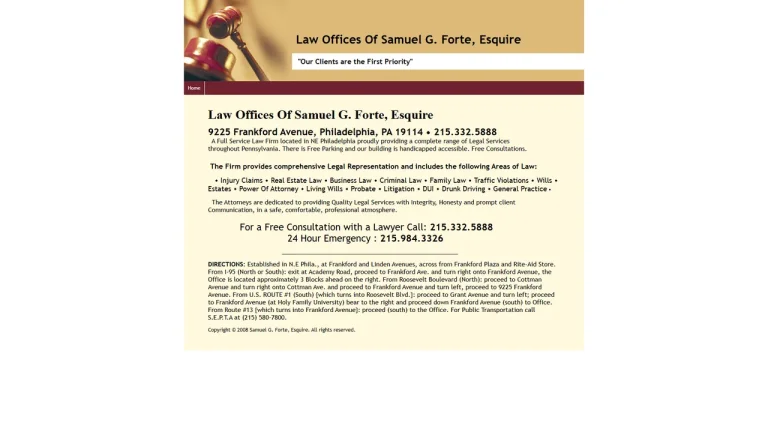
Law Offices Of Samuel G. Forte - Philadelphia, PA

Christian Legal Clinics of Philadelphia, PA

Diamond Polsky & Bauer - Philadelphia, PA

Temple Legal Aid Office - Philadelphia, PA

McCarthy Weidler P.C. - Philadelphia, PA

Family Law Corp. - Philadelphia, PA

Briggs Law Office - Philadelphia, PA
Law Office of Pearlette V. Toussant LLC - Philadelphia, PA

Dilworth Paxson LLP - Philadelphia, PA

Obermayer Rebmann Maxwell & Hippel LLP - Philadelphia, PA

Center City Notary & Apostille Co. - Philadelphia, PA

Brenner & Brenner - Philadelphia, PA
Law Office of Alison Altman Gross - Philadelphia, PA

Kivitz & Kivitz, P.C. - Philadelphia, PA

Daiello Law - Philadelphia, PA

Metka Law, LLC - Philadelphia, PA
Philadelphia Power of Attorney & Fiduciary Governance
Establishing an enforceable power of attorney in Philadelphia requires careful adherence to the Pennsylvania Probate, Estates and Fiduciaries Code. Fiduciary appointments and disputed authority matters in Philadelphia County are adjudicated before the Orphans Court Division of the Philadelphia Court of Common Pleas, located inside historic City Hall. Whether designating a trusted agent for financial decision-making or drafting an advance healthcare directive, legal counsel ensures documents satisfy stringent Commonwealth statutory execution rules.
Healthcare facilities across Philadelphia-including the Hospital of the University of Pennsylvania, Temple University Hospital, and Thomas Jefferson University Hospital-strictly inspect medical powers of attorney and living wills before honoring third-party surrogate consent. Similarly, regional financial institutions and credit unions in Center City require precise statutory authorizations before allowing designated agents to manage bank accounts, disburse funds, or transfer real estate deeds registered with the Philadelphia Department of Records.
When a power of attorney is poorly drafted, vague, or missing mandatory statutory warnings, family members often encounter institutional refusal, leaving them unable to pay medical providers or manage family property. In scenarios involving cognitive decline or medical emergencies, having a properly structured durable power of attorney circumvents the delay and substantial expense associated with contested adult guardianship litigation.
Power of Attorney & Fiduciary Representation Costs
| Case Scenario | Fee Structure | Estimated Cost (USD) | Key Cost Determinants |
|---|---|---|---|
| Durable Financial Power of Attorney (Standard Estate Package) | Flat Fee / Package | $500 - $1,500 | Scope of agent authority, inclusion of specific hot powers, and asset portfolio coordination. |
| Combined Estate Bundle (Financial POA, Healthcare Directive, Living Will) | Flat Fee / Estate Retainer | $1,200 - $3,500 | Degree of medical directive customization, HIPAA disclosures, and digital asset provisions. |
| Contested Agent Accounting & Fiduciary Breach Petitions | Hourly Rate ($325 - $600/hr) | $5,000 - $20,000+ | Forensic financial auditing volume, petition drafting, and Orphans Court evidentiary hearings. |
| Emergency Incompetency & Court Guardianship Proceedings | Hourly Retainer ($350 - $650/hr) | $4,000 - $15,000 | Medical expert testimony, court-appointed counsel fees, and disputed familial cross-petitions. |
Critical Legal Deadlines & Statutes in Pennsylvania
Power of attorney instruments in Philadelphia are strictly regulated under Pennsylvania Act 95, codified in the PEF Code at 20 Pa. C.S. § 5601. For a financial power of attorney to be legally valid in the Commonwealth, it must contain the verbatim capital-letter statutory notice signed by the principal under 20 Pa. C.S. § 5601(c) and an executed agent acknowledgment form under 20 Pa. C.S. § 5601(d). The document must be signed before two independent witnesses and acknowledged before a commissioned notary public.
Healthcare powers of attorney and living will directives operate under 20 Pa. C.S. § 5454, which governs surrogate decision-making upon physician certification of the principal lack of decisional capacity. When family members suspect an agent is misappropriating funds or failing to act in the principal best interests, an action for formal fiduciary accounting may be brought before the Orphans Court under 20 Pa. C.S. § 5610. If no valid power of attorney exists and sudden incapacity occurs, interested parties must initiate emergency guardianship proceedings pursuant to 20 Pa. C.S. § 5511.
Small Claims Limits vs. Professional Representation
While the Philadelphia Municipal Court possesses jurisdiction over low-level breach of contract and monetary debt claims up to $12,000, it lacks jurisdictional authority over fiduciary accounting, agency revocation, and competency determinations. All disputes involving power of attorney validity, alleged fiduciary self-dealing, or contested guardianship fall within the exclusive jurisdiction of the Philadelphia County Court of Common Pleas Orphans Court Division.
Attempting to execute self-drafted or standardized online power of attorney forms routinely leads to document rejection by Philadelphia banks and title insurance carriers. Generic internet forms frequently fail to comply with Pennsylvania statutory disclosure rules or inadvertently grant dangerous hot powers, such as gifting rights or beneficiary alterations. Retaining a qualified Philadelphia attorney guarantees that your documents strictly adhere to Commonwealth statutes and withstand future institutional or judicial scrutiny.
Red Flags When Hiring a Philadelphia Power of Attorney Lawyer
- Reliance on standardized boilerplate templates that lack mandatory Pennsylvania statutory notices under Act 95.
- Failure to explain hot powers, such as the authority to make gifts, alter trusts, or change retirement account beneficiaries.
- Willingness to draft or execute instruments without privately confirming the principal legal competence and voluntary intent.
- Attorneys who do not maintain active standing with the Disciplinary Board of the Supreme Court of Pennsylvania.
Frequently Asked Questions
What makes a financial power of attorney legally valid in Pennsylvania?
Under 20 Pa. C.S. § 5601, a valid financial power of attorney must contain the statutory notice signed by the principal, an executed acknowledgment of fiduciary duty signed by the agent, and must be witnessed by two adults and notarized.
What is the difference between a durable and a springing power of attorney?
A durable power of attorney remains effective immediately upon signing and continues through any subsequent incapacity. A springing power of attorney takes effect only after a physician formally certifies that the principal has become incapacitated.
Where are power of attorney challenges heard in Philadelphia?
Disputes regarding an agent fiduciary conduct, allegations of financial abuse, or petition challenges are heard in the Orphans Court Division of the Philadelphia Court of Common Pleas, located at Philadelphia City Hall.
Can a power of attorney avoid the need for court guardianship?
Yes. Executing comprehensive financial and healthcare powers of attorney while competent allows a trusted agent to step in immediately, eliminating the delay, public exposure, and high cost of filing an Orphans Court guardianship petition under 20 Pa. C.S. § 5511.
Can a Philadelphia bank refuse to accept a power of attorney?
Under Pennsylvania law, financial institutions may reject a power of attorney if it lacks required statutory notices, is more than ten years old without confirmation, or if there is reasonable cause to believe the document is invalid or the agent is acting beyond their authority.