
Wage & Hour Lawyers in Texas
Consulting a skilled wage and hour lawyer in Texas ensures your earned pay, overtime, and commissions are recovered under state and federal statutes. Dedicated labor counsel investigates illegal deductions and worker misclassification to secure unpaid compensation through administrative or court proceedings. Explore our statewide directory below to connect with an experienced Texas wage and hour attorney.

Space City Law Firm - Houston, TX

The Melton Law Firm - Austin, TX

Masterly Legal Solutions - Dallas, TX

Stewart Law Group PLLC - Dallas, TX

Brown & Fortunato - Amarillo, TX

Tremain Artaza PLLC - Dallas, TX

Cozen O'Connor - Dallas, TX

Hansum Law Firm, PLLC - Austin, TX
The Law Offices of James N. Francis - Dallas, TX
Iacuone McAllister Potter PLLC - Dallas, TX

Carrier Law Group, P.C. | Melody Chappell Carrier - Beaumont, TX
Anderson Alexander, PLLC - Corpus Christi, TX

The Law Offices of Filteau & Sullivan, LTD., LLP - Houston, TX

Upton Mickits Heymann - Corpus Christi, TX
Texas RioGrande Legal Aid - Brownsville, TX

Leeds Law Firm, PLLC - Houston, TX

Texas RioGrande Legal Aid - Austin, TX

Ross Scalise Employment Lawyers - Austin, TX
Dykema Gossett PLLC - Dallas, TX
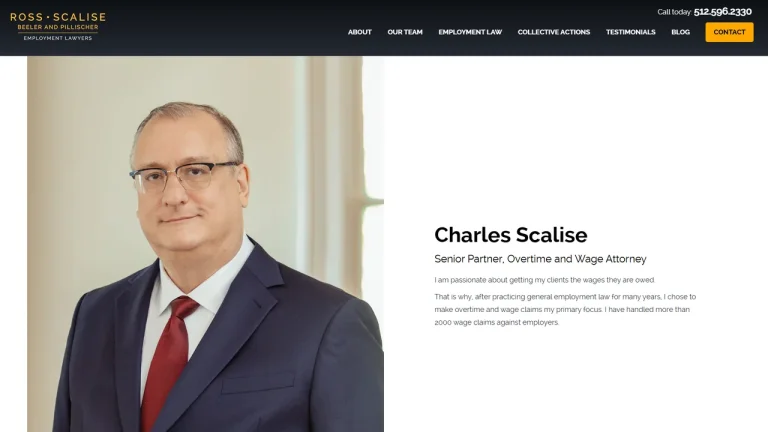
Charles Scalise - Austin, TX

Law Office of R.S. Ghio, P.C. - Arlington, TX

Munden Kathleen - Fort Worth, TX
Farrow-Gillespie Heath Wilmoth LLP - Dallas, TX
Enforcing Texas Wage & Hour Laws Across State Jurisdictions
Wage and hour enforcement across Texas is anchored by the Texas Payday Law, administered by the Texas Workforce Commission (TWC) in Austin, and the federal Fair Labor Standards Act (FLSA), enforced by the U.S. Department of Labor. Aggrieved workers can pursue unpaid earnings through administrative claims or direct civil litigation.
Unlawful compensation practices frequently affect workers in energy extraction and refining in the Permian Basin and Gulf Coast, logistics, construction, and corporate operations in Dallas, Fort Worth, and Houston, and hospitality sectors across Austin and San Antonio. Dedicated attorneys review digital timecard logs, independent contractor classifications, and commission agreements to identify systemic payroll violations.
Litigation over unpaid overtime and minimum wages is frequently conducted in the U.S. District Courts for the Northern, Southern, Eastern, or Western Districts of Texas, or within Texas County Civil Courts at Law and District Courts. Electronic filings are managed through eFileTexas and federal CM/ECF. Retaining an attorney licensed by the State Bar of Texas ensures aggressive representation and full recovery of liquidated damages.
Fee Structures for Texas Wage & Hour Recovery
| Case Scenario | Fee Structure | Estimated Cost (USD) | Key Cost Determinants |
|---|---|---|---|
| Unpaid Final Paycheck / Commission Demand | Contingency or Hourly | $250 - $450 / hour or 33.3% | Written bonus or commission agreement terms, employer responsiveness to formal demand. |
| FLSA Individual Overtime Lawsuit | Contingency Fee (Statutory) | 33.3% - 40% (Employer Pays) | Exemption misclassification proofs, off-the-clock timecard audits, willful violation evidence. |
| FLSA Collective Action Litigation | Contingency (Court-Approved) | 33.3% - 40% of common fund | Class size, multi-location electronic payroll discovery, nationwide opt-in administration. |
| Executive Deferred Compensation Dispute | Hybrid / Retainer | $400 - $700 / hour | Stock option agreements, incentive plan covenants, severance contract interpretations. |
Critical Legal Deadlines & Statutes in Texas
Unpaid compensation claims in Texas are governed by tight statutory deadlines. Under the Texas Payday Law, an administrative wage claim must be filed with the TWC no later than 180 days after the date the wages were originally due pursuant to Tex. Lab. Code § 61.051(c). For discharged employees, employers must issue final compensation within six calendar days of termination under Tex. Lab. Code § 61.014(a), whereas employees who resign must be paid by the next regularly scheduled payday under Tex. Lab. Code § 61.014(b).
Federal overtime and minimum wage actions filed under the Fair Labor Standards Act are governed by 29 U.S.C. § 255(a), which provides a two-year statute of limitations for standard violations, extending to three years if the employer committed a willful violation. Under 29 U.S.C. § 216(b), prevailing employees are entitled to recover 100% liquidated damages (double damages) and mandatory attorney fees, creating substantial financial leverage against non-compliant employers.
Justice of the Peace Jurisdiction vs. Federal Collective Actions
The Texas Justice of the Peace Court possesses civil jurisdiction over claims up to $20,000 under Tex. Gov't Code § 27.031. If an employee is owed a single unpaid paycheck or a modest commission check under $20,000, filing a small claims petition in JP Court provides an affordable, expedited process without procedural discovery hurdles.
However, when systemic wage violations occur-such as misclassifying oilfield workers, nurses, or IT staff as exempt salaried employees or independent contractors-damages rapidly surpass $20,000 once liquidated damages are applied under 29 U.S.C. § 216(b). JP Courts cannot handle multi-employee collective actions or compel extensive corporate electronic discovery. Retaining an experienced Texas wage and hour lawyer ensures that statutory fee-shifting is utilized to compel the employer to pay your legal fees while securing full double damages in federal or state District Court.
Red Flags to Avoid When Selecting Wage & Hour Counsel
- Missing the 180-Day TWC Payday Deadline: Beware of attorneys who overlook the strict 180-day limitation window for filing state administrative claims under Tex. Lab. Code § 61.051(c).
- Charging High Upfront Retainers for Wage Claims: Because federal law mandates employer-paid legal fees for prevailing workers under 29 U.S.C. § 216(b), reputable wage firms operate on contingency.
- Failing to Pursue Liquidated Damages: Steer clear of practitioners who seek only back pay without pursuing mandatory double damages available under federal labor statutes.
- Lack of Experience with Texas Federal Courts: Ensure your attorney regularly litigates before U.S. District Courts in Texas where complex FLSA collective actions are adjudicated.
Frequently Asked Questions
How long do I have to file a wage claim under the Texas Payday Law?
Under Tex. Lab. Code § 61.051(c), you must file a wage claim with the Texas Workforce Commission within 180 days after the date the wages were due for payment.
When must a Texas employer issue a final paycheck after firing an employee?
Pursuant to Tex. Lab. Code § 61.014(a), an employee who is discharged or laid off must be paid in full within six calendar days of termination.
What is the statute of limitations for unpaid overtime in Texas?
Under the federal FLSA (29 U.S.C. § 255(a)), the statute of limitations is two years, but extends to three years if the employer willfully violated the law.
Can my employer deduct money from my paycheck in Texas?
Under Tex. Lab. Code § 61.018, employers cannot make payroll deductions unless authorized by law, ordered by a court, or authorized in writing by the employee.
Who pays attorney fees in a successful Texas overtime lawsuit?
Under 29 U.S.C. § 216(b), prevailing employees are entitled to have all reasonable attorney fees and litigation court costs paid by the employer.