
Specialty Courts (Drug, Family, Juvenile) in Chicago
Specialty courts in Chicago deliver targeted judicial oversight and restorative alternatives for substance rehabilitation, parental disputes, and juvenile matters across Cook County. Navigating these problem-solving dockets requires understanding specialized entry criteria, clinical assessments, and strict compliance milestones. Consult our directory below to find Chicago specialty court contacts, program administrators, and family resources.
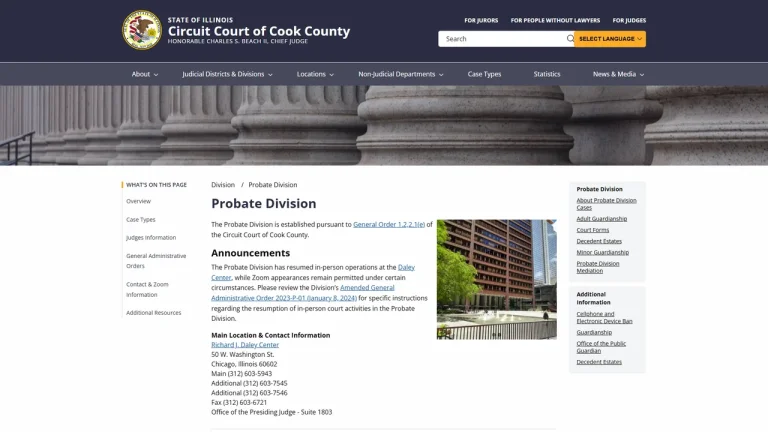
Circuit Court of Cook County - Probate Division (Daley Center) - Chicago, IL

Problem-Solving and Specialized Court Dockets in Cook County
Specialty and problem-solving courts in Chicago represent an innovative branch of the Circuit Court of Cook County designed to address root behavioral issues rather than relying solely on traditional punitive measures. These dockets integrate intensive judicial monitoring, clinical rehabilitation, and community support networks. Key problem-solving divisions operate out of major county justice facilities, including the Leighton Criminal Court Building at 26th and California and suburban municipal courthouses, offering structured diversion programs for eligible individuals.
Among the most established problem-solving tracks is the Cook County Drug Treatment Court, functioning under statutory authorization of 730 ILCS 166/, which routes non-violent offenders into supervised treatment as an alternative to prison sentences. Related problem-solving programs include the Mental Health Court, authorized under 730 ILCS 168/, and the Veterans Treatment Court, established pursuant to 730 ILCS 167/, tailored to active servicemembers and honorably discharged military veterans dealing with service-related trauma.
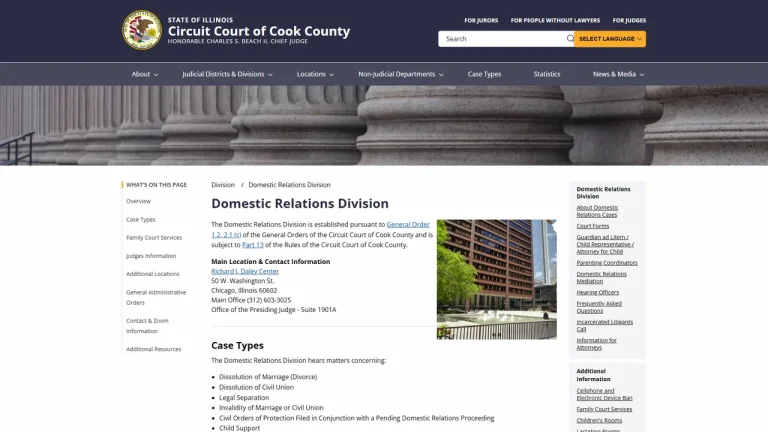
Family and juvenile matters are administered in dedicated facilities across the city. The Domestic Relations Division at the Richard J. Daley Center (50 W. Washington St.) oversees family matters including divorce, legal separation, and the allocation of parental responsibilities. Juvenile justice and child protection cases are centralized at the Cook County Juvenile Court Center at 1100 S. Hamilton Avenue-the site of the first juvenile court in the world-governed by the Juvenile Court Act of 1987 under 705 ILCS 405/.
Specialty Court Programs, Entry Requirements, and Milestones
| Service / Matter | Required Documents / Prerequisites | Statutory Fee (USD) | Processing Timeline |
|---|---|---|---|
| Drug Court Diversion Application (730 ILCS 166/) | Clinical diagnostic evaluation, state attorney screening consent | $0 program fee (assessment fees may apply) | 2 - 4 weeks for clinical and legal screening |
| Parenting Plan / Custody Allocation Petition | Petition for Allocation, Uniform Child Custody Affidavit | $250 - $388 filing fee (fee waiver available) | 30 - 60 days to initial case management conference |
| Juvenile Record Expungement Petition | Certified juvenile arrest report, verified expungement petition | $0 statutory fee under Illinois juvenile law | 60 - 90 days for state police and judicial review |
| Veterans Court Transfer Motion (730 ILCS 167/) | Form DD-214, VA medical assessment, formal transfer motion | $0 transfer fee | 14 - 30 days pending judicial assessment |
Critical Legal Deadlines & Statutes in Illinois
Proceedings within Chicago specialty and juvenile divisions operate under rigorous legal timetables. In juvenile child protection cases, 705 ILCS 405/2-9 mandates that when a minor is taken into temporary protective custody by law enforcement or the Illinois Department of Children and Family Services (DCFS), a temporary custody hearing (shelter care hearing) must be held within 48 hours, excluding weekends and court holidays.
In family court proceedings governed by the Illinois Marriage and Dissolution of Marriage Act, parents involved in allocation disputes must submit a proposed parenting plan under 750 ILCS 5/602.7 within 120 days after the service of a petition. For problem-solving diversion programs, the Illinois Drug Court Treatment Act under 730 ILCS 166/ requires participants to complete a treatment regimen lasting typically between 12 and 24 months, with regular random drug testing and judicial compliance hearings scheduled bi-weekly or monthly.
Self-Navigation vs. Representation in Chicago Specialty Courts
Citizens can directly access select administrative and supportive services within specialized courts. In the Domestic Relations Division, parents can independently complete court-mandated Focus on Children parenting webinars, file fee waiver petitions, and access self-help legal desks on the 8th floor of the Daley Center. At the Juvenile Court Center, family members can access court social services and meet with child protection ombudsmen.
However, entering a specialty problem-solving court involves significant legal consequences. Entering drug or mental health court frequently requires executing a conditional guilty plea or waiving specific appellate rights under state statute. If a participant is terminated from the program due to non-compliance, they are subjected to immediate sentencing. Retaining dedicated counsel ensures eligibility criteria are properly vetted, protects constitutional safeguards during sanction hearings, and secures dismissal of original charges upon successful graduation.
Red Flags in Specialty Court Services and Private Programs
- Unaccredited Private Rehabilitation Facilities: Beware of commercial treatment centers promising guaranteed entrance into Cook County Drug Court; eligibility is determined solely by the court team and the Cook County State Attorney Office.
- Unlicensed "Parental Rights Advocates": Avoid non-lawyer consultants who sell informal custody packages; only attorneys licensed by the ARDC can file parenting petitions or represent you in child allocation hearings.
- Fees for Juvenile Record Expungement: Reject services demanding high upfront processing fees for juvenile expungements; Illinois law eliminates filing fees for juvenile record clearing under 705 ILCS 405/5-915.
- Failure to Secure Charge Dismissal Guarantees: Ensure that any specialty diversion agreement formally documents what happens upon completion; without clear written stipulations, participants risk completing programs without resolving underlying charges.
Frequently Asked Questions
What are the eligibility criteria for Cook County Drug Treatment Court?
Under 730 ILCS 166/20, eligibility requires that the defendant be diagnosed with a substance use disorder, have no convictions for violent crimes within the previous 10 years, and express a willingness to participate in intensive treatment. Admission requires approval from the presiding judge and agreement from the prosecution.
Where are juvenile court proceedings held in Chicago?
All juvenile justice and child protection proceedings in Cook County are held at the Juvenile Court Center, located at 1100 S. Hamilton Avenue, Chicago, IL 60612. Juvenile records and hearings are confidential and closed to the general public under Illinois law.
What happens if a participant fails to complete a specialty court program?
If a participant is discharged or terminated from a problem-solving court due to recurring violations or absconding, their case returns to the standard criminal docket. If a conditional guilty plea was entered upon admission, the judge proceeds directly to sentencing under the Illinois Unified Code of Corrections.
What are Restorative Justice Community Courts in Chicago?
Restorative Justice Community Courts (RJCC) are neighborhood-based courts operating in Chicago communities such as North Lawndale, Englewood, and Avondale. They handle non-violent offenses involving young adults aged 18 to 26, using peace circles to resolve conflict, repair community harm, and dismiss charges upon completion of repair agreements.
Where do I file for child custody or parentage in Chicago?
Child custody (allocation of parental responsibilities) and parentage actions are filed with the Domestic Relations Division of the Circuit Court of Cook County, located on the upper floors of the Richard J. Daley Center at 50 W. Washington Street, Chicago.