
Specialty Courts (Drug, Family, Juvenile) in Illinois
Navigating Illinois specialty courts requires understanding how problem-solving dockets, family divisions, and juvenile courts operate across circuit courts. Specialized tracks like drug courts and juvenile justice focus on rehabilitation, treatment, and restorative justice rather than traditional punitive measures. Explore our directory below to locate circuit court specialty divisions, intake coordinators, and community resources throughout Illinois.
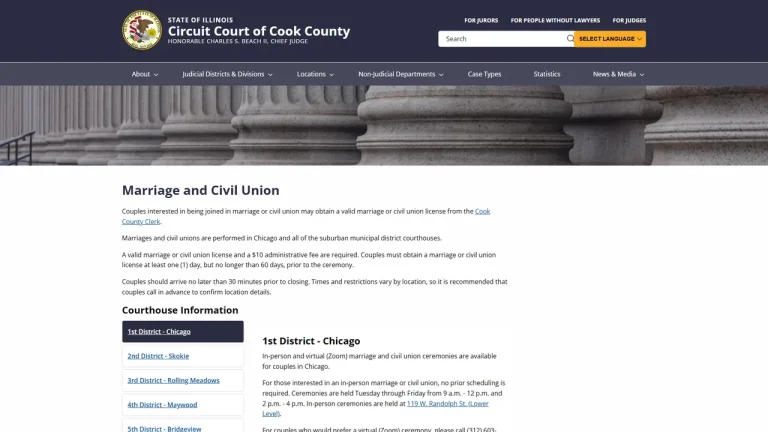

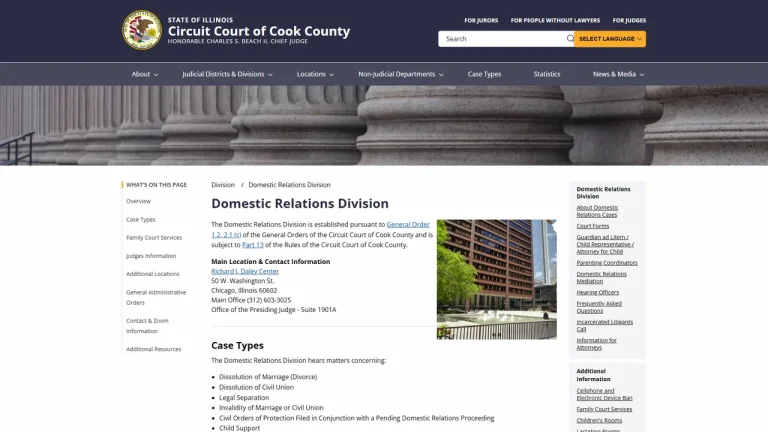

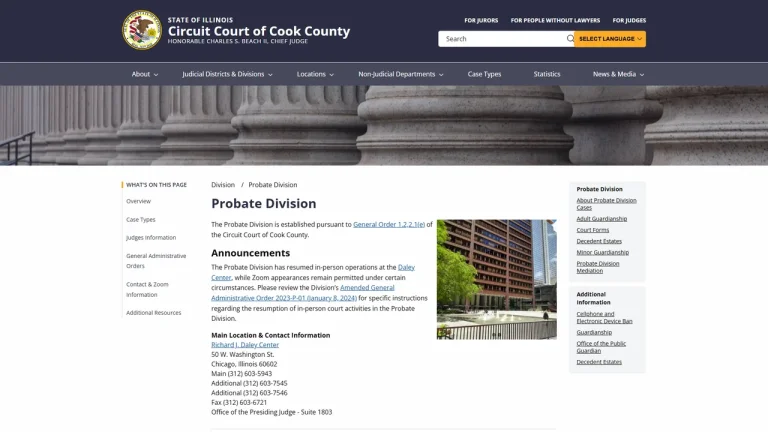
Circuit Court of Cook County - Probate Division (Daley Center) - Chicago, IL
Problem-Solving and Specialty Court Jurisdiction in Illinois
Specialty and problem-solving courts in Illinois operate within the state unified Circuit Court system, structured across 24 Judicial Circuits alongside the Circuit Court of Cook County. Established under legislative frameworks and administrative directives from the Supreme Court of Illinois, these dedicated court divisions diverge from traditional adversarial litigation. Instead, they implement collaborative, therapeutic jurisprudence designed to address the underlying causes of criminal behavior, family dysfunction, and adolescent delinquency through individualized case management, clinical treatment, and frequent judicial oversight.
The Illinois circuit court system manages several distinct categories of specialty dockets. Problem-solving courts primarily encompass Drug Treatment Courts, Mental Health Courts, and Veterans Treatment Courts, operating across high-volume circuits such as Cook County, the 18th Judicial Circuit in DuPage County, the 19th Judicial Circuit in Lake County, and downstate jurisdictions like the 7th Judicial Circuit in Sangamon County. In these dockets, multi-disciplinary teams consisting of circuit judges, assistant state attorneys, public defenders, probation officers, and licensed treatment clinicians coordinate supervised rehabilitation programs as an alternative to statutory terms of incarceration in the Illinois Department of Corrections.
Family Court Divisions and Juvenile Justice Courts maintain distinct statutory jurisdictions within each circuit. Juvenile courts exercise exclusive authority over cases involving minors alleged to be delinquent, abused, neglected, or dependent under the Juvenile Court Act of 1987, operating through dedicated facilities such as the Cook County Juvenile Court Center in Chicago. Family divisions, frequently designated as Domestic Relations Divisions, adjudicate parental responsibility allocations, marital dissolutions, child support enforcement, and emergency protection orders, emphasizing the best interests of minor children and family preservation.
Specialty Court Admissions, Filing Protocols, and Turnaround Timelines
| Service / Matter | Required Documents / Prerequisites | Statutory Fee (USD) | Processing Timeline |
|---|---|---|---|
| Drug Court Program Screening Application | Clinical assessment referral, criminal history review, State Attorney consent | $0.00 intake screening fee (program fees vary) | 14 to 30 days for clinical eligibility review |
| Emergency Order of Protection (EOP) | Petition for Order of Protection, sworn affidavit detailing recent abuse | $0.00 (Statutorily waived under Illinois law) | Same-day ex parte judicial review |
| Juvenile Temporary Detention Hearing | State juvenile delinquency petition, intake custody evaluation | $0.00 statutory court fee | Within 40 statutory hours of physical custody |
| Petition for Allocation of Parental Responsibilities | Petition for Allocation (Form JD-FM), summons, UCCJEA child affidavit | $250.00 to $388.00 (varies by circuit court) | 30-day statutory responsive appearance window |
Critical Statutory Deadlines & Procedural Rules in Illinois Specialty Courts
Participation in specialty courts and family dockets is governed by stringent timelines codified in the Illinois Compiled Statutes. Under the Drug Court Treatment Act, codified at 730 ILCS 166/20, a defendant charged with a non-violent offense must submit to diagnostic screening and secure formal agreement from both the court and the prosecuting authority prior to the entry of an agreed disposition or sentence. Successful completion of the multi-phase program can result in the formal dismissal of criminal charges or early termination of specialized probation.
Juvenile proceedings operate under urgent statutory constraints established in the Juvenile Court Act of 1987. Pursuant to 705 ILCS 405/5-415, when a juvenile is taken into physical custody by law enforcement, an initial detention or shelter care hearing must be held before a circuit judge within 40 hours of detention, excluding weekends and legal court holidays. Failure to conduct this hearing within the mandatory 40-hour window mandates the immediate release of the minor to a parent or legal guardian.
In family matters, Emergency Orders of Protection are governed by the Illinois Domestic Violence Act of 1986 under 750 ILCS 60/214. An emergency order issued ex parte remains effective for a statutory period not to exceed 21 days, during which the respondent must be served with process before a plenary hearing is conducted. In domestic relations litigation involving child custody, parents are required under 750 ILCS 5/602.5 to submit a joint or individual proposed parenting plan within 120 days after service of the initial petition, outlining decision-making responsibilities and parenting time schedules.
Direct Program Navigation vs. Representation by Defense Counsel
Self-represented litigants frequently initiate administrative filings and protective procedures in Illinois courts without an attorney. Filing a petition for an Emergency Order of Protection through circuit court help desks, accessing family court mediation orientation, and completing pro se parent education programs required in domestic relations divisions can be performed directly by petitioners using standardized court forms approved by the Illinois Supreme Court Access to Justice Commission.
However, navigating specialty dockets and juvenile proceedings carries severe legal ramifications that make representation by a licensed Illinois attorney essential. Entering an Illinois drug court or mental health court requires waiving crucial procedural protections, including the right to a speedy trial and the right to a jury trial. Experienced criminal defense counsel evaluates whether the state evidence supports formal suppression motions before a defendant signs an intensive treatment contract. In juvenile justice dockets, where minors face potential transfer to adult criminal court or commitment to the Illinois Department of Juvenile Justice, legal representation is statutorily mandated to protect constitutional rights. Similarly, in high-conflict family court trials involving forensic psychological evaluations and business asset valuations, trial counsel is necessary to navigate the Illinois Rules of Evidence.
Red Flags: Identifying Misleading Treatment Court Solicitations
- Private entities or deceptive websites claiming they can guarantee admission into an Illinois Drug Court or Veterans Court in exchange for upfront cash consulting fees.
- Unlicensed non-attorney document preparation services charging fees to draft emergency protection petitions that circuit court clerks and domestic violence victim advocates provide free of charge.
- Third-party agencies demanding payments to provide fast-track juvenile record expungements without submitting verified petitions through the Illinois circuit court of origin.
- For-profit sober living homes or unauthorized clinicians falsely asserting that their proprietary programs satisfy statutory circuit court probation treatment conditions without court approval.
Frequently Asked Questions
What qualifies a defendant for Drug Treatment Court in Illinois?
Under Illinois statutory law, eligibility generally requires a documented substance use disorder, a pending non-violent criminal charge or probation violation, and a willingness to undergo intensive judicial supervision and outpatient or inpatient therapy. Individuals with convictions for crimes of violence within statutory lookback windows are legally excluded from participation.
What happens if an individual fails to complete an Illinois specialty court program?
If a participant is discharged or terminated from a problem-solving court for non-compliance or new criminal offenses, the stay on traditional criminal proceedings is lifted. The case is returned to the regular trial call or the judge proceeds directly to sentencing based on previously entered conditional guilty pleas.
Are juvenile court records automatically sealed in Illinois?
While juvenile arrest and court records are confidential and shielded from general public disclosure under Illinois law, automatic expungement applies only to specific non-adjudicated offenses or minor misdemeanor offenses. Many juvenile felony adjudications require submitting a formal expungement petition to the circuit court upon reaching adulthood.
How do I file for an Emergency Order of Protection in Illinois?
You can file a petition for an Emergency Order of Protection at the domestic relations or municipal district office of the Circuit Court in the county where you reside, where the respondent resides, or where the abuse occurred. Many circuits provide on-site domestic violence victim assistance programs to assist with paperwork without filing fees.
What is the difference between parental allocation and child custody in Illinois?
Illinois family law eliminated the legal terms custody and visitation. State statute now designates these rights as the allocation of parental responsibilities, which divides major decision-making authority regarding education, health, and extracurricular activities, alongside establishing a specific parenting time schedule.