
Specialty Courts (Drug, Family, Juvenile) in Augusta
Discover specialty court dockets in Augusta, Maine. Access family law resources, juvenile justice programs, and treatment recovery courts operating within the Capital Judicial Center to address sensitive legal matters. Explore our comprehensive directory below to locate specialized judicial personnel, case filing protocols, and support services.
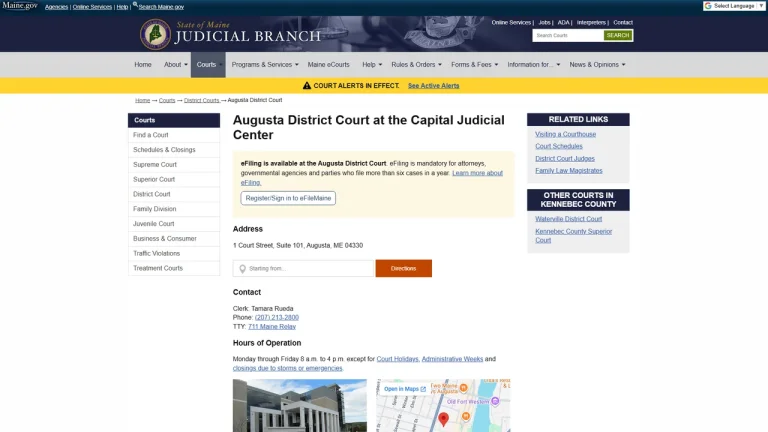



Specialty Dockets & Problem-Solving Courts in Augusta
Specialty courts in Augusta provide focused judicial resolution for sensitive domestic conflicts, juvenile rehabilitation, and substance use disorders. Situated within the Capital Judicial Center at 1 Court Street, these specialized divisions utilize therapeutic and restorative judicial processes rather than conventional adversarial proceedings.
The Family Division of the Maine District Court handles domestic relations dockets, utilizing dedicated Family Law Magistrates to conduct initial case management conferences, calculate statutory child support awards, and supervise mandatory mediation for parental rights disputes. Residents of Augusta, Waterville, Gardiner, and surrounding Kennebec County towns access this division for marital dissolutions and custody determinations.
Juvenile offenses are managed through specialized proceedings under the Maine Juvenile Code in partnership with the Maine Department of Corrections Division of Juvenile Services. In addition, the Kennebec County Treatment Recovery Court provides supervised clinical treatment and intensive case monitoring for eligible individuals facing substance use challenges within the criminal justice system.
Augusta Specialty Court Filings, Eligibility & Statutory Fees
| Service / Matter | Required Documents / Prerequisites | Statutory Fee (USD) | Processing Timeline |
|---|---|---|---|
| Divorce or Parental Rights & Responsibilities Action | Summons, Verified Complaint, Child Support Affidavit, FM Information Sheet | $120.00 filing fee (waiver available) | 4 to 8 months to final decree |
| Petition for Protection from Abuse (PFA) | Sworn Affidavit of Abuse, PFA Complaint Form, Identification | $0.00 statutory fee (exempt by law) | Immediate ex parte; full hearing in 14 to 21 days |
| Treatment Recovery Court Participation Diversion | Clinical Diagnostic Evaluation, DA Referral, Voluntary Plea Agreement | $0.00 entry fee / phase treatment costs | 12 to 18-month structured program |
| Juvenile Informal Adjustment Intake Review | Intake Referral from JCCO, Parental Attendance, Signed Agreement | $0.00 statutory fee | 30 to 60-day intake assessment |
Critical Legal Deadlines & Statutes in Maine
Participating in specialty court divisions in Kennebec County requires strict adherence to statutory deadlines designed to safeguard family welfare and protect the procedural rights of young persons and treatment candidates.
Emergency relief in domestic safety crises is governed by comprehensive protective order legislation. Under 19-A M.R.S. § 4108, the District Court may enter an immediate temporary ex parte protection from abuse order upon a showing of immediate danger, with a mandatory full evidentiary hearing held within 21 days pursuant to 19-A M.R.S. § 4110.
Detention of youth is tightly controlled under the Maine Juvenile Code. Under 15 M.R.S. § 3203-A, a juvenile taken into custody must receive a judicial detention hearing within 48 hours, excluding weekends and court holidays, to evaluate continued detention criteria. Intake officers may also establish informal adjustments without formal court petitions under 15 M.R.S. § 3301.
Specialized treatment dockets operate under legislative authorization established in 4 M.R.S. § 421, integrating evidence-based treatment plans with regular judicial compliance reviews. In family matters, parties disputing parental rights are required to participate in good faith in court-sponsored alternative dispute resolution under 19-A M.R.S. § 251 before proceeding to contested judicial trials.
Direct Court Navigation vs. Retaining Specialized Legal Counsel
Individuals can directly access several essential protections within Augusta's specialty court divisions. Petitioners seeking emergency Protection from Abuse or Protection from Harassment orders can file sworn complaints directly with court clerk staff at the Capital Judicial Center with the assistance of court-based victim advocacy organizations at no financial cost.
However, when family disputes involve contested child custody schedules, high-value asset divisions, or disputed spousal support claims, retaining a dedicated family law attorney is critical. Family Law Magistrates and District Court judges require compliance with evidentiary presentation standards, formal financial disclosures, and the child's best interests standard under state statutory frameworks.
In juvenile justice and treatment court proceedings, legal representation is indispensable. Defense counsel evaluates diversion eligibility, ensures voluntary consent before signing binding recovery court contracts, and protects the juvenile's long-term educational and employment record from formal delinquency adjudications.
Specialty Court Red Flags & Procedural Traps
- Entering a Treatment Recovery Court contract without independent legal counsel examining underlying evidentiary weaknesses in the prosecution's primary criminal charges.
- Utilizing generic non-Maine online document mills for divorce or child custody paperwork that fail to satisfy specific Maine family court disclosure rules and magistrate requirements.
- Failing to submit certified financial affidavits and child support worksheets before mandatory family case management conferences at the Capital Judicial Center.
- Treating juvenile intake meetings with Juvenile Community Corrections Officers (JCCOs) as informal conversations without understanding that statements made can influence formal petition decisions.
Frequently Asked Questions
Where are family and juvenile court matters held in Augusta?
Family law matters, juvenile proceedings, and recovery dockets are heard at the Capital Judicial Center, located at 1 Court Street, Suite 101, in downtown Augusta.
Is there a fee to file a Protection from Abuse petition in Augusta?
No, Maine law exempts petitioners from filing fees, service costs, or administrative charges when submitting a Protection from Abuse or Protection from Harassment petition.
What role do Family Law Magistrates play in the Augusta District Court?
Family Law Magistrates preside over preliminary proceedings in divorce and parental rights cases, establish interim child support awards, manage case schedules, and facilitate mediation conferences.
How does someone qualify for the Kennebec County Treatment Recovery Court?
Eligibility generally requires a pending nonviolent criminal charge, a documented substance use disorder, referral by legal counsel or the District Attorney, and clinical evaluation confirming suitability for intensive judicial supervision.
Are juvenile court records in Augusta open to the public?
Most juvenile proceedings and records are confidential under Maine statutory law to promote rehabilitation, though exceptions exist for specific serious juvenile offenses.