
Jails, Prisons & Detention Centers in New Hampshire
Correctional facilities in New Hampshire are divided between state prisons under the Department of Corrections and ten county-operated adult detention centers. Families and legal counsel can locate inmates, schedule visitation, and navigate bail procedures under New Hampshire law. Review our verified directory below to find county jail coordinates, state prison contacts, and inmate lookup guidelines.





New Hampshire Correctional Jurisdiction & Facility Structure
In the State of New Hampshire, correctional facilities operate under a dual jurisdiction system comprising state-operated penitentiaries and county adult detention centers. Long-term post-conviction incarceration for individuals sentenced to state prison terms exceeding one year is administered by the New Hampshire Department of Corrections (NHDOC), headquartered in Concord under the authority of N.H. Rev. Stat. Ann. § 21-H:1. NHDOC manages major state facilities including the New Hampshire State Prison for Men in Concord, the New Hampshire Correctional Facility for Women in Concord, and the Northern New Hampshire Correctional Facility in Berlin.
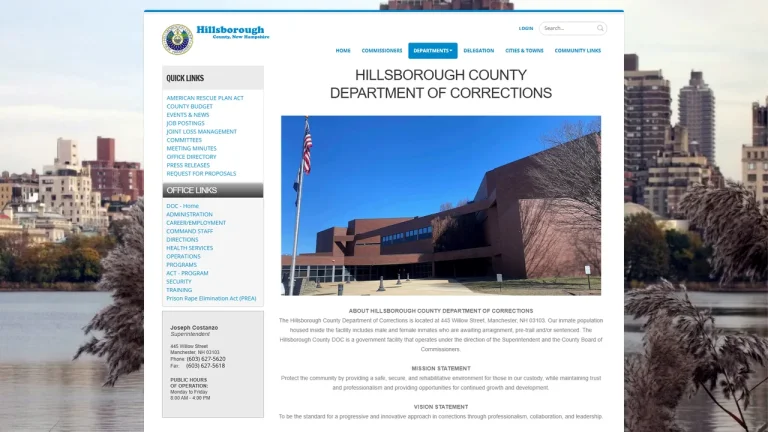
Pretrial detention and sentences of one year or less fall under the exclusive statutory authority of New Hampshire's ten county governments pursuant to N.H. Rev. Stat. Ann. § 30-B:1. Each county operates an independent County Department of Corrections headed by an appointed Superintendent, including high-capacity facilities such as the Hillsborough County Department of Corrections in Manchester, the Rockingham County Department of Corrections in Brentwood, and the Merrimack County Department of Corrections in Boscawen.
Whether seeking to post bail for a newly detained individual, arrange attorney-client contact, or complete visitor registration, citizens must distinguish between county jails housing pretrial detainees and state prisons executing post-sentencing supervision.
Key New Hampshire Correctional Services, Prerequisites & Timelines
| Service / Matter | Required Documents / Prerequisites | Statutory Fee (USD) | Processing Timeline |
|---|---|---|---|
| County Jail Cash Bail Posting | Valid government photo ID, exact cash or certified bank check, and completed bail recognizance form | $0 to $40 statutory bail commissioner fee (N.H. Rev. Stat. Ann. § 597:38) | 1 to 4 hours following booking completion and judicial bail order |
| NHDOC Inmate Visitation Application | Completed NHDOC Visiting Application, criminal background consent, and government photo ID | $0 application fee | 14 to 30 business days for security background screening |
| Inmate Commissary Account Deposit | Inmate booking or DOC identification number, authorized depositor account, and valid payment | $0 state fee; commercial vendor transaction fees apply ($2 to $6) | Immediate to 24 hours for electronic funds posting |
| Attorney Professional Legal Visit Scheduling | Active New Hampshire Bar card, government photo ID, and advance notice to facility records | $0 fee for confidential legal consultations | 24 hours advance notice requested; expedited access for urgent hearings |
Critical Legal Deadlines & Statutes in New Hampshire
Engaging with New Hampshire county detention centers and state prisons requires tracking key procedural deadlines established by state law:
- Statutory Arraignment Timetable: Under N.H. Rev. Stat. Ann. § 594:20-a, any person arrested and held in custody in a county jail without bail must be brought before the Circuit Court District Division or Superior Court for arraignment within 24 hours of arrest, excluding Saturdays, Sundays, and legal holidays.
- Bail Review and Reconsideration: Under N.H. Rev. Stat. Ann. § 597:2, an individual ordered detained or subjected to restrictive bail conditions is entitled to petition the court for a de novo bail hearing or review of bail conditions based on changed financial or personal circumstances.
- Contraband in Penal Facilities: Delivering weapons, controlled substances, cellular phones, or unauthorized articles to a prisoner in a county jail or state prison is a Class B felony under N.H. Rev. Stat. Ann. § 642:9, carrying penalties of up to 7 years in state prison.
- Inmate Administrative Grievances: Under NHDOC administrative rules, state prison inmates must file initial formal grievances within 30 calendar days of the underlying incident to exhaust mandatory administrative remedies before seeking judicial relief.
Direct Agency Access vs. Legal Counsel
Family members and members of the public can handle many routine administrative interactions with New Hampshire correctional facilities pro se. Inquiring about an inmate's booking status via county jail telephone rosters, applying for an approved visiting list with NHDOC, depositing funds through authorized electronic commissary vendors, and communicating through approved prison email systems can be completed directly without hiring an attorney.
However, when an incarcerated person requires legal intervention regarding detention status, sentence computation, or disciplinary actions, retaining a licensed attorney is vital. Securing release from a county jail requires legal advocacy at the arraignment under N.H. Rev. Stat. Ann. § 597:2, where counsel can present evidence supporting personal recognizance, community monitoring, or affordable bail terms. For state prison inmates, challenging unlawful detention or conditions of confinement requires filing a petition for writ of habeas corpus in the New Hampshire Superior Court under N.H. Rev. Stat. Ann. § 534:1, demanding precise legal argumentation and compliance with the New Hampshire Rules of Civil Procedure.
While minor debt and civil property disputes up to $10,000 are adjudicated informally in the New Hampshire Circuit Court District Division small claims docket under N.H. Rev. Stat. Ann. § 503:1, small claims courts have zero authority over jail management, inmate custody conditions, or criminal bail determinations. Correctional disputes require formal legal action before the Superior Court.
Common Red Flags & Regulatory Pitfalls
- Unofficial Inmate Locator Websites: Third-party commercial registries that charge recurring monthly fees to search for inmates whose location can be verified directly and freely through NHDOC or county jail rosters.
- Inadvertent Contraband Violations: Bringing unapproved personal items, prescription medications, or electronic recording devices into secure visiting areas, triggering criminal felony prosecution under N.H. Rev. Stat. Ann. § 642:9.
- Bail Commissioner Impersonation Scams: Phone scammers demanding immediate wire transfers or gift cards to pay bail; genuine New Hampshire bail commissioners or jail clerks collect statutory fees directly at the courthouse or detention facility.
- Failing to Disclose Criminal History on Visiting Forms: Providing inaccurate or incomplete background information on an NHDOC visiting application, which results in permanent denial of visitation privileges.
Frequently Asked Questions
What is the difference between a New Hampshire county jail and a state prison?
New Hampshire county jails are operated by county superintendents under N.H. Rev. Stat. Ann. § 30-B:1 to house pretrial detainees and individuals serving sentences of one year or less. State prisons are run by the NHDOC for individuals convicted of felonies serving sentences over one year.
How do I locate an inmate incarcerated in the New Hampshire state prison system?
You can locate individuals serving state prison sentences using the online Inmate Locator tool on the official New Hampshire Department of Corrections website by entering the individual's legal name or NHDOC inmate number.
How quickly must a person arrested in New Hampshire receive an arraignment hearing?
Under N.H. Rev. Stat. Ann. § 594:20-a, a person arrested and held in custody must be brought before a court for arraignment within 24 hours of arrest, excluding weekends and legal holidays.
What are the statutory rules for posting bail in a New Hampshire county detention center?
Bail must be posted in accordance with conditions ordered by the court or a bail commissioner under N.H. Rev. Stat. Ann. § 597:2, which may include personal recognizance, cash bail, or corporate surety.
What items are considered illegal contraband in New Hampshire correctional facilities?
Under N.H. Rev. Stat. Ann. § 642:9, delivering weapons, alcohol, controlled drugs, prescription medication, telecommunication devices, or unauthorized items to an inmate is classified as a felony offense.