
County Clerk in New Jersey
Accessing county administrative services in New Jersey requires an understanding of the constitutional office of the County Clerk across all 21 counties. County Clerks administer election ballots, certify trade names, process passport applications, and manage historic public archives. Explore our verified statewide directory below to connect directly with county clerk divisions, election administrators, and public registry services.

Hudson County Superior Court - Finance Division (Violations) - Jersey City, NJ


Essex County Clerk - Passport Services - Newark, NJ

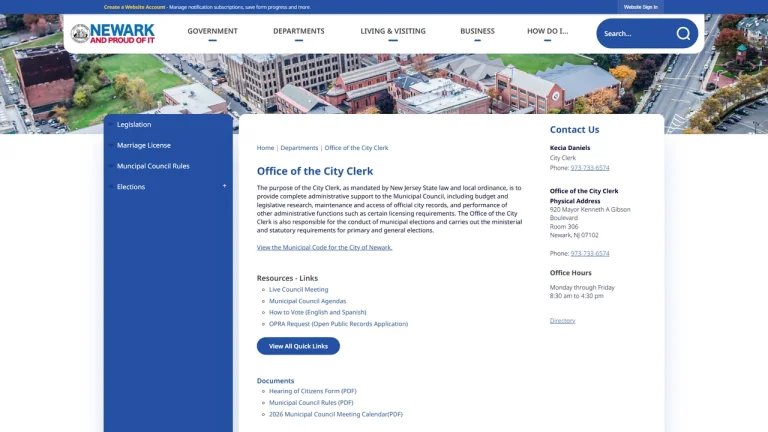

Essex County Board of Taxation - Newark, NJ



The Constitutional Framework of New Jersey County Clerks
In the State of New Jersey, the County Clerk is an independent constitutional officer elected by the voters pursuant to Article VII, Section II, Paragraph 2 of the New Jersey Constitution. Serving five-year terms across all 21 counties-including Bergen County in Hackensack, Essex County in Newark, Middlesex County in New Brunswick, Monmouth County in Freehold, and Ocean County in Toms River-the County Clerk acts as a vital bridge between citizens, county government, and state administrative systems.
The statutory responsibilities of New Jersey County Clerks encompass distinct administrative domains. Under Title 19 of the New Jersey Statutes, County Clerks direct election administration in coordination with County Boards of Elections and County Superintendents of Elections. The County Clerk is responsible for designing official ballots, printing sample ballots, processing vote-by-mail ballot applications, and certifying official county election tallies. Additionally, County Clerk offices serve as designated passport acceptance facilities on behalf of the federal government.
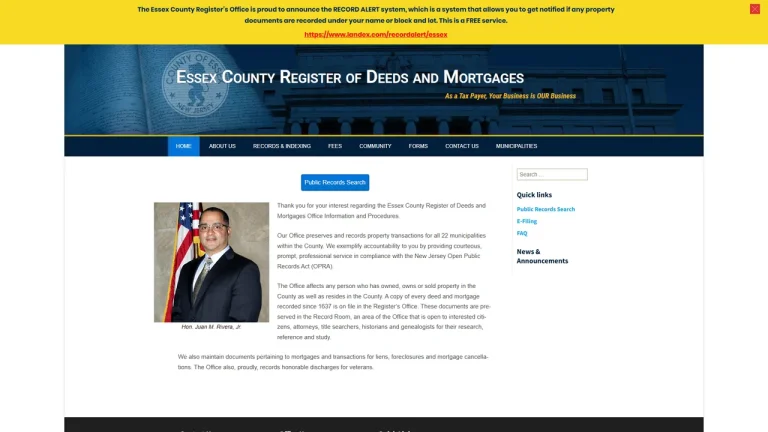
Furthermore, County Clerks administer local trade name registrations (DBAs) for unincorporated commercial enterprises, swear in commissioned notaries public under Title 52, issue county veteran identification cards, and maintain historic county archives. In 16 of New Jersey's 21 counties, the County Clerk also operates the county recording division for land deeds and mortgages, whereas five counties maintain a separate elected Register of Deeds and Mortgages.
Common County Clerk Services & Statutory Fee Schedule
| Service / Matter | Required Documents / Prerequisites | Statutory Fee (USD) | Processing Timeline |
|---|---|---|---|
| Business Trade Name Certificate (DBA) | Completed Certificate Form, Valid Government ID, Notarized Signatures | $50 Statutory Base Fee | Same day to 48 hours |
| Notary Public Swearing-In & Qualification | State Notary Commission Certificate, Oath Form, Driver's License | $15 Statutory County Fee | Immediate in-person |
| Vote-by-Mail Ballot Processing | Completed Mail-in Ballot Application, Verified Voter Registration | Free (Statutory Public Right) | Within 48 hours of receipt |
| Open Public Records Act (OPRA) Request | Written Request, Specific Description of County Records, Requester Details | Free ($0.05/page copy fee) | Strictly within 7 business days |
Critical Legal Deadlines & Statutes in New Jersey
Administrative processes managed by New Jersey County Clerks are governed by strict statutory timelines. Under N.J. Stat. Ann. § 56:1-1, any individual or general partnership conducting business under an assumed trade name must file a trade name certificate with the County Clerk prior to engaging in commerce; conducting business without this filing constitutes a statutory misdemeanor under N.J. Stat. Ann. § 56:1-4.
Election deadlines are codified under Title 19. Pursuant to N.J. Stat. Ann. § 19:63-3, applications for a vote-by-mail ballot submitted through the postal service must be received by the County Clerk at least 7 calendar days prior to the election, while in-person applications are accepted at the clerk's office up to 3:00 PM on the day preceding the election. Petitions challenging election irregularities or ballot tally certifications must be filed in the New Jersey Superior Court within 30 days after the results are certified pursuant to N.J. Stat. Ann. § 19:29-3.
Public access to county government records is protected by the Open Public Records Act under N.J. Stat. Ann. § 47:1A-5, which imposes a mandatory statutory deadline requiring the records custodian to respond within 7 business days. For commissioned notaries public, N.J. Stat. Ann. § 52:7-14 requires the applicant to appear before the County Clerk to take the constitutional oath of office within 3 months of the issuance of their state commission, or the appointment is deemed void.
Direct Citizen Access vs. Legal Counsel in County Affairs
Citizens and small business operators frequently interact directly with their County Clerk's office without professional legal counsel. Applying for an international passport, taking the notary oath of office, filing an individual trade name certificate, or requesting a mail-in ballot can be accomplished directly by completing official county forms and presenting statutory identification.
However, when county administrative matters intersect with legal controversies, retaining licensed legal counsel is critical. Litigating ballot positioning, signature challenges, or contested election outcomes under Title 19 requires filing emergent verified complaints in the Law Division of the New Jersey Superior Court. Similarly, commercial disputes involving trade name infringement, common law trademark rights, or unfair competition governed by Title 56 demand formal representation in Superior Court.
It is important to distinguish the County Clerk from the judicial Clerk of the Superior Court in Trenton. Actions seeking to compel or overturn actions of a County Clerk are litigated through actions in lieu of prerogative writs under N.J. Ct. R. 4:69-1 in Superior Court. New Jersey Special Civil Part Small Claims courts under N.J. Ct. R. 6:1-2 have a strict $5,000 ceiling and lack equitable authority over election certifications or county administrative mandates.
Red Flags & Public Safety Warnings Regarding County Services
- Be cautious of private websites charging $60 to $120 to process vote-by-mail ballot applications or passport appointment bookings, which are provided directly without surcharge by your County Clerk.
- Never operate a sole proprietorship or general partnership without filing a Trade Name Certificate under N.J. Stat. Ann. § 56:1-1; doing so impairs your ability to maintain civil lawsuits in New Jersey courts.
- Do not miss the 3-month statutory deadline under N.J. Stat. Ann. § 52:7-14 to take the official notary oath after receiving a state commission, as the state will automatically cancel the appointment.
- Avoid third-party vendors charging high fees to order certified copies of historic deeds or lien records that are publicly accessible through your County Clerk's official records room.
Frequently Asked Questions
What is the primary role of an elected County Clerk in New Jersey?
The New Jersey County Clerk is a constitutional officer who oversees the preparation and printing of election ballots, processes vote-by-mail applications, accepts passport applications, registers business trade names, and administers notary oaths.
How do I register a business trade name (DBA) in New Jersey?
Under N.J. Stat. Ann. § 56:1-1, unincorporated businesses (such as sole proprietorships and general partnerships) must file a notarized Trade Name Certificate with the County Clerk in the county where business is conducted, paying the $50 statutory fee.
What is the deadline to request a Vote-by-Mail ballot from the County Clerk?
Pursuant to N.J. Stat. Ann. § 19:63-3, mail-in ballot applications sent by mail must be received by the County Clerk at least 7 days before the election, while in-person applications are accepted until 3:00 PM on the day before the election.
What is the response timeframe for a county OPRA public records request?
Under N.J. Stat. Ann. § 47:1A-5, county records custodians have strictly seven business days from receipt of an Open Public Records Act request to provide the records, issue a denial, or specify an extension date.
How long do I have to take the notary oath after receiving my commission?
Under N.J. Stat. Ann. § 52:7-14, commissioned notaries public must appear before the County Clerk to take the oath of office within three months of receiving their commission, paying a $15 statutory fee.