
Federal Law Enforcement in New York City
Federal law enforcement agencies in New York City investigate federal crimes, enforce maritime and border security, and safeguard federal judicial facilities. Navigating federal investigations or contacting federal field offices requires understanding strict procedural boundaries and constitutional rights. Explore our verified registry below to access official field offices, regional headquarters, and administrative contacts.


Federal Law Enforcement Operations Across New York City
Federal law enforcement in New York City operates across two distinct federal judicial jurisdictions: the Southern District of New York (SDNY), covering Manhattan and the Bronx, and the Eastern District of New York (EDNY), covering Brooklyn, Queens, and Staten Island. Because New York City serves as a global financial, cultural, and transit hub, federal agencies maintain major field headquarters and specialized strike forces throughout the five boroughs.
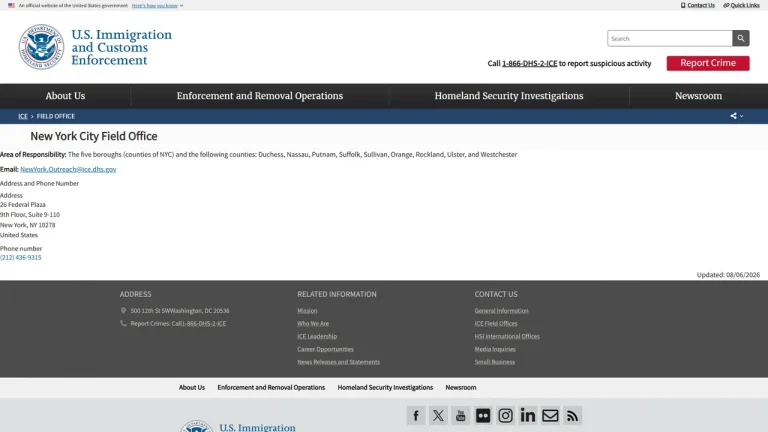
Key investigative and enforcement bodies maintain centralized operations in Lower Manhattan and Downtown Brooklyn. The Federal Bureau of Investigation (FBI) New York Field Office operates out of 26 Federal Plaza, coordinating counterterrorism, corporate fraud, and public integrity task forces. The Drug Enforcement Administration (DEA) New York Division is headquartered in Manhattan, while the Bureau of Alcohol, Tobacco, Firearms and Explosives (ATF) New York Field Division manages firearm trafficking initiatives across all five boroughs. Border security, customs enforcement, and immigration investigations are directed by U.S. Customs and Border Protection (CBP) and Homeland Security Investigations (HSI) at regional ports and John F. Kennedy International Airport.
Judicial protection and witness security are administered by the United States Marshals Service (USMS). Marshals operate within the federal judicial complexes at the Daniel Patrick Moynihan and Thurgood Marshall U.S. Courthouses at Foley Square in Manhattan, and the Theodore Roosevelt U.S. Courthouse at Cadman Plaza in Brooklyn. Federal prosecutions originating from these agencies are handled by the United States Attorney Office for the Southern District of New York at 1 St. Andrew Plaza or the Eastern District of New York at 271 Cadman Plaza East.
Federal Law Enforcement Procedures, Fees, and Timelines
| Service / Matter | Required Documents / Prerequisites | Statutory Fee (USD) | Processing Timeline |
|---|---|---|---|
| FOIA Law Enforcement Records Request | Standard written request, certified identity verification | $0 (Duplication fees may apply) | 20 business days statutory determination |
| Civil Asset Forfeiture Notice of Claim | Form CAFRA notice, verified statement of property interest | $0 (No filing bond permitted) | 30 to 60 days to USAO response |
| Federal Arrestee Presentment & Bond | Pretrial Services intake, corporate or personal surety package | $0 (Set by Magistrate Judge) | Same-day or next-day presentment |
| Witness Proffer / Voluntary Interview | Signed proffer agreement, presence of retained defense counsel | $0 (Administrative procedure) | Coordinated with Assistant U.S. Attorney |
Critical Legal Deadlines & Statutes in New York
Engaging with federal law enforcement involves rigid constitutional and statutory rules where missed deadlines can permanently forfeit legal rights. Under the Freedom of Information Act, codified at 5 U.S. Code § 552, federal agencies have 20 business days to make an initial determination regarding public records requests, with an available 10-day extension for unusual circumstances.
When federal agencies seize property for civil asset forfeiture, the Civil Asset Forfeiture Reform Act (CAFRA) under 18 U.S. Code § 983 imposes strict deadlines. Claimants must file a verified administrative claim within 30 days of receiving personal written notice or within 30 days of final internet publication. Once a valid claim is submitted, the U.S. Attorney has 90 days to file a formal civil forfeiture complaint in federal district court or return the seized property.
For individuals arrested by federal authorities, Fed. R. Crim. P. 5 requires that the arrestee be brought before a federal magistrate judge without unnecessary delay, typically within 24 to 48 hours. Under the federal Speedy Trial Act, codified at 18 U.S. Code § 3161, an indictment or information must be filed within 30 days of an arrest, and trial must commence within 70 days of the indictment or the defendant initial court appearance. Additionally, any statement made to a federal agent is governed by 18 U.S. Code § 1001, making it a felony punishable by up to five years in federal prison to make false statements during an investigation.
Direct Citizen Access vs. Legal Counsel in Federal Matters
Citizens can contact federal law enforcement directly for routine matters, such as submitting crime tips to the FBI New York Field Office, filing internet fraud complaints via the Internet Crime Complaint Center (IC3), or submitting administrative FOIA requests. Victims of federal offenses can also access support through the Victim Witness Assistance Programs administered by the U.S. Attorney Offices in Manhattan and Brooklyn.
However, if federal special agents attempt to question an individual, execute a search warrant, or deliver a grand jury subpoena, retaining an experienced federal criminal defense attorney is essential. Navigating interviews without legal representation carries immense risk under federal false statement statutes. A seasoned federal defense lawyer negotiates proffer agreements, coordinates responses to federal grand jury subpoenas, petitions magistrate judges for pretrial release at presentment, and interfaces directly with Assistant U.S. Attorneys in the SDNY or EDNY to mitigate criminal exposure.
Red Flags & Consumer Scams Involving Federal Agencies
- Telephone callers or text messages claiming to be federal agents from the FBI, DEA, or U.S. Marshals demanding payment via wire transfer, gift cards, or cryptocurrency to resolve arrest warrants.
- Private intermediaries or non-attorney consultants claiming they can leverage personal connections to halt an ongoing federal investigation or dismiss a grand jury indictment.
- Deceptive websites charging fees to download standard federal administrative claim forms or file FOIA requests that are freely accessible on genuine government portals.
- Individuals impersonating federal agents conducting unauthorized inspections or shakedowns near transit hubs, commercial freight depots, or immigrant communities in Queens and Brooklyn.
Frequently Asked Questions
What should I do if federal agents come to my home or business in NYC?
You have the constitutional right under the Fifth and Sixth Amendments to remain silent and decline to answer substantive questions. Ask to see credentials, request business cards, and state clearly that you wish to consult with an attorney before providing any statements.
Where are federal arrestees presented in New York City?
Arrestees in Manhattan and the Bronx are presented before a U.S. Magistrate Judge at the Daniel Patrick Moynihan Courthouse at 500 Pearl Street. Arrestees in Brooklyn, Queens, and Staten Island are presented at the Theodore Roosevelt U.S. Courthouse at 225 Cadman Plaza East.
What is the geographic division between SDNY and EDNY in New York City?
The Southern District of New York (SDNY) covers New York County (Manhattan) and Bronx County, along with six suburban counties. The Eastern District of New York (EDNY) covers Kings County (Brooklyn), Queens County, and Richmond County (Staten Island), as well as Long Island.
How can I recover property seized by federal agents in New York City?
You must file a formal verified claim of ownership under CAFRA within the statutory deadline stated on the notice of seizure. If criminal charges are pending, your defense attorney can file a motion for return of property under Federal Rule of Criminal Procedure 41(g).
What is a proffer session with federal prosecutors?
A proffer session, commonly known as a queen for a day agreement, is a formal interview between a subject or witness and federal prosecutors, conducted under a written contract that limits how the government may use the statements against the individual in subsequent criminal proceedings.