
Public Records & Filing Offices in Harrisburg
Public records and filing offices in Harrisburg maintain critical property, court, corporate, and vital statistics for Dauphin County and Pennsylvania. Submitting accurate documentation through official statutory channels safeguards your legal titles, business filings, and public records access. Explore our comprehensive directory below to identify key Harrisburg filing repositories and legal professionals.

Disciplinary Board of the Supreme Court of Pennsylvania - Harrisburg, PA













Dauphin County & Pennsylvania State Filing Jurisdictions
Harrisburg holds a distinct dual status as the county seat of Dauphin County and the capital city of the Commonwealth of Pennsylvania. This concentration creates a centralized infrastructure for both county-level judicial records and statewide administrative repositories. County property transfers, lien docketing, and civil court records are centered at the Dauphin County Courthouse at 101 Market Street in downtown Harrisburg, serving municipalities including Harrisburg, Hershey, Lower Paxton, Swatara, and Susquehanna Township.
Within the county government framework, record keeping is partitioned among independent constitutional offices. The Dauphin County Prothonotary serves as the chief clerk for civil actions, maintaining dockets for lawsuits, judgments, and mechanics' liens. The Clerk of Courts manages criminal court case dockets. The Dauphin County Recorder of Deeds handles real estate conveyances, deeds, mortgages, and subdivision plans, while the Register of Wills oversees probate filings, wills, and marriage licenses within the Orphans' Court Division.
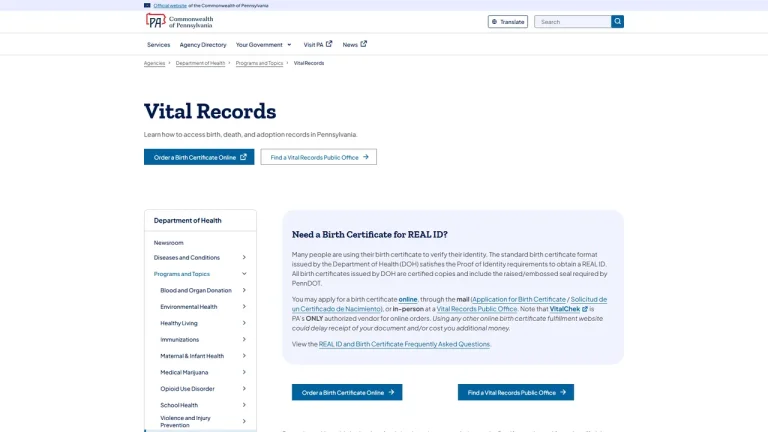
At the state level, Harrisburg accommodates the executive record-keeping bureaus for the entire Commonwealth. The Pennsylvania Department of State Bureau of Corporations and Charitable Organizations on North Office Building processes commercial registrations and uniform commercial code filings. Statewide vital records are managed by the Pennsylvania Department of Health Division of Vital Records, and administrative transparency inquiries are coordinated through the Pennsylvania Office of Open Records (OOR).
Harrisburg Public Records Filing Procedures & Statutory Fees
| Service / Matter | Required Documents / Prerequisites | Statutory Fee (USD) | Processing Timeline |
|---|---|---|---|
| Dauphin County Deed & Mortgage Recording | Executed deed/mortgage, certificate of residence, PA Statement of Value (REV-183) | $80.75 (Base recording fee plus statutory surcharges) | 3-5 business days for indexing |
| PA Right-to-Know Law (RTKL) Request | Standard Statewide RTKL Form, specific agency records description | $0 (Statutory waiver; $0.25/page duplication fee) | 5 statutory business days |
| Certified PA Vital Record (Birth/Death) | Application form, government photo ID, documentation of direct relationship | $20 (Statutory state vital records fee) | Same-day in person; 2-3 weeks by mail |
| Business Formation Certificate (Dept. of State) | Docketing Statement (DSCB:15-134A), Certificate of Organization/Articles | $125 (Statutory Department of State filing fee) | 1-3 business days electronically |
Critical Legal Deadlines & Statutes in Pennsylvania
Filing and public records procedures in Harrisburg are governed by strict Pennsylvania statutory timeframes. Under the Pennsylvania Right-to-Know Law, 65 P.S. § 67.901, an agency Open Records Officer must respond to a formal public records request within five business days from the date it is received, with a permitted 30-day extension upon written notice for specified statutory reasons.
When a records request is denied or deemed denied by a Harrisburg or Commonwealth agency, administrative appeal deadlines are narrow. In accordance with 65 P.S. § 67.1101, the requester must file an appeal with the Pennsylvania Office of Open Records within 15 business days of the mailing date of the agency's response or deemed denial.
In real property and judgment matters, recording deadlines protect legal priority. Pennsylvania operates under a race-notice recording statute pursuant to 21 P.S. § 351, meaning an unrecorded deed or mortgage is void against any subsequent bona fide purchaser who records first. For money judgments docketed with the Dauphin County Prothonotary, judgment liens remain an active encumbrance on real property for five years under 42 Pa. C.S. § 5526, requiring the filing of a formal writ of revival before expiration to maintain priority.
Direct Public Filing vs. Retaining Legal Counsel
Citizens and business owners can execute routine records requests and standard filings directly with Harrisburg administrative offices. Ordering certified birth or death certificates from the Department of Health, filing standard RTKL requests with municipal open records officers, searching Dauphin County land records online, or filing routine entity name reservations can be handled without legal representation.
However, when transactions involve legal liability, property encumbrances, or contested administrative proceedings, retaining an attorney admitted to the Supreme Court of Pennsylvania is crucial. Drafting complex deeds with easements, probating contested estates before the Dauphin County Register of Wills, filing mechanics' liens with the Prothonotary, or challenging a state agency determination under the Administrative Agency Law (2 Pa. C.S. § 702) carries substantial legal consequences. Flawed filings can result in unmarketable real estate titles, loss of priority against competing creditors, or procedural waiver of appellate rights.
Red Flags & Operational Warnings
- Beware of misleading third-party mailers offering to procure copies of your Dauphin County deed for inflated sums; official certified copies can be obtained directly from the Recorder of Deeds for standard statutory copy fees.
- Do not use unofficial online portals that charge excessive processing fees for Pennsylvania business entity formations that can be filed directly with the Department of State.
- Never miss the 15-business-day appeal deadline under 65 P.S. § 67.1101 following an adverse open records determination, as late submissions bar review by the Office of Open Records.
- Ensure all real property deeds recorded in Dauphin County include compliant Pennsylvania Realty Transfer Tax statements (REV-183) to avoid costly departmental tax assessments and penalties.
Frequently Asked Questions
Where are deeds and mortgages recorded in Harrisburg?
Deeds and mortgages are recorded at the Dauphin County Recorder of Deeds office, located on the first floor of the Dauphin County Courthouse at 101 Market Street, Harrisburg, PA 17101.
What is the statutory deadline for an agency response to a RTKL request in Pennsylvania?
Under 65 P.S. § 67.901, government agencies must issue a response within five business days of receiving a written Right-to-Know request.
What records are maintained by the Dauphin County Prothonotary?
The Dauphin County Prothonotary maintains civil court records, including divorce dockets, civil lawsuits, mechanics' liens, judgment dockets, and local court appeals.
How long does a judgment lien remain valid in Dauphin County?
Under 42 Pa. C.S. § 5526, a judgment lien on real property remains enforceable for five years and must be renewed through a writ of revival to retain its priority.
Where can I obtain certified vital records in Harrisburg?
Certified copies of birth and death certificates are issued by the Pennsylvania Department of Health Division of Vital Records, which maintains public walk-in customer service in Harrisburg.