
Workplace Discrimination Lawyers in Kansas
Partnering with an experienced Kansas workplace discrimination lawyer protects your career and holds biased employers accountable under state and federal civil rights laws. Skilled employment attorneys navigate administrative filings before the Kansas Human Rights Commission and negotiate comprehensive financial remedies. Browse our directory below to connect with verified Kansas attorneys ready to evaluate your claim.

Law Office of Albert F. Kuhl - Overland Park, KS
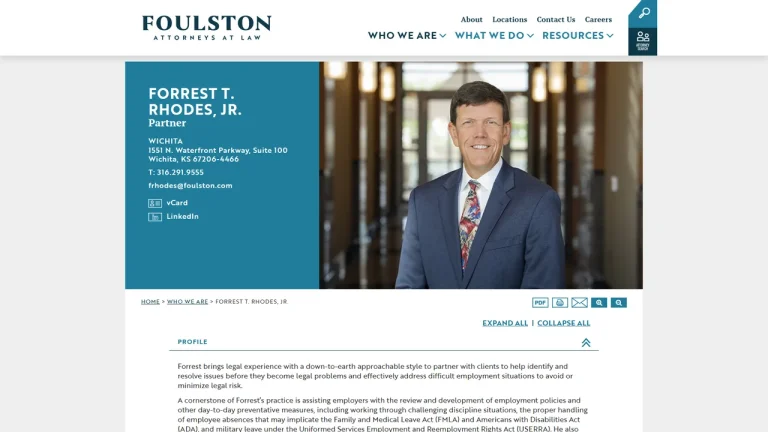
Forrest T. Rhodes Jr. - Wichita, KS

The Law Office of Robert R. Lee II - Wichita, KS

Doyle & Bruce LLC - Kansas City, KS

Dietrick Law - Topeka, KS

Littler Mendelson P.C. - Overland Park, KS

Joseph, Hollander & Craft LLC - Overland Park, KS
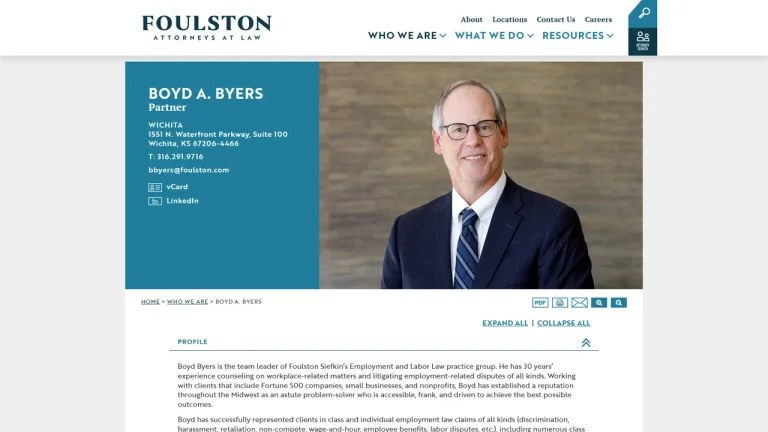
Boyd A. Byers - Wichita, KS
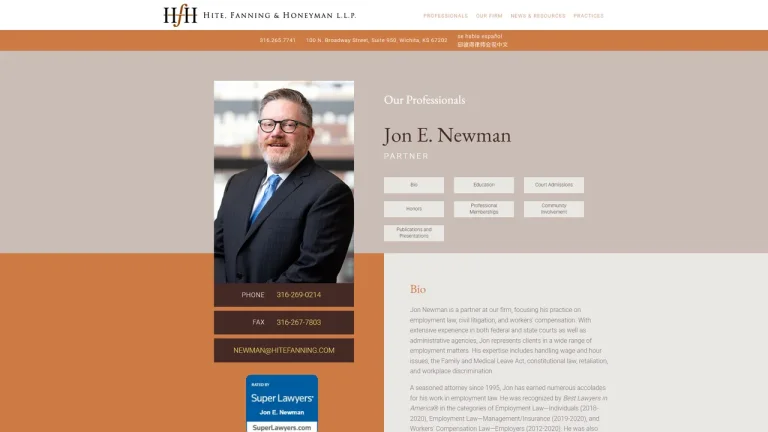
Jon E. Newman - Wichita, KS
Kalberg Law Office L.L.C. - Overland Park, KS

Sean McGivern - Graybill & Hazlewood, L.L.C. - Wichita, KS

Employee and Labor Law Group of KC - Overland Park, KS
Evans & Dixon, LLC - Overland Park, KS
Colantuono Guinn Keppler LLC - Overland Park, KS

Tara Eberline, Attorney at Law - Overland Park, KS
Galdean Law Firm - Wichita, KS
Teresa L. Shulda - Foulston Siefkin LLP - Wichita, KS

Liesmann Law - Topeka, KS
Eric Kjorlie - Topeka, KS

Snyder Law Firm LLC - Overland Park, KS
Law Office of Sean M. Dwyer - Wichita, KS
Kansas Employee Lawyer - Hite, Fanning & Honeyman, LLP - Wichita, KS
McAnany, Van Cleave and Phillips, P.A. - Kansas City, KS
Protecting Civil Rights in Kansas Workplaces Across State and Federal Courts
Employees in Kansas are protected against unlawful employment practices based on race, religion, color, sex, disability, national origin, ancestry, or age. When prejudice impacts hiring, promotions, compensation, or job retention, pursuing justice requires asserting rights under comprehensive statutory frameworks.
State discrimination charges originate with the Kansas Human Rights Commission (KHRC), headquartered in Topeka, or the federal Equal Employment Opportunity Commission (EEOC). Following administrative exhaustion, formal lawsuits are filed in Kansas District Courts-including high-volume dockets in Johnson County (Olathe), Sedgwick County (Wichita), and Shawnee County (Topeka)-or the United States District Court for the District of Kansas.
All state court actions utilize the Kansas Courts eFiling system. Retaining an attorney admitted to the Kansas Bar Association ensures your administrative charges are timely perfected, adverse personnel records are subpoenaed, and statutory damage remedies are aggressively pursued.
Kansas Employment Discrimination Case Scenarios and Fee Benchmarks
| Case Scenario | Fee Structure | Estimated Cost (USD) | Key Cost Determinants |
|---|---|---|---|
| Failure to Accommodate Disability Under KAAD / ADA | Contingency Fee (33.33%) | $0 Upfront (Contingency Basis) | Medical interactive process documentation, reasonableness of requested workplace accommodation, back-pay loss. |
| Kansas Human Rights Commission (KHRC) Conciliation | Flat Fee or Retainer | $2,500 - $6,500 | KHRC investigation findings, witness interview statements, position paper preparation, mediation sessions. |
| Age Discrimination in Employment Act (KADEA) Litigation | Contingency or Hybrid | $0 Upfront ($5,000+ Advanced Costs) | Direct ageist remarks, statistical evidence of replacement by younger workers, lost pension benefits. |
| Title VII / KAAD Race or Gender Discrimination Trial | Contingency (40%) + Advanced Costs | $0 Upfront ($25,000 - $60,000+ Advanced Expenses) | Disparate impact analysis, deposition of corporate executives, expert economic loss modeling, District Court jury trial length. |
Critical Legal Deadlines & Statutes in Kansas
Civil rights enforcement in Kansas is strictly tied to administrative exhaustion timelines. Under the Kansas Act Against Discrimination (KAAD) codified at K.S.A. § 44-1001, it is an unlawful employment practice under K.S.A. § 44-1009 for an employer with four or more employees (K.S.A. § 44-1002(b)) to discriminate against an individual in compensation or terms of employment because of race, religion, color, sex, disability, national origin, or ancestry. Age discrimination is prohibited under the Kansas Age Discrimination in Employment Act at K.S.A. § 44-1111.
To preserve state law claims, a complaint must be filed with the Kansas Human Rights Commission within strictly six months (one hundred eighty days) from the last discriminatory act pursuant to K.S.A. § 44-1005(i). Under the work-sharing agreement between the KHRC and the EEOC, claims under Title VII (42 U.S. Code § 2000e-5) may be dual-filed within three hundred days. Once administrative remedies are exhausted, judicial review in Kansas District Court proceeds under K.S.A. § 44-1011, while federal court actions must be filed within ninety days of receiving an EEOC Notice of Right to Sue.
Small Claims Court Restrictions vs. District Court Civil Rights Actions
Under K.S.A. § 61-2703, the Small Claims Procedure Act sets a monetary ceiling of $10,000 for simplified civil actions. However, small claims courts are completely barred from hearing civil rights or employment discrimination disputes. Pursuant to K.S.A. § 61-2707(a), lawyers are not permitted to participate in small claims hearings, and the court cannot order workplace accommodations, issue right-to-sue determinations, or award statutory emotional distress damages.
Workplace discrimination claims demand rigorous statutory discovery, including depositions of human resources personnel, statistical payroll analysis, and comparative reviews of similarly situated employees. Navigating administrative investigations before the KHRC and prosecuting subsequent lawsuits in the Kansas District Court or federal court requires experienced legal counsel. Retaining an attorney ensures that evidentiary standards are satisfied and that statutory remedies-including back pay, front pay, and injunctive relief-are preserved.
Red Flags When Selecting a Kansas Discrimination Attorney
- Failing to file an initial complaint with the KHRC within the strict six-month limitation under K.S.A. § 44-1005(i), which permanently extinguishes state law claims.
- Attorneys who guarantee financial recovery amounts before reviewing performance appraisals, employer position statements, and comparator data.
- Practitioners unfamiliar with dual-filing procedures between the KHRC in Topeka and regional EEOC offices.
- Law firms that charge upfront retainers without exploring contingency representation for workers who have suffered discriminatory wage loss or termination.
Frequently Asked Questions
How long do I have to report workplace discrimination to the KHRC in Kansas?
Under K.S.A. § 44-1005(i), you must file a formal complaint with the Kansas Human Rights Commission within six months (180 days) of the last alleged discriminatory incident to preserve your rights under Kansas state law.
What employers are covered under the Kansas Act Against Discrimination?
Pursuant to K.S.A. § 44-1002(b), the KAAD applies to all private and public employers employing four or more persons, providing broader coverage than federal Title VII, which requires fifteen or more employees.
What is the difference between filing with the KHRC versus the EEOC?
The KHRC enforces Kansas state civil rights statutes, while the EEOC enforces federal civil rights laws. Because of a work-sharing agreement, filing with one agency typically dual-files with the other, preserving both state and federal claims.
What remedies are available under Kansas workplace discrimination laws?
Available remedies under the KAAD include back pay, reinstatement, prospective front pay, reimbursement for lost benefits, and civil orders compelling the employer to cease unlawful discriminatory practices.
Can an employer retaliate against me for reporting discrimination in Kansas?
No. Under K.S.A. § 44-1009(a)(4), it is an independent violation of Kansas law for an employer to retaliate, demote, harass, or terminate an employee because they opposed unlawful discrimination or participated in a KHRC proceeding.