
Courts in Connecticut
Accessing Connecticut courts requires navigating the state unified judicial system across its 13 Judicial Districts and municipal Probate Courts. Understanding electronic filing procedures, clerk requirements, and court schedules ensures timely legal action. Explore our directory below to locate courthouses, filing portals, and administrative contacts throughout Connecticut.
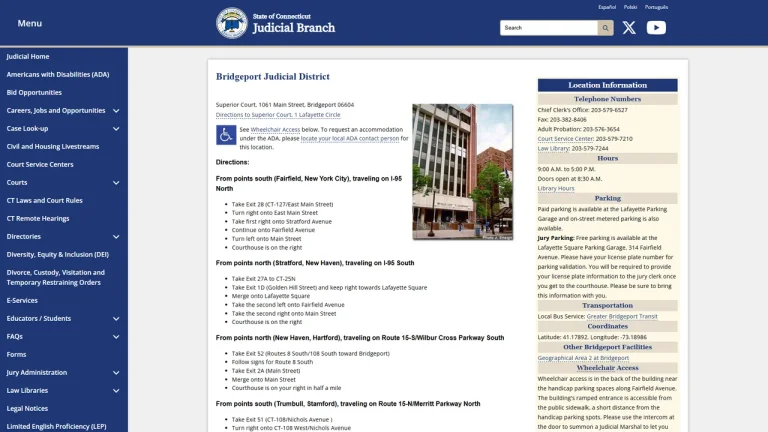
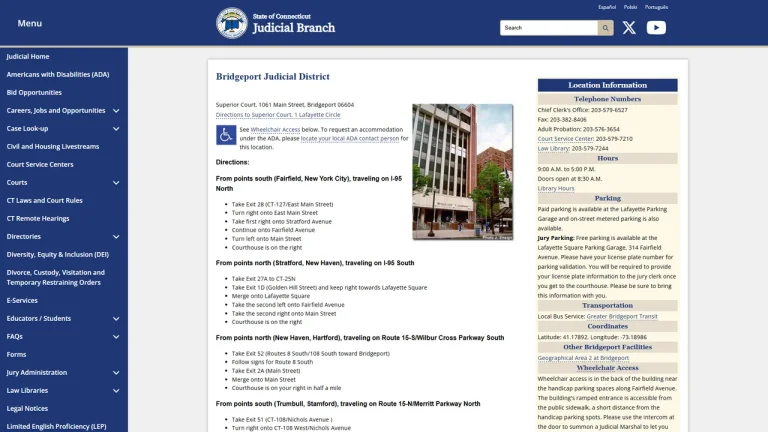
Bridgeport Superior Court - Geographical Area 2 - Bridgeport, CT


The Connecticut Judicial Branch and Trial Court Jurisdiction
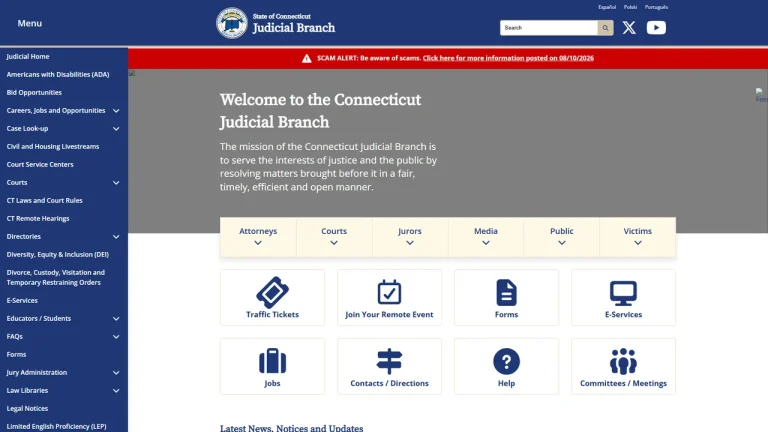
The state of Connecticut operates a unified judicial system managed under the administrative authority of the Connecticut Judicial Branch. Unlike states with fragmented municipal court layers, Connecticut consolidates all major trial proceedings into a single statewide trial court known as the Superior Court. The Superior Court exercises general jurisdiction over civil actions, criminal matters, family law disputes, and housing proceedings, organizing operations across 13 Judicial Districts and multiple Geographical Area courts throughout the state.
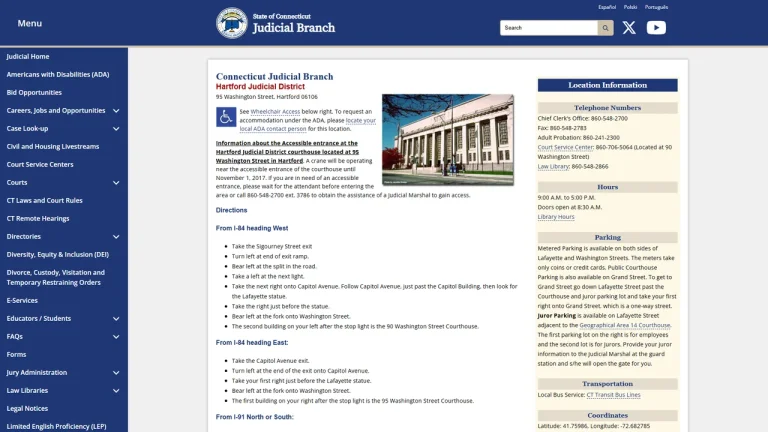
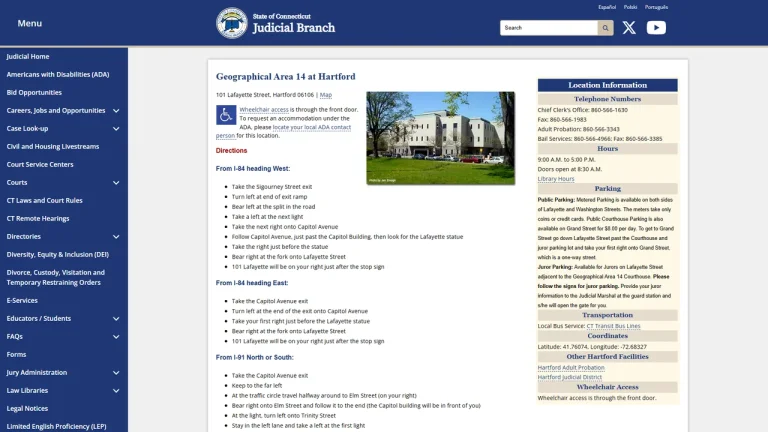
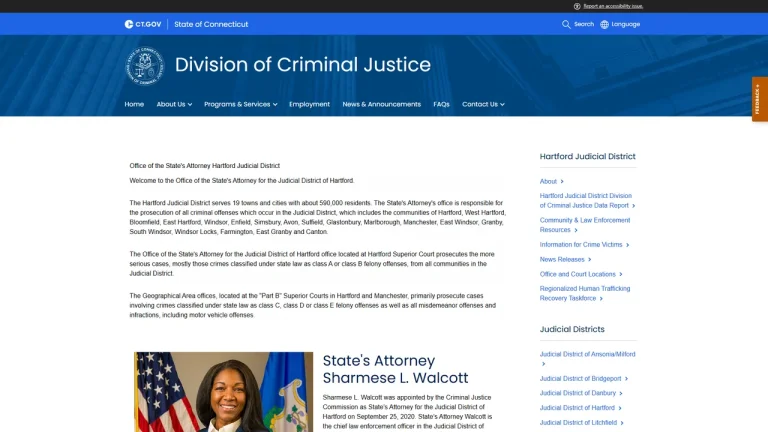
Judicial Districts serve as the jurisdictional hubs for major civil lawsuits, complex litigation, and serious felony criminal matters (designated as Part A proceedings). Key district courthouses include the Hartford Judicial District Courthouse on Washington Street, the New Haven Judicial District Courthouse on Church Street, the Fairfield Judicial District Courthouse in Bridgeport, and regional facilities serving Waterbury, Stamford-Norwalk, and New Britain. Alongside Judicial Districts, Geographical Area courts handle misdemeanor arraignments, motor vehicle offenses, and preliminary criminal matters (designated as Part B proceedings).
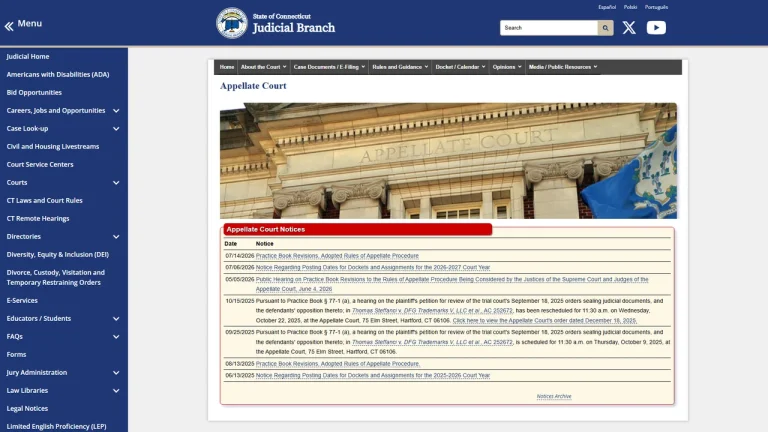
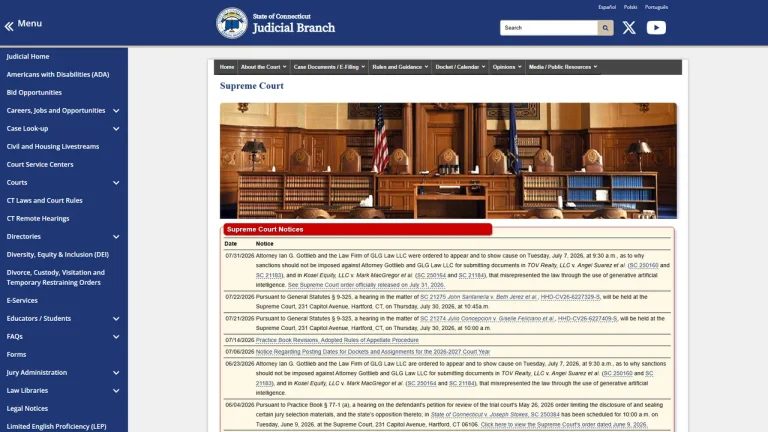
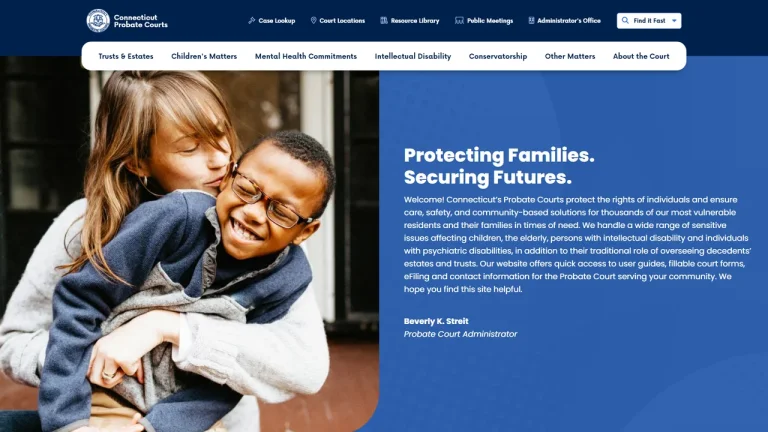
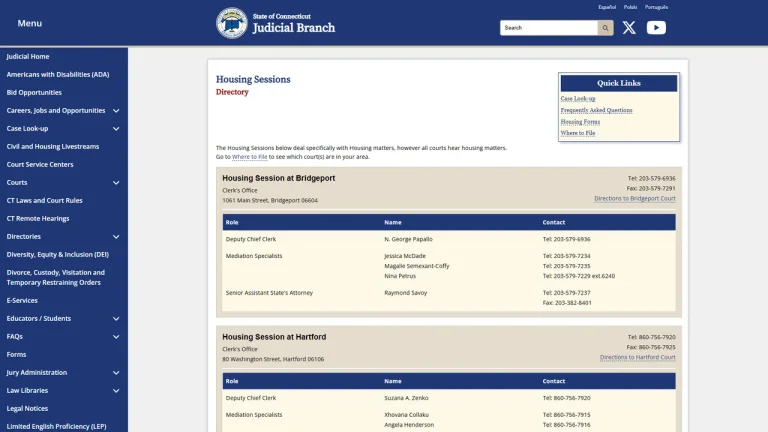
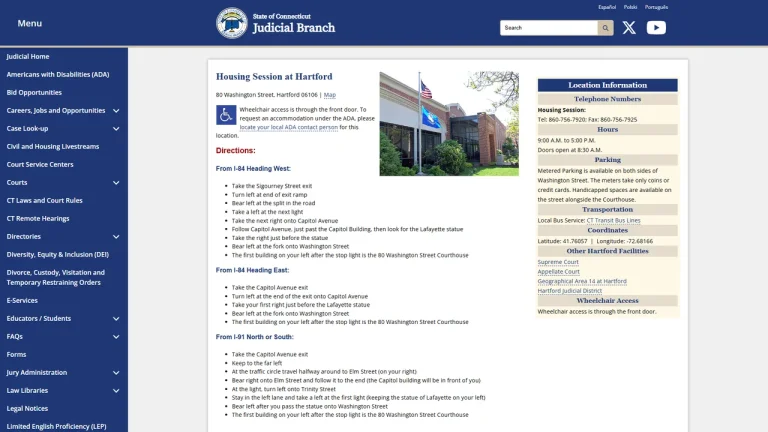
Complementing the general jurisdiction trial courts, Connecticut maintains specialized court sessions and distinct courts. Housing Sessions operate in major urban centers to manage landlord-tenant disputes and eviction actions. The Connecticut Supreme Court and the Connecticut Appellate Court, both seated in the capital city of Hartford, provide appellate review of Superior Court determinations. Additionally, autonomous municipal Probate Courts oversee the administration of wills, estates, trusts, conservatorships, and parental guardianship proceedings across local probate districts.
Connecticut Court Filings, Statutory Fees, and Administrative Timelines
| Service / Matter | Required Documents / Prerequisites | Statutory Fee (USD) | Processing Timeline |
|---|---|---|---|
| Superior Court Civil Action Filing | Form JD-CV-1 Summons, Complaint, proof of service by State Marshal | $360.00 statutory entry fee | Recorded upon entry on Return Day |
| Small Claims Writ and Notice of Suit | Form JD-CV-40, factual statement of debt, military service affidavit | $95.00 statutory filing fee | 30 to 60 days to answer or hearing |
| Dissolution of Marriage (Divorce) | Summons, Complaint for Dissolution, Notice of Automatic Orders | $360.00 entry fee | 90-day statutory cooling-off period |
| Certified Copy of Court Judgment | Form JD-ES-139, case docket number, party identification | $25.00 certification fee ($1.00 per page) | 5 to 10 business days |
Critical Legal Deadlines and Statutory Timelines in Connecticut
Litigants in Connecticut must adhere strictly to statutory limitation periods codified in the Connecticut General Statutes. Civil actions grounded in negligence, personal injury, or damage to real or personal property must be commenced within two years from the date the injury is sustained or discovered under Conn. Gen. Stat. § 52-584, subject to an ultimate three-year repose period from the date of the wrongful act.
Contractual disputes are governed by distinct statutory timelines depending on the form of the agreement. Lawsuits based on simple or implied contracts must be brought within six years under Conn. Gen. Stat. § 52-576. For domestic relations actions, Conn. Gen. Stat. § 46b-44 imposes a 90-day statutory waiting period following the return date before a final decree of dissolution of marriage may be entered, alongside state residency requirements for final decree jurisdiction.
Procedural rules governing civil actions require strict service of process. Under Conn. Gen. Stat. § 52-46, civil process must be served at least 12 days before the return day for Superior Court actions, and process must be returned to the clerk at least six days prior to the return day. For small monetary claims, the jurisdiction of the Small Claims session is established under Conn. Gen. Stat. § 51-15, restricting cases to controversies where the matter in dispute does not exceed $5,000.
Self-Representation (Pro Se) vs. Retaining a Connecticut Attorney
Citizens have the right to represent themselves as self-represented litigants (pro se) in Connecticut courts. Pro se representation is common and feasible in the Small Claims session of the Superior Court for claims up to $5,000, where informal procedures and simplified evidentiary rules apply. Self-represented individuals also routinely manage uncontested estate probates in local Probate Courts, uncontested name change petitions, and simple motor vehicle infractions adjudicated through the Centralized Infractions Bureau in Hartford.
In contrast, retaining an admitted Connecticut attorney is essential for complex disputes in the Superior Court. Civil litigation, contested divorces involving complex assets, child custody proceedings, commercial disputes, and Part A felony defenses demand strict adherence to the Connecticut Practice Book and formal rules of evidence. Attorneys navigate the Connecticut Judicial Branch E-Services system, conduct formal discovery, take depositions, file dispositive motions, and represent clients during mandatory pre-trial settlement conferences or trial proceedings. In corporate matters, Connecticut law prohibits business entities (corporations and LLCs) from representing themselves in Superior Court civil actions, requiring licensed legal representation.
Red Flags: Identifying Filing Fraud and Unauthorized Legal Intermediaries
- Non-attorney document preparation services charging expensive fees for standard court forms that the Connecticut Judicial Branch provides free of charge on its official web portal.
- Commercial entities demanding recurring subscription payments to view court calendars or case dockets that are publicly accessible through Connecticut Judicial Branch E-Services.
- Scam telephone calls or automated messages claiming to be from a Connecticut State Marshal or Superior Court clerk demanding immediate wire payments to avoid arrest for missed jury duty.
- Unlicensed individuals marketing "expedited probate clearance" or "guaranteed eviction filings" outside established statutory procedures governed by the Connecticut Practice Book.
Frequently Asked Questions
What is a Return Day in Connecticut civil court cases?
A Return Day in Connecticut is a procedural benchmark date set by the plaintiff rather than an actual court appearance date. It serves as the official reference point from which statutory appearance deadlines, pleading timelines, and responsive filings are calculated under the Connecticut Practice Book.
How do I search for active court cases in Connecticut?
Active and disposed cases can be searched online using the official Connecticut Judicial Branch E-Services portal. Searches can be conducted by party name, attorney Juris number, or court docket number across civil, family, housing, and criminal dockets without incurring search fees.
What is the dollar limit for Small Claims cases in Connecticut?
Under state statute, the jurisdictional limit for Small Claims matters in the Connecticut Superior Court is $5,000. Small Claims sessions provide an expedited, cost-effective forum for recovering monetary debts or contract damages without formal pleadings.
What is the role of a State Marshal in Connecticut court proceedings?
Connecticut State Marshals are independent public officers authorized by statute to serve civil process, including summonses, complaints, subpoenas, and wage executions. Unlike sheriffs in other jurisdictions, State Marshals are primarily responsible for executing legal process and court-ordered evictions rather than managing county jail facilities.
Can an LLC or corporation represent itself in Connecticut Superior Court?
No. Under Connecticut judicial rules and common law, business entities such as limited liability companies and corporations cannot appear pro se in Superior Court civil actions. They must be represented by an attorney admitted to practice before the Connecticut bar, except in limited small claims hearings where statutory exceptions apply.