
Federal Courts in Connecticut
Access official jurisdiction guidelines, filing protocols, and courthouse directories for the United States District Court for the District of Connecticut. Litigants and legal professionals navigate federal civil filings, criminal proceedings, and bankruptcy dockets across active seat locations in Hartford, New Haven, and Bridgeport. Explore our comprehensive directory below to locate federal clerk offices, magistrate divisions, and credentialed defense representation.


United States Federal Judicial Structure in Connecticut
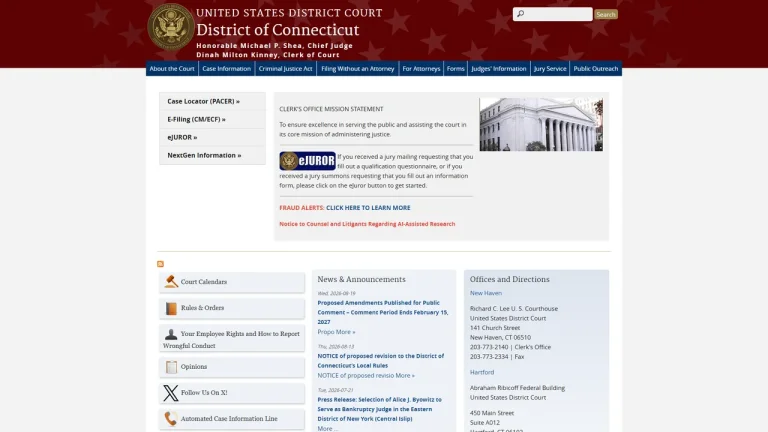
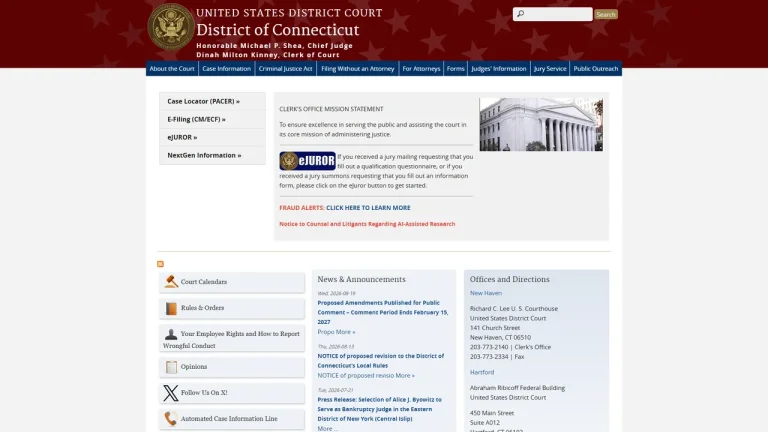
Federal judicial proceedings across Connecticut are administered through the United States District Court for the District of Connecticut, operating under the appellate authority of the United States Court of Appeals for the Second Circuit. Federal jurisdiction is strictly limited to matters involving constitutional questions, federal statutory enforcement, maritime law, bankruptcy administration, and disputes between parties of diverse state citizenship under 28 U.S. Code § 1332.
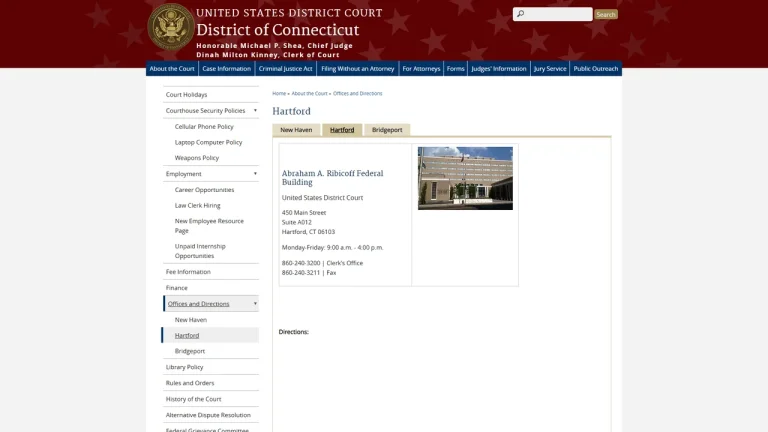
The district operates through three staffed divisional courthouses: the Abraham A. Ribicoff Federal Building and Courthouse in Hartford, the Richard C. Lee United States Courthouse in New Haven, and the Brien McMahon Federal Building and United States Courthouse in Bridgeport. Each courthouse hosts district judges, magistrate judges, and clerk division staff handling complex federal litigation, federal grand jury matters, and post-indictment criminal defense proceedings.
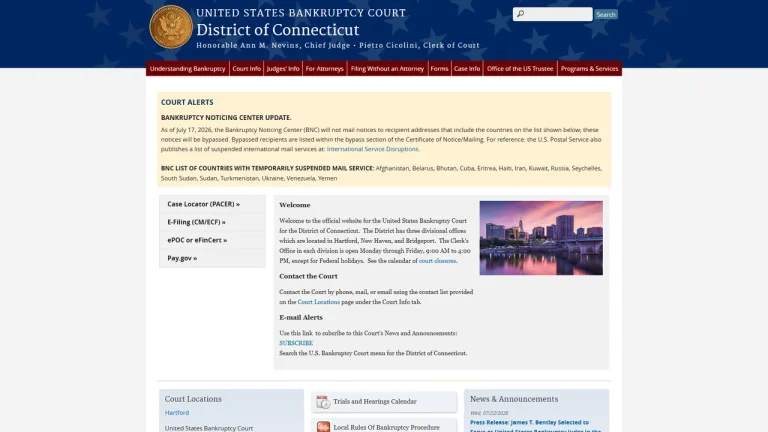
In addition to district courts, the United States Bankruptcy Court for the District of Connecticut operates divisional clerk dockets across Hartford, New Haven, and Bridgeport to oversee corporate reorganizations, personal liquidations, and creditor committee actions under Title 11 of the United States Code.
Common Federal Court Filings, Statutory Fees & Processing Timelines
| Service / Matter | Required Documents / Prerequisites | Statutory Fee (USD) | Processing Timeline |
|---|---|---|---|
| Civil Complaint Filing | Civil Cover Sheet JS-44, summons forms, verified complaint via CM/ECF | $405 ($350 filing fee + $55 administrative fee) | Immediate electronic docketing; summons issued within 24-48 hours |
| Notice of Appeal to Second Circuit | Form Notice of Appeal, entry of appearance, proof of service | $605 ($5 statutory fee + $600 docket fee) | Transmitted to Second Circuit within 3-5 business days |
| Petition for Writ of Habeas Corpus | Standard 2254 or 2255 petition forms, exhaustion of state remedies | $5 ($0 for federal custody 2255 motions) | Initial judicial review within 30-90 days |
| Certified Docket & Judgment Records | Case docket number, written request or PACER clerk search request | $12 per certification plus $0.50 per page | 1-3 business days for electronic or clerk certification |
Critical Legal Deadlines & Federal Statutes in Connecticut
Federal litigation is governed by uncompromising statutory deadlines where failure to comply leads to swift procedural dismissal. Under the Federal Rules of Civil Procedure and local rules of the District of Connecticut, responsive pleadings and appeals require strict adherence to federal timetables:
- Notice of Appeal: An appeal from a final district court judgment to the Second Circuit must be filed within 30 days of entry under Fed. R. App. P. 4, or within 60 days if the federal government is a party.
- Answer to Complaint: A defendant must serve an answer or motion under Fed. R. Civ. P. 12 within 21 days after being served with the summons, or within 60 days if waiver of service was granted under Fed. R. Civ. P. 4.
- Removal from State Superior Court: Notice of removal from a Connecticut Superior Court to the federal district court must be filed within 30 days of receipt of the initial pleading under 28 U.S. Code § 1446.
- Speedy Trial Guarantees: In federal criminal prosecutions, an indictment must be filed within 30 days of arrest, and trial must commence within 70 days under 18 U.S. Code § 3161.
Direct Agency Access vs. Retaining Federal Legal Counsel
While the general public has the constitutional right to inspect unsealed federal filings via the Public Access to Court Electronic Records (PACER) system or in person at clerk intake counters in Hartford, New Haven, or Bridgeport, navigating substantive federal claims pro se carries extreme risks. Unrepresented litigants are held to the exact procedural standards, local court rules, and evidentiary protocols as licensed federal advocates under D. Conn. L. Civ. R. 83.1.
Administrative requests such as ordering certified paper records, checking docket statuses, or reviewing public trial calendars can be executed independently through clerk staff. Conversely, handling complex commercial disputes, responding to federal grand jury subpoenas, addressing indictment counts, or litigating constitutional claims against government entities requires experienced counsel admitted to practice before the District of Connecticut and the Second Circuit Court of Appeals.
Red Flags & Federal Court Public Warnings
The Clerk of Court for the District of Connecticut regularly cautions residents against widespread fraudulent schemes targeting public users:
- Jury Duty Arrest Scams: Fraudsters posing as federal marshals or court clerks contact individuals claiming an arrest warrant has been issued for missing federal jury duty, demanding payment via prepaid cards, wire transfers, or cryptocurrency. Federal courts never demand financial payment over the phone.
- Predatory Public Record Resellers: Third-party commercial websites mimic PACER portals and charge exorbitant subscription fees for public federal dockets that are available directly from the clerk for cents per page.
- Unauthorized Legal Representatives: Non-attorney consultants or disbarred practitioners offering federal filing assistance without formal admission to the Bar of the United States District Court for the District of Connecticut.
- Bogus Federal Notice Phishing: Fraudulent electronic emails resembling official CM/ECF notices carrying malicious software or demands for immediate compliance verification.
Frequently Asked Questions
Where are the federal courthouses located in Connecticut?
The United States District Court for the District of Connecticut maintains three staffed courthouses located in Hartford at the Abraham A. Ribicoff Federal Building, in New Haven at the Richard C. Lee United States Courthouse, and in Bridgeport at the Brien McMahon Federal Building.
How do I search federal court records and dockets in Connecticut?
Public case files and dockets can be searched online through the nationwide PACER (Public Access to Court Electronic Records) service or by visiting public access terminals located at the Clerk of Court intake offices in Hartford, New Haven, and Bridgeport.
What is the difference between Connecticut Superior Court and Federal District Court?
Connecticut Superior Courts are trial courts of general jurisdiction handling state criminal offenses, state statutory disputes, and local civil actions. The Federal District Court has limited jurisdiction, adjudicating federal constitutional issues, federal crimes, interstate commerce disputes, and claims involving diversity of citizenship exceeding $75,000 under 28 U.S. Code § 1332.
Can an attorney licensed in Connecticut automatically practice in federal court?
No. Admission to the Connecticut state bar does not automatically grant admission to practice before the United States District Court for the District of Connecticut. Attorneys must formally apply, demonstrate good standing, and be sponsored and admitted pursuant to D. Conn. L. Civ. R. 83.1.
Which appellate court hears appeals from Connecticut federal courts?
Appeals from final decisions of the United States District Court for the District of Connecticut are directed exclusively to the United States Court of Appeals for the Second Circuit, which exercises federal appellate jurisdiction over Connecticut, New York, and Vermont.