
State & Local Courts in Chicago
State and local courts in Chicago provide essential judicial access across civil, criminal, traffic, and family matters throughout Cook County. Understanding individual courthouse divisions, mandatory e-filing protocols, and jurisdictional boundaries ensures your legal filings are processed without procedural delay. Explore our comprehensive directory below to locate specific Chicago court facilities, clerk offices, and contact details.
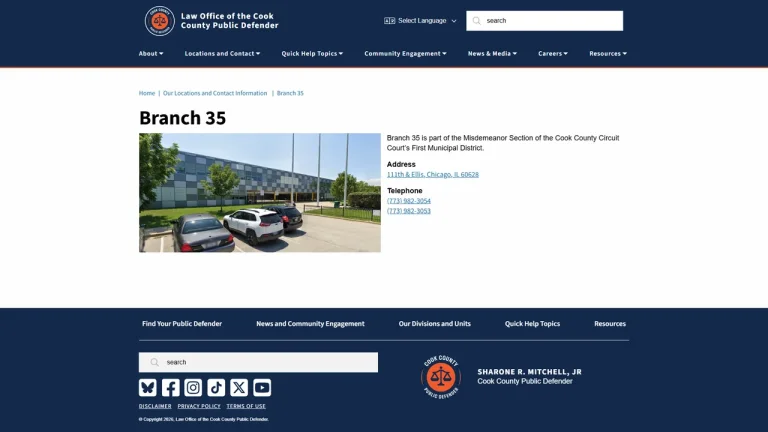
Circuit Court Branch 43 & 44 (Harrison & Kedzie) - Chicago, IL
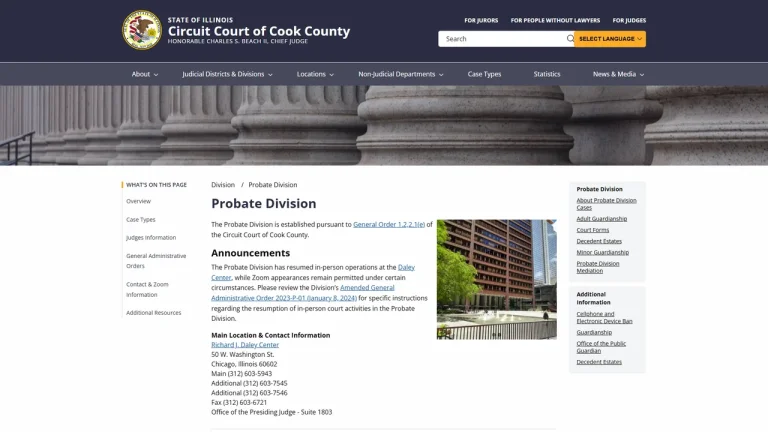
Circuit Court of Cook County - Probate Division (Daley Center) - Chicago, IL
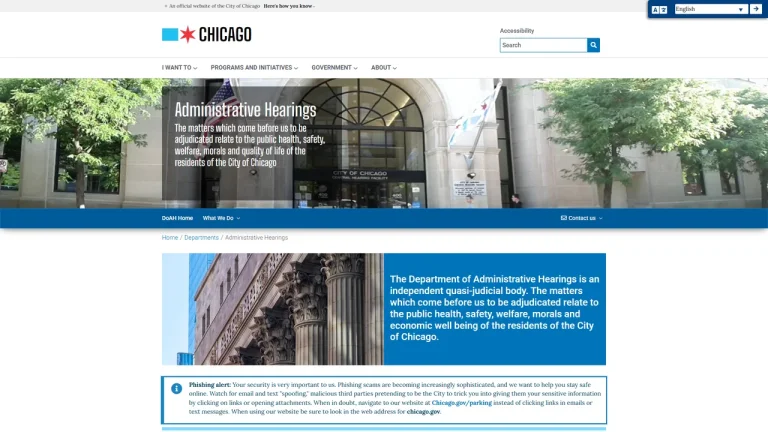
Department of Administrative Hearings Central Hearing Facility - Chicago, IL
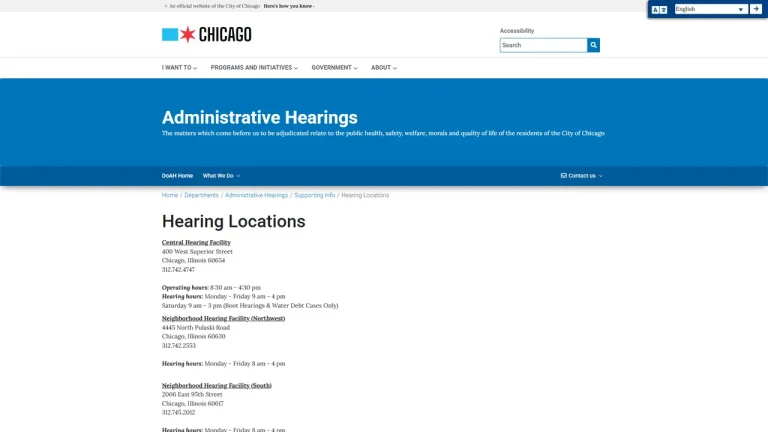
City of Chicago Department of Administrative Hearings - Chicago, IL


The Judicial Architecture of Cook County Courts in Chicago
The state court system in Chicago is organized under the Circuit Court of Cook County, recognized as one of the largest unified court networks in the United States under the authority of 705 ILCS 35/. Serving the City of Chicago and surrounding municipalities, the court is organized into specialized countywide divisions and geographic municipal districts. The First Municipal District encompasses the entire City of Chicago, providing administrative, civil, and misdemeanor judicial management for millions of local residents.
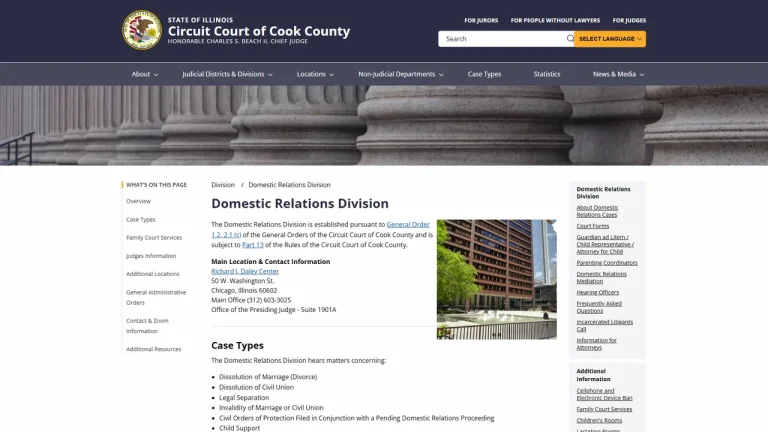
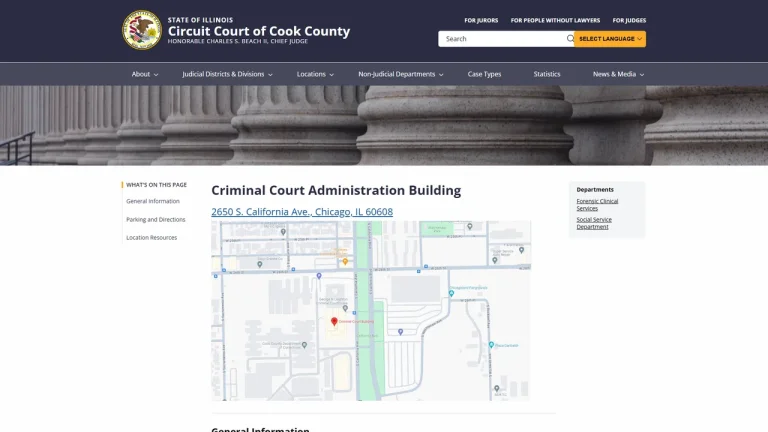
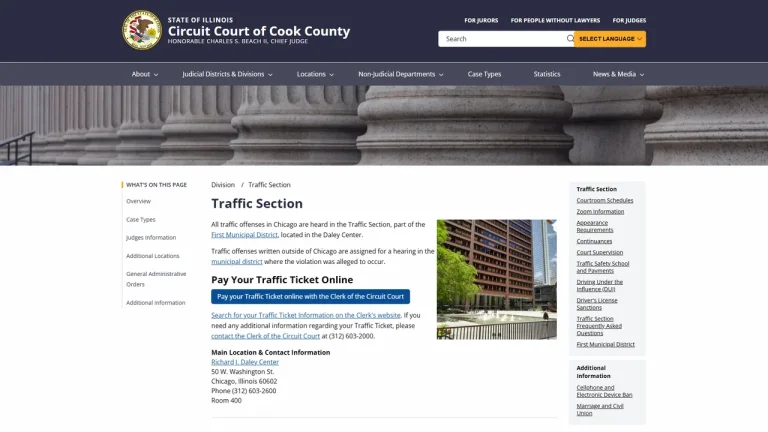
Judicial proceedings are distributed across landmark facilities throughout the city. The Richard J. Daley Center at 50 W. Washington Street in The Loop serves as the primary hub for civil litigation, housing the Law Division, Chancery Division, Probate Division, Domestic Relations Division, and the high-volume Traffic Court located on the concourse level. Felony criminal prosecutions are concentrated at the George N. Leighton Criminal Court Building at 2650 S. California Avenue (26th and California). In addition, specialized facilities include the Cook County Domestic Violence Courthouse at 555 W. Harrison Street and the Juvenile Court Center at 1100 S. Hamilton Avenue.
Court administration, public case records, and docketing are managed by the Clerk of the Circuit Court of Cook County. All modern civil case filings must be submitted through the state electronic filing network, eFileIL. Appellate reviews of Cook County Circuit Court decisions proceed to the Illinois Appellate Court for the First District, housed in the Michael A. Bilandic Building at 160 N. LaSalle Street in Downtown Chicago.
Common Filings, Statutory Fees, and Court Timelines
| Service / Matter | Required Documents / Prerequisites | Statutory Fee (USD) | Processing Timeline |
|---|---|---|---|
| Civil Complaint Filing (Law Division over $50,000) | Summons, Verified Complaint, Civil Cover Sheet via eFileIL | $388 - $450 statutory fee | Electronic review within 24 to 48 business hours |
| Certified Court Record / Disposition Search | Case docket number, written public record request form | $6 - $15 per certification | Same-day in person at Daley Center; 5-7 days by mail |
| Notice of Appeal to First District Appellate Court | Notice of Appeal, circuit court docket sheet, service proof | $50 - $100 docketing fee | Strict 30-day statutory filing window from judgment |
| Emergency Order of Protection Petition | Sworn petition, detailed affidavit of abuse allegations | $0 statutory fee | Same-day ex parte hearing at 555 W. Harrison St. |
Critical Legal Deadlines & Statutes in Illinois
Navigating the Cook County court system requires rigorous adherence to statutory deadlines established by Illinois court rules. Under Ill. Sup. Ct. R. 303, a party seeking to appeal a final judgment from the Circuit Court of Cook County must file a formal Notice of Appeal with the circuit court clerk within 30 days after the entry of the final judgment or within 30 days after the order disposing of a timely post-trial motion. Missing this 30-day deadline deprives the appellate court of jurisdiction.
For civil actions initiated under the Illinois Code of Civil Procedure, personal service of summons must be diligently pursued pursuant to 735 ILCS 5/2-201; failure to obtain prompt service can result in dismissal under Illinois Supreme Court Rule 103(b). When requesting public administrative court records, public access is governed by the Illinois Freedom of Information Act under 5 ILCS 140/, granting public bodies five business days to respond to non-commercial record requests, with a possible five-day extension under statutory criteria.
Direct Agency Access vs. Legal Counsel in Cook County Courts
Members of the public are legally permitted to access numerous court services independently. Individuals can inspect public dockets using public access terminals at the Daley Center, request certified copies of case dispositions from the Clerk Office, file small claims matters under $10,000 governed by Ill. Sup. Ct. R. 281, or petition for an Emergency Order of Protection without an attorney at 555 W. Harrison Street.
However, when litigation enters substantive branches-such as Chancery injunctions, high-value commercial lawsuits, complex probate contests, or felony criminal indictments-attempting self-representation carries extreme procedural risk. Furthermore, under 705 ILCS 220/1, corporate entities, including LLCs and corporations, cannot appear pro se and must retain licensed legal counsel. Retaining an attorney ensures adherence to the Local Rules of the Circuit Court of Cook County, prevents default orders, and protects critical constitutional claims.
Red Flags and Public Warnings for Chicago Court Filers
- Unauthorized Fee-Charging Form Websites: Never pay third-party commercial websites for standardized Illinois court forms; all official circuit court forms are provided free of charge by the Clerk of the Circuit Court of Cook County.
- Phone Scams Regarding Missed Jury Duty: Beware of callers claiming to represent the Cook County Sheriff or Court Clerk demanding money or gift cards to cancel an arrest warrant for missed jury service; Cook County courts never solicit fines over the phone.
- Unlicensed Legal Consultants and "Court Runners": Only attorneys licensed by the Illinois Attorney Registration and Disciplinary Commission (ARDC) can give legal advice; non-lawyer court service providers cannot represent you before judges.
- Incorrect Courthouse Routing: Verify courthouse venue before traveling; filing a criminal or domestic relations motion in the wrong branch facility can cause missed appearances and immediate bench warrants or default dismissals.
Frequently Asked Questions
Where do I pay traffic tickets or attend traffic court in Chicago?
Traffic violations issued within the City of Chicago are handled by the First Municipal District Traffic Division, located on the Lower Level concourse of the Richard J. Daley Center at 50 W. Washington Street. Many non-court-mandatory traffic citations can also be resolved online through the Cook County Court Clerk portal.
What are the operating hours of the Clerk of the Circuit Court of Cook County?
The Clerk of the Circuit Court of Cook County offices generally operate Monday through Friday from 8:30 AM to 4:30 PM, excluding official court holidays recognized by the State of Illinois. Electronic filing via eFileIL remains available 24 hours a day, 7 days a week.
Where are felony criminal cases heard in Chicago?
Felony criminal indictments and jury trials arising within Chicago are heard at the George N. Leighton Criminal Court Building, located at 2650 S. California Avenue (26th and California), Chicago, IL 60608.
Are court records publicly accessible in Cook County?
Yes, most circuit court records are open to the public for inspection pursuant to Illinois public records laws. Public terminals are accessible at the Daley Center and regional court facilities. Certain records, such as juvenile matters, mental health proceedings, and sealed or expunged criminal records, are strictly confidential.
Can I get a fee waiver if I cannot afford Cook County court filing fees?
Yes. Under Illinois Supreme Court Rule 298 and 735 ILCS 5/5-105, indigent litigants can file an Application for Waiver of Court Fees. If approved by a judge based on income qualifications or receipt of public assistance, court filing fees, summons fees, and service costs are waived.