
Courts in Maryland
Navigating the Maryland judicial system requires identifying the proper venue across the state's four-tier court structure. Whether handling civil claims, criminal proceedings, or domestic relations, understanding jurisdictional boundaries ensures compliance with strict statutory deadlines. Browse our comprehensive directory below to access court dockets, filing guidelines, and contact records for all Maryland jurisdictions.
The Maryland Judicial Framework and Court Jurisdictions
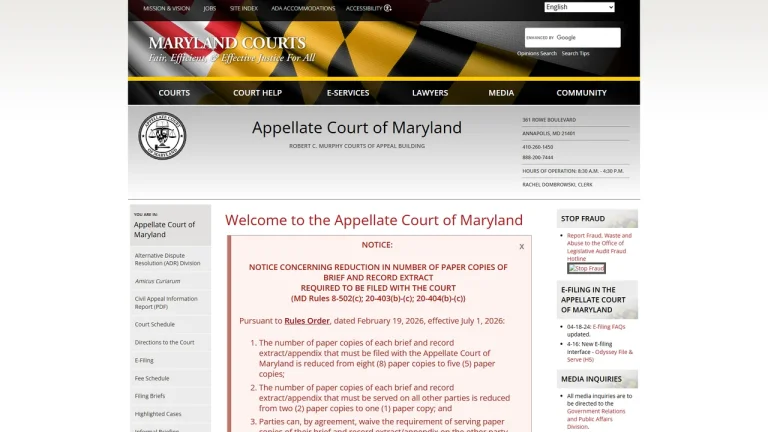
Maryland features a unified four-tier judicial hierarchy established by the state constitution and governed by statewide procedural rules. The highest judicial tribunal is the Supreme Court of Maryland, located in the historic state capital of Annapolis, which provides final discretionary appellate review. Directly beneath is the Appellate Court of Maryland, serving as the state's intermediate appellate court with mandatory jurisdiction over appeals originating from trial courts. Both appellate bodies provide definitive interpretations of Maryland statutory law and administrative regulations.
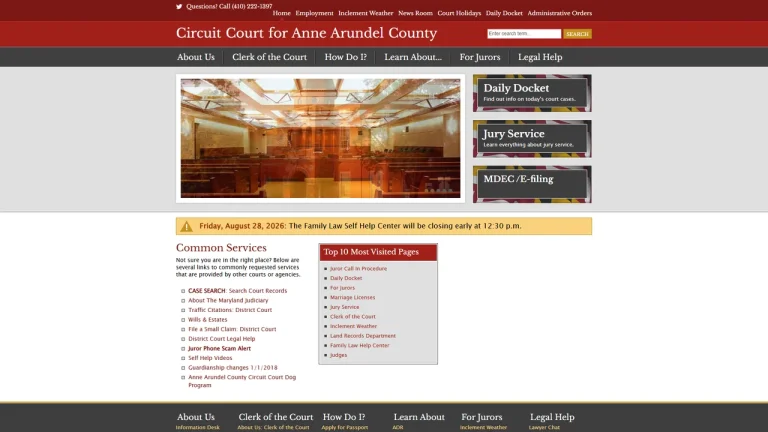
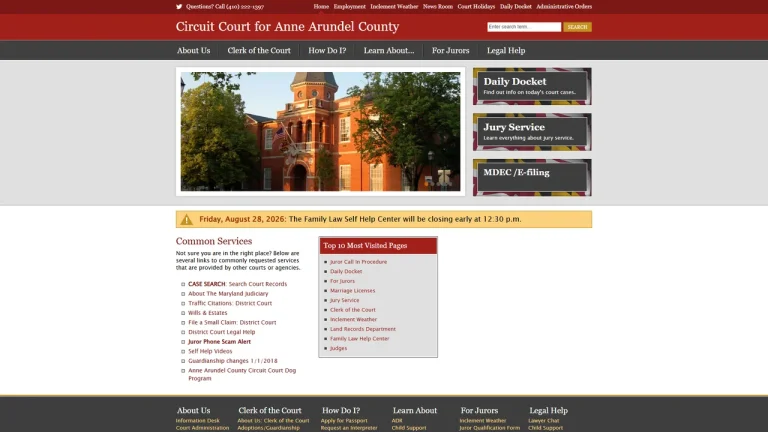
Trial-level jurisprudence is partitioned between the Circuit Courts and the District Court of Maryland. The Circuit Courts operate in each of the state's twenty-three counties and Baltimore City, divided across eight judicial circuits. Circuit Courts possess general jurisdiction over major civil lawsuits, complex commercial matters, domestic and juvenile litigation, and jury trial criminal felonies. Prominent trial hubs include the Baltimore City Circuit Court, the Montgomery County Circuit Court in Rockville, and the Prince George's County Circuit Court in Upper Marlboro.
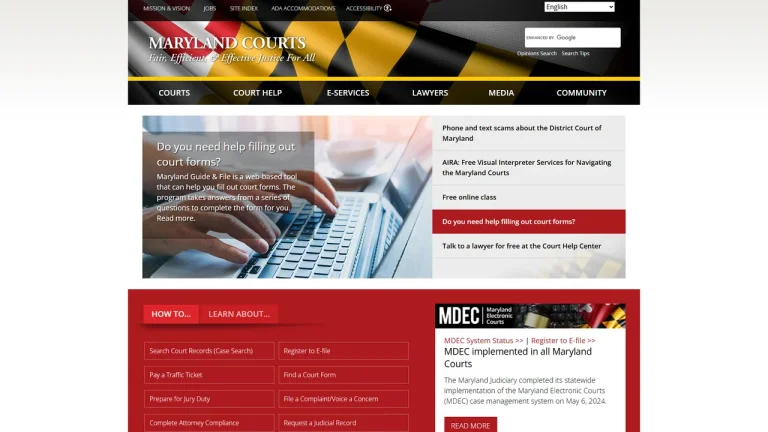
The District Court of Maryland operates as a non-jury court of limited jurisdiction distributed across twelve districts. It handles landlord-tenant disputes, motor vehicle violations, municipal infractions, criminal misdemeanors, and civil claims not exceeding statutory monetary thresholds. Maryland utilizes the Maryland Electronic Courts (MDEC) system for digital filing and provides the public Maryland Judiciary Case Search portal to examine civil dockets, criminal appearances, and judicial dispositions statewide.
Court Actions, Filing Fees, and Procedural Timelines
| Service / Matter | Required Documents / Prerequisites | Statutory Fee (USD) | Processing Timeline |
|---|---|---|---|
| District Court Small Claim Action (Up to $5,000) | Form DC-CV-001 (Complaint), proof of demand, verified military service affidavit | $34 standard filing fee plus $10 service per defendant | 30 to 60 days to scheduled trial date |
| Circuit Court General Civil Filing (Over $30,000) | Formal civil complaint, case information report, civil summons, fee transmittal | $165 base filing fee plus sheriff or private service fees | 12 to 18 months through discovery and trial |
| Notice of Appeal from Circuit Court to Appellate Court | Form Notice of Appeal filed in Circuit Court, certificate of service, docket deposit | $110 fee payable to Circuit Court plus $50 Appellate docket fee | 30 days statutory deadline to file notice |
| Certified Copy of Judgment, Decree, or Docket Record | Case caption, case number, formal record request, payment of statutory copy fees | $5 certification fee plus $0.50 per page | 3 to 10 business days for electronic or physical delivery |
Critical Legal Deadlines & Statutes in Maryland
Practicing before Maryland courts requires rigorous adherence to statutory limitation periods and procedural deadlines established under state law. Pursuant to Md. Code, Cts. & Jud. Proc. § 5-101, civil lawsuits for personal injury, negligence, and breach of contract must be commenced within three years from the date the cause of action accrues. Failure to file within this period permanently bars legal recovery in state courts.
In civil litigation before the Circuit Court, a defendant served with an initial summons within Maryland must file a written answer within thirty days under Md. Rule 2-321, extending to sixty days for out-of-state parties. For appellate proceedings, Md. Rule 8-202 requires that an appellant file a formal notice of appeal within thirty days of the entry of the final judgment or appealable order being challenged.
Monetary claims filed in the District Court are governed by Md. Code, Cts. & Jud. Proc. § 4-405, which limits small claims procedures strictly to disputes not exceeding $5,000. In concurrent jurisdiction matters between $5,000 and $30,000, either party may demand a jury trial under Md. Code, Cts. & Jud. Proc. § 4-402, which immediately transfers the proceeding from the District Court to the county Circuit Court.
Small Claims and Self-Representation vs. Professional Legal Counsel
Individuals have the right to represent themselves pro se in certain Maryland court proceedings. In the District Court's small claims division (claims up to $5,000), court rules are simplified under Md. Rule 3-701. Formal evidentiary rules are relaxed, pre-trial discovery such as depositions and interrogatories is prohibited without leave of court, and disputes are adjudicated efficiently before a judge. Self-represented litigants frequently manage routine debt collection defenses, unreturned security deposits, and minor property damage actions without attorney representation.
However, when a civil dispute involves sums above $30,000, equitable remedies such as injunctions, or complex multi-party commercial disputes, proceeding without an attorney carries grave financial risks. Under Maryland law, corporations, limited liability companies, and other artificial business entities are generally prohibited from filing lawsuits or defending actions pro se in Circuit Court and must be represented by an attorney admitted to the Maryland Bar. Complex trial procedures, expert witness depositions, and strict motions practice require the strategic advocacy of experienced litigation counsel.
Red Flags, Phishing Schemes, and Judicial Scams
- Be vigilant against fraudulent communications claiming an arrest warrant has been issued for missing jury service, especially if the caller demands immediate payment via prepaid gift cards, electronic wire, or cryptocurrency.
- Avoid third-party copycat websites that charge exorbitant service fees to provide standard Maryland District Court and Circuit Court forms that are published for free on mdcourts.gov.
- Reject offers from unaccredited electronic filing services claiming to represent you in the Maryland Electronic Courts (MDEC) system without a verified Maryland attorney license number.
- Do not pay private intermediaries offering guaranteed court date postponements or expedited judicial review, as continuances can only be granted by the presiding judge upon formal motion.
Frequently Asked Questions
What is the jurisdictional difference between Maryland District Courts and Circuit Courts?
The District Court of Maryland handles civil disputes up to $5,000 as small claims, concurrent jurisdiction civil actions up to $30,000, traffic citations, and misdemeanor crimes, functioning without jury trials. Circuit Courts hold exclusive jurisdiction over civil claims exceeding $30,000, family law matters, juvenile proceedings, and major criminal felonies, providing jury trial trials upon demand.
How do I locate a court case using Maryland Judiciary Case Search?
Maryland Judiciary Case Search is a free online public database providing docket entries, court dates, and judgment histories. Users search by party name, corporate name, or case tracking number, selecting the specific county or searching statewide records for both District and Circuit Court filings.
Can a corporation or LLC represent itself in a Maryland Circuit Court?
No. Under Maryland court rules and legal ethics standards, corporations, partnerships, and limited liability companies must be represented by an attorney licensed to practice law in Maryland when litigating matters in the Circuit Court. Limited self-representation exceptions exist only for specific small claims actions in District Court.
What is the monetary cap for filing a small claim in Maryland?
The monetary cap for small claims in Maryland is $5,000. Claims in this category are subject to simplified informal rules under Maryland Rule 3-701, where traditional rules of evidence are relaxed and formal pre-trial discovery is unavailable.
How does a party initiate an appeal from a Maryland Circuit Court final judgment?
An appeal is initiated by filing a formal Notice of Appeal in the Circuit Court that entered the final judgment within thirty calendar days of judgment entry. The appellant must pay the required filing fees and serve copies on all parties in accordance with Maryland Rule 8-202.