
Jails, Prisons & Detention Centers in Maryland
Accessing Maryland correctional facilities requires compliance with state intake procedures, bail schedules, and visiting guidelines. Knowing whether an individual is housed in a county detention center or state prison simplifies communication and bail processing. Explore our directory below to locate facilities, inmate search links, and official administrative resources across Maryland.
Maryland Correctional Hierarchy & Facility Jurisdiction
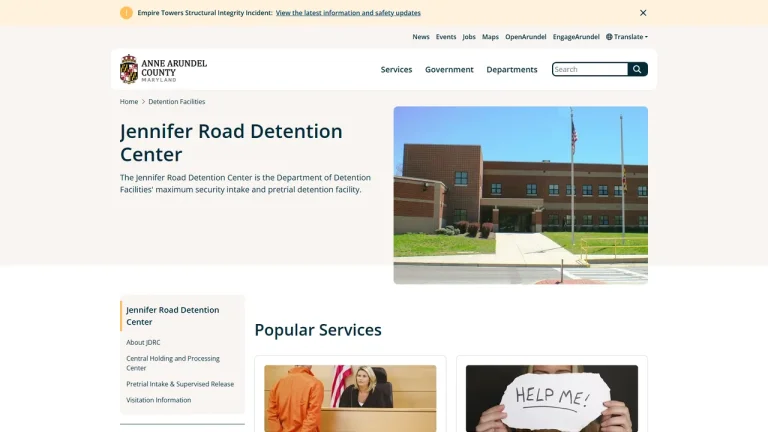
Maryland's correctional infrastructure operates through a structured division of authority between county detention centers and the Maryland Department of Public Safety and Correctional Services (DPSCS). County facilities-managed by local county sheriffs or county departments of correction-house individuals awaiting trial, those held on bail, and offenders serving sentences generally under eighteen months. Key county institutions include the Montgomery County Correctional Facility in Boyds, the Prince George's County Correctional Center in Upper Marlboro, and the Baltimore County Detention Center in Towson.
Baltimore City maintains an exceptional statutory arrangement under Maryland law. Pretrial detention and booking within Baltimore City are administered directly by the state through the DPSCS Division of Pretrial Detention and Services (DPDS), primarily operating through the Baltimore Central Booking and Intake Center (BCBIC). Individuals convicted of felonies and serving longer terms are classified through the Maryland Reception, Diagnostic and Classification Center (MRDCC) in Baltimore before transfer to major state prisons such as the Maryland Correctional Institution - Jessup (MCI-J) or Western Correctional Institution (WCI) in Cumberland.
Navigating detention protocols across Maryland requires strict observance of state and local administrative guidelines. Facility rules govern visitation schedules, attorney access protocols, commissary accounts, and inmate communications. Because security classifications dictate daily routines and transfer timelines, understanding institutional jurisdictions helps families and legal representatives manage the incarceration process effectively.
Inmate Booking, Bail, & Administrative Service Protocols
| Service / Matter | Required Documents / Prerequisites | Statutory Fee (USD) | Processing Timeline |
|---|---|---|---|
| County Inmate Bail & Bond Posting | Valid state photo ID, certified funds or cashier's check, signed bond paperwork | $0.00 commissioner processing fee (bail amount set by court) | 2 to 6 hours after judicial bond order |
| In-Person Visitation Registration | Government photo ID, approved visitor application, compliance with dress code | $0.00 registration fee | 14 to 30 days for background clearance |
| DPSCS Statewide Inmate Locator Search | Inmate state identification (SID) number or full legal name and birthdate | $0.00 public inquiry fee | Real-time automated online search |
| Attorney-Client Legal Visit Authorization | Active Maryland Bar card, valid government photo ID, advance written notice | $0.00 professional access fee | 24 to 48 hours advance coordination |
Critical Legal Deadlines & Statutes in Maryland
Detention and pretrial processes in Maryland operate under strict statutory timelines codified in the Maryland Rules and the Correctional Services Article:
First, following an arrest, an accused individual must be presented before a District Court judicial commissioner without unnecessary delay and within 24 hours of arrest pursuant to Md. Rule 4-212 and Md. Rule 4-216.1. The commissioner determines whether probable cause exists and establishes initial release conditions.
Second, if an individual remains detained following the commissioner's determination, judicial bail review must occur on the next court business day before a District Court judge under Md. Rule 4-216.2.
Third, individuals seeking to challenge unlawful confinement or intolerable detention conditions may file an application for a writ of habeas corpus pursuant to Md. Code, Cts. & Jud. Proc. § 3-702.
Finally, state prison management, administrative disciplinary hearings, and diminution credits (good conduct deductions) are governed by Md. Code, Corr. Servs. § 3-704 and Md. Code, Corr. Servs. § 9-601.
Direct Inmate Support vs. Retaining Criminal Defense Counsel
Families and friends can perform many essential inmate support tasks independently. Anyone may use the DPSCS public locator to verify an individual's housing facility, fund an inmate telephone account through authorized financial vendors, send approved correspondence, or submit background questionnaires for visitation approval. These administrative processes do not require legal representation.
However, securing release from custody, challenging pretrial detention, or protecting an inmate's constitutional rights requires the skilled intervention of a licensed Maryland criminal defense attorney. Maryland Rule 4-216.1 emphasizes non-monetary release conditions and individual financial capabilities, making legal advocacy critical at initial bail review hearings.
Defense attorneys present mitigating evidence regarding community ties, employment, and alternative pretrial monitoring programs to secure release. Furthermore, legal counsel handles administrative grievances concerning prison medical neglect, challenges improper disciplinary isolation, and files motions for modification of sentence under Md. Rule 4-345.
Maryland Detention Facility Scams & Red Flags
Navigating the correctional system leaves families vulnerable to deceptive schemes. Be vigilant against these widespread fraudulent practices:
- Urgent Bail Telephone Solicitations: Scammers call family members impersonating correctional officers or court clerks, falsely claiming an inmate requires immediate bail transferred via peer-to-peer applications, wire transfer, or cryptocurrency. Maryland detention centers never request bail payments over the phone through informal digital channels.
- Unlicensed Bail Runners: Avoid predatory bail bond runners soliciting business directly outside intake facilities without displaying valid licensing credentials from the Maryland Insurance Administration. Bond agreements must clearly articulate statutory premiums without undisclosed add-on fees.
- Subscription Inmate Tracking Platforms: Third-party commercial sites often demand monthly subscription fees to search inmate records that are provided free of charge by the Maryland DPSCS locator or county jail databases.
- Guaranteed Transfer or Release Scams: Beware of individuals claiming to possess backchannel authority to secure immediate prison transfers, administrative downgrades, or expedited parole dates in exchange for cash payments. Inmate classification is strictly determined by statutory DPSCS administrative metrics.
Frequently Asked Questions
How do I find someone detained in a Maryland correctional facility?
You can locate individuals in Maryland state custody using the DPSCS Inmate Locator available on the official state correctional website. You will need the person's full legal name or their unique six-digit State Identification (SID) number. For individuals arrested within the last 48 hours or housed in local county jails, check the specific county detention center's online booking log or contact the county sheriff's records division directly.
What is the difference between a Maryland county detention center and a state prison?
Maryland county detention centers are operated by county sheriffs or local corrections departments to hold individuals awaiting trial or serving sentences of eighteen months or less. State prisons, operated by the DPSCS Division of Correction, house convicted individuals serving sentences exceeding eighteen months. Intake and diagnostic classification for state inmates occur centrally through MRDCC in Baltimore.
How quickly after an arrest does a bail review hearing take place in Maryland?
Under Md. Rule 4-212, an arrestee must be presented to a judicial commissioner within 24 hours of booking. If the commissioner does not release the defendant on recognizance or the defendant cannot post bond, a formal bail review hearing before a District Court judge must take place on the next day court is in session under Md. Rule 4-216.2.
What are the requirements for legal visits with detained clients in Maryland?
Attorneys licensed in Maryland must present an active bar membership card and valid government-issued photo identification upon arrival. Most state facilities and county detention centers require 24 to 48 hours advance notice to arrange contact or non-contact professional consultation rooms. Attorney-client meetings are privileged and protected from audio recording.
Can family members send care packages or money directly to inmates in Maryland?
Maryland DPSCS institutions do not permit direct physical packages sent from private residences. Inmate trust deposits and commissary care packages must be purchased and processed through designated third-party vendors contracted with the state. All written correspondence is subject to inspection for contraband according to facility regulations.