
Federal Courts in New Jersey
Federal courts in New Jersey adjudicate complex federal litigation, constitutional questions, bankruptcy filings, and federal criminal prosecutions statewide. Accessing federal clerk offices and navigating electronic dockets requires adherence to strict Federal Rules of Procedure. Review our directory below to locate federal courthouses, divisional clerk offices, and judicial chambers across New Jersey.
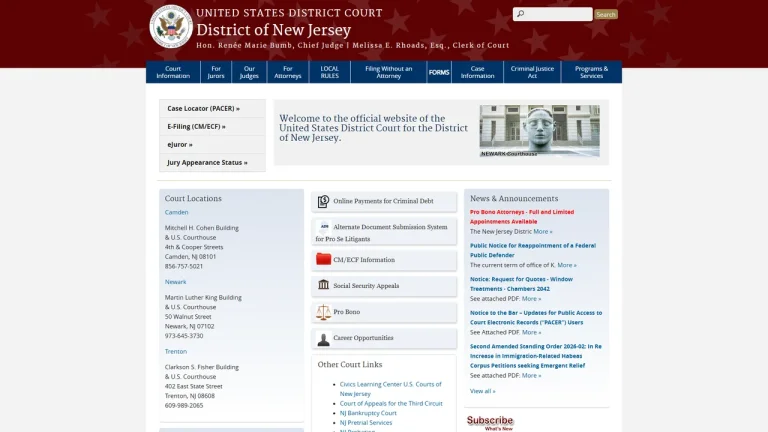
United States District Court - Trenton Vicinage (Clarkson S. Fisher Building)
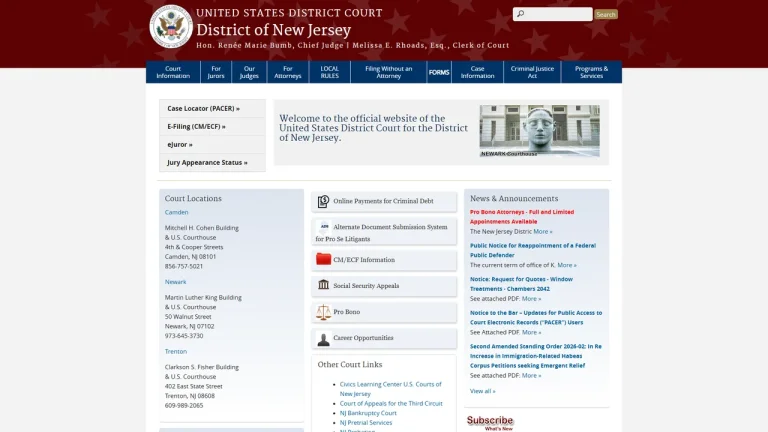
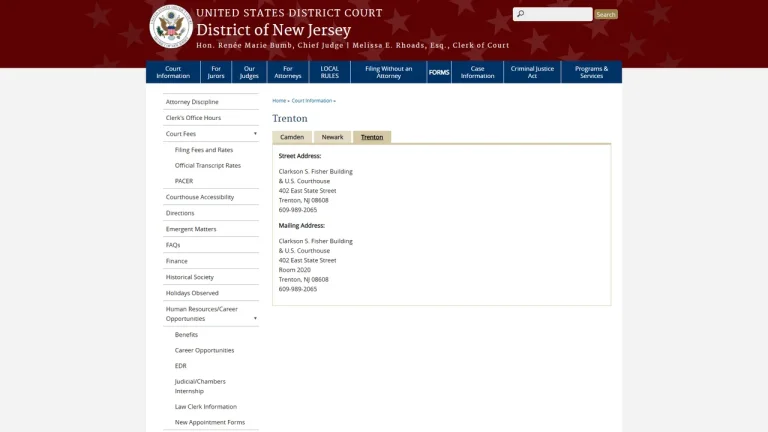
Clarkson S. Fisher Federal Building And United States Courthouse - Trenton, NJ

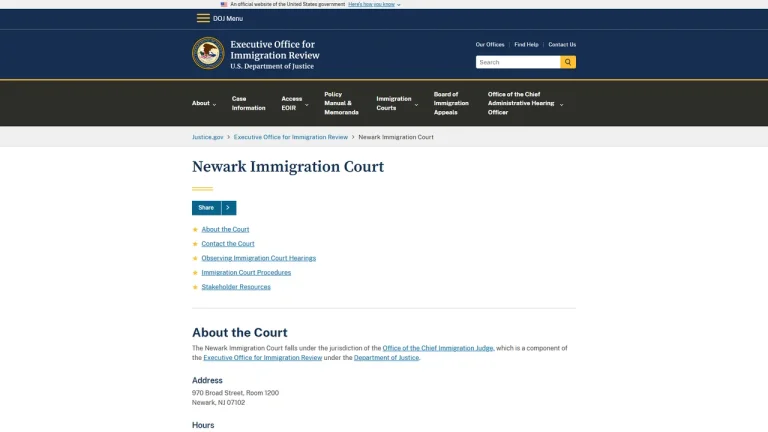
Jurisdiction and Organization of Federal Courts in New Jersey
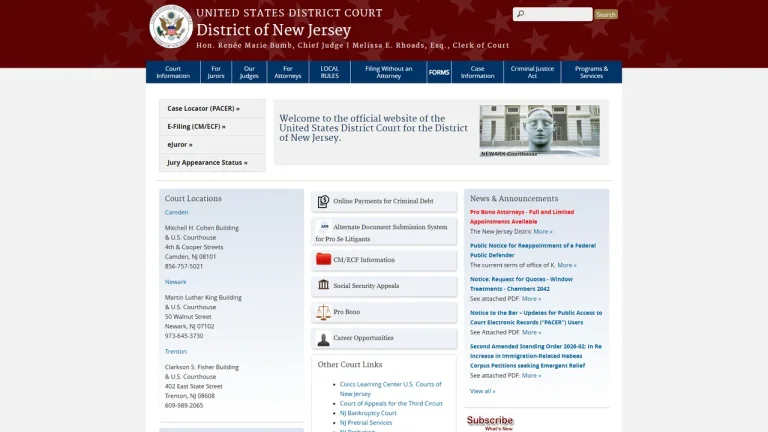
The federal judicial branch in New Jersey is organized under a single statewide district, the United States District Court for the District of New Jersey, established pursuant to 28 U.S. Code § 110. Operating under the appellate oversight of the United States Court of Appeals for the Third Circuit, the District of New Jersey is among the busiest federal trial benches in the nation, maintaining general jurisdiction over federal question litigation, civil diversity matters, and federal criminal prosecutions.
Judicial administration is apportioned across three staffed vicinages: the Martin Luther King, Jr. Federal Building and U.S. Courthouse in Newark (Northern Vicinage), the Clarkson S. Fisher Federal Building and U.S. Courthouse in Trenton (Central Vicinage), and the Mitchell H. Cohen Building and U.S. Courthouse in Camden (Southern Vicinage). Each vicinage houses district judges, magistrate judges, and dedicated divisional clerk personnel.
In addition to district judges, the District of New Jersey operates a specialized United States Bankruptcy Court with courthouses in Newark, Trenton, and Camden to handle Title 11 bankruptcy matters. All federal civil and criminal filings are processed electronically through the federal Case Management and Electronic Case Files system and PACER.
Federal Court Filing Fees and Case Schedules
| Service / Matter | Required Documents / Prerequisites | Statutory Fee (USD) | Processing Timeline |
|---|---|---|---|
| Civil Complaint Filing (District Court) | Verified complaint, civil cover sheet (JS-44), summons issuance | $405 statutory fee ($350 filing fee + $55 administrative fee) | Immediate docketing via CM/ECF |
| Chapter 7 Bankruptcy Petition | Voluntary petition, schedules A-J, statement of financial affairs, credit certificate | $338 statutory filing fee | Automatic stay effective upon filing; discharge in 4-6 months |
| Notice of Appeal to the Third Circuit | Notice of appeal, certificate of service, trial docket sheet | $605 appellate docketing fee ($5 statutory fee + $600 docket fee) | 30 calendar days from entry of final judgment |
| Certificate of Good Standing (Federal Bar) | Active bar membership, attorney registration number, written request | $21 statutory certificate fee | 1-3 business days via Clerk of Court |
Critical Legal Deadlines & Statutes in New Jersey
Timelines in federal court litigation are inflexible and strictly enforced under the Federal Rules of Civil Procedure and District of New Jersey Local Civil Rules. Under Fed. R. Civ. P. 12(a)(1), a defendant served with a federal civil summons and complaint must serve an answer or pre-answer motion within 21 calendar days, or 60 days if service is waived under Fed. R. Civ. P. 4(d). If the defendant is the United States or a federal officer, the deadline extends to 60 days under Fed. R. Civ. P. 12(a)(2).
The deadline for appealing a final judgment to the United States Court of Appeals for the Third Circuit is governed by Fed. R. App. P. 4(a)(1)(A), which requires the notice of appeal to be filed within 30 calendar days after the entry of judgment. If the federal government is a party to the proceeding, the appellate filing deadline expands to 60 days pursuant to Fed. R. App. P. 4(a)(1)(B). Missing this jurisdictional window results in the complete forfeiture of appellate review.
In diversity actions where state substantive law governs, federal courts apply New Jersey limitation periods. For personal injury actions, N.J. Stat. Ann. § 2A:14-2 establishes a strict two-year statute of limitations. For breach of contract actions, litigants must observe the six-year statutory deadline defined under N.J. Stat. Ann. § 2A:14-1.
Direct Pro Se Filing vs. Retaining Federal Counsel
Individual citizens have the constitutional right to represent themselves pro se in the District of New Jersey in personal civil lawsuits or individual Chapter 7 bankruptcy petitions. Pro se litigants can access public dockets at courthouse clerk terminals in Newark, Trenton, or Camden and utilize standardized non-prisoner complaint forms published by the Clerk of the Court.
However, retaining experienced federal litigation counsel is imperative for commercial and complex matters. Under federal procedural law, corporate entities, limited liability companies, and partnerships cannot appear pro se and must be represented by an attorney admitted to the Bar of the District of New Jersey. Federal practice involves intricate local civil rules, mandatory initial disclosures under Fed. R. Civ. P. 26, and specialized discovery protocol; mistakes in pleading or motion practice can lead to severe sanctions or dismissal with prejudice.
Common Red Flags & Federal Courthouse Warnings
- Beware of phone scams where callers pose as federal marshals or court clerks claiming an arrest warrant has been issued for missing federal grand jury duty and demanding payment via wire transfer or gift cards.
- Avoid non-attorney petition preparers who solicit bankruptcy filings, as they are legally prohibited from offering legal advice or representing debtors at Section 341 creditor meetings.
- Do not attempt to file corporate litigation pro se; federal district courts in New Jersey will enter default judgments or dismiss pleadings filed by unrepresented business entities.
- Verify all electronic filing notifications through the official PACER service, avoiding phishing emails that mimic court notices demanding immediate credit card verification.
Frequently Asked Questions
What federal courthouses operate in the District of New Jersey?
The District of New Jersey operates three divisional courthouses: the Martin Luther King, Jr. Federal Building in Newark, the Clarkson S. Fisher Federal Building in Trenton, and the Mitchell H. Cohen Building in Camden.
Which appellate court hears appeals from New Jersey federal district courts?
Appeals from the United States District Court for the District of New Jersey are heard by the United States Court of Appeals for the Third Circuit, located in Philadelphia.
What is the deadline to answer a federal complaint in New Jersey?
Under the Federal Rules of Civil Procedure, a defendant must serve an answer or motion within 21 days of being served, or within 60 days if service was formally waived or the defendant is a federal agency.
Can a corporation represent itself in New Jersey federal court?
No. Federal law strictly prohibits corporations, partnerships, and limited liability companies from appearing pro se; they must be represented by an admitted attorney.
Where are federal bankruptcy cases filed in New Jersey?
Bankruptcy petitions are filed with the United States Bankruptcy Court for the District of New Jersey, which maintains divisional offices in Newark, Trenton, and Camden based on the debtor county of residence.