
Specialty Courts (Drug, Family, Juvenile) in New York City
Specialty courts in New York City provide treatment alternatives, youth justice proceedings, and family dispute resolution across all five municipal boroughs. These dedicated parts handle sensitive matters involving juvenile justice, domestic relations, and substance use diversion under specialized state statutes. Consult our verified directory below to identify courthouse facilities, clerk contacts, and intake requirements.
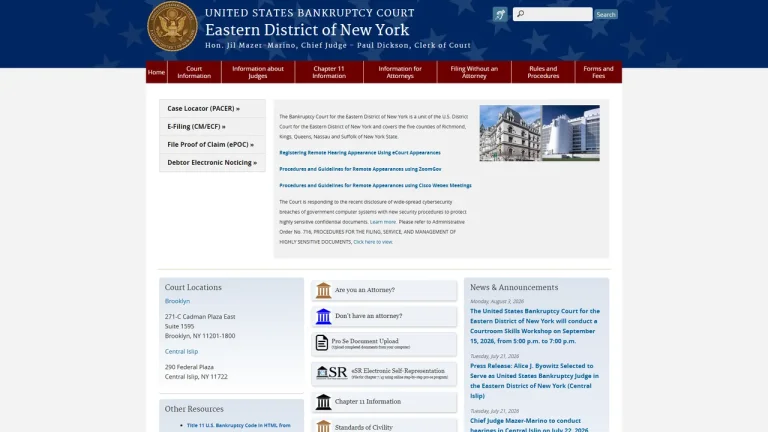
Conrad B. Duberstein U.S. Courthouse (U.S. Bankruptcy Court, Eastern District) - New York, NY
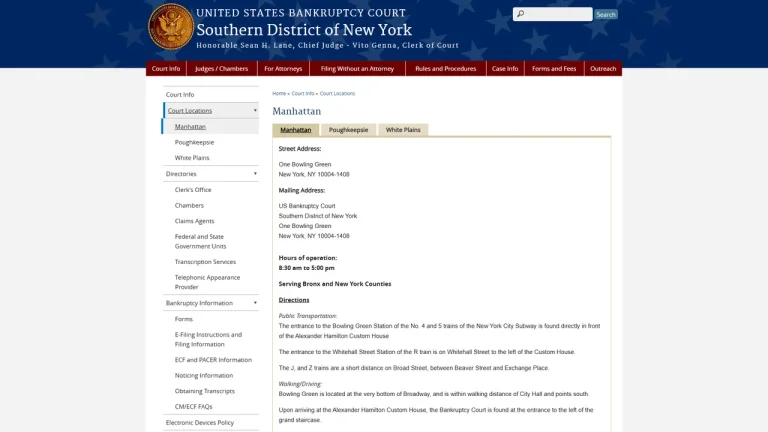
Southern District of New York Bankruptcy Court serving Bronx and New York Counties - New York, NY





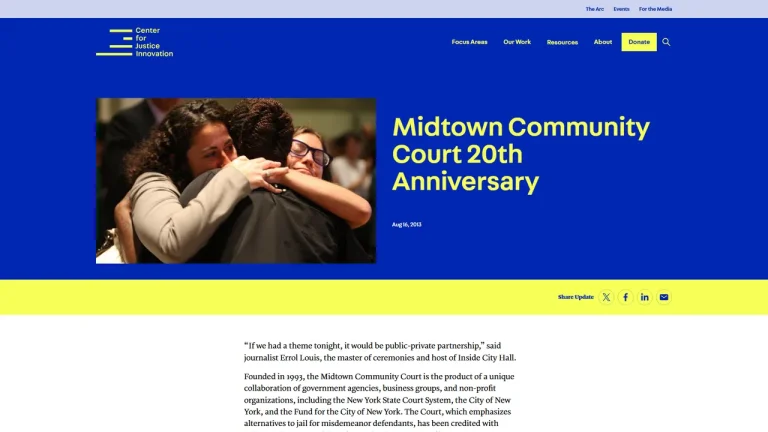


Bronx County Courthouse (Supreme Court, Civil & Surrogate's Court)
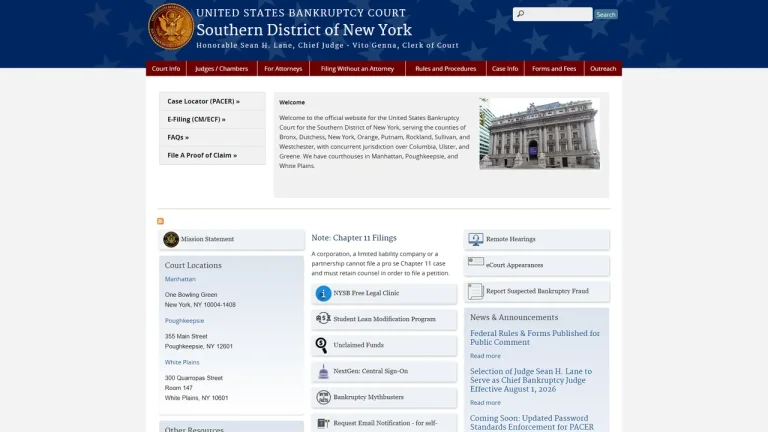
United States Bankruptcy Court, Southern District of New York

The Role and Jurisdiction of NYC Problem-Solving and Specialty Courts
Specialty and problem-solving courts throughout New York City operate under the New York State Unified Court System to address specific social and legal challenges through therapeutic intervention, restorative justice, and family stabilization. These parts divert qualifying individuals from traditional incarceration into supervised clinical rehabilitation, mental health monitoring, and community restitution.
Family Court branches operate in each of the five boroughs: 60 Lafayette Street in Manhattan, 330 Jay Street in Brooklyn, 900 Sheridan Avenue in the Bronx, 151-20 Jamaica Avenue in Queens, and 100 Richmond Terrace on Staten Island. These venues exercise jurisdiction over child custody, child protective filings, visitation petitions, juvenile delinquency matters, and family offense orders of protection.
Problem-solving courts include specialized drug diversion initiatives such as the Brooklyn Treatment Court, Manhattan Drug Action Court, and borough-based Mental Health and Veterans Treatment Courts. In addition, New York's Raise the Age framework established specialized Youth Parts within the Supreme Court to manage adolescent cases, while Integrated Domestic Violence (IDV) Courts consolidate concurrent criminal, family, and matrimonial matters involving a single family before a single judge.
Specialty Court Intake, Statutory Requirements, and Processing Schedules
| Service / Matter | Required Documents / Prerequisites | Statutory Fee (USD) | Processing Timeline |
|---|---|---|---|
| Family Court Custody or Child Support Petition | Valid ID, child's birth certificate or paternity acknowledgment | $0 (No filing fee) | Initial appearance set within 3 to 6 weeks |
| Family Offense Order of Protection | Sworn petition detailing intimate partner or familial domestic incident | $0 (No filing fee) | Immediate same-day ex parte hearing |
| Judicial Drug Diversion Program Intake | Clinical substance evaluation and court referral under CPL 216 | $0 (State-administered) | Clinical assessment within 1 to 2 weeks |
| Youth Part Removal Motion to Family Court | Formal motion by defense counsel under CPL 722.23 | $0 (Statutory motion) | Judicial determination within 30 calendar days |
Critical Legal Deadlines & Statutes in New York
Specialty court matters are subject to strict statutory guidelines designed to protect vulnerable individuals and preserve constitutional rights. In Family Court, child custody and visitation determinations are governed by N.Y. Fam. Ct. Act § 651, while family offense petitions seeking orders of protection are authorized under N.Y. Fam. Ct. Act § 812. Child support calculations are mandated by the Child Support Standards Act codified at N.Y. Fam. Ct. Act § 413.
Orders of protection issued in Family Court remain effective for up to two years, but may extend up to five years if aggravating circumstances-such as physical injury or weapon display-are established pursuant to N.Y. Fam. Ct. Act § 842. In emergency child protective investigations under Article 10, a parent whose child has been temporarily removed has the right to demand an expedited hearing within three business days under N.Y. Fam. Ct. Act § 1028.
Under New York's Raise the Age legislation, adolescent offenders charged with qualifying offenses in the Supreme Court Youth Part are subject to mandatory removal to Family Court unless the prosecution files a written motion demonstrating extraordinary circumstances within thirty calendar days of arraignment under N.Y. C.P.L. § 722.23. Adult defendants seeking clinical diversion must apply for Judicial Diversion under N.Y. C.P.L. § 216.05 prior to the entry of a guilty plea or the commencement of trial.
Direct Public Access vs. Mandated Legal Counsel in Specialty Courts
Members of the public have direct statutory access to New York City Family Court intake counters. Individuals can file for child support, establish paternity, or petition for an emergency family offense order of protection without paying court fees or retaining an attorney. Courthouse help desks and the court system's Electronic Document Delivery System facilitate direct public filings.
However, when proceedings involve contested custody trials, termination of parental rights, juvenile delinquency, or criminal diversion compliance, retaining legal representation is critical. Under N.Y. Fam. Ct. Act § 262, indigent parents facing child removal or contempt have a statutory right to assigned legal counsel. Children in Family Court are independently represented by an appointed Attorney for the Child. In drug treatment and youth courts, skilled counsel ensures statutory diversion rights are preserved and plea terms do not trigger adverse immigration or licensing consequences.
Red Flags & Public Warnings in Specialty Court Proceedings
- Unaccredited community service offices or non-lawyers outside Family Court facilities demanding cash fees to complete standard, cost-free court petitions.
- Uncertified private clinical treatment facilities claiming to offer approved drug court diversion programs that lack licensing from the New York State Office of Addiction Services and Supports.
- Disregarding terms of a temporary order of protection, which constitutes a mandatory arrest offense resulting in independent criminal contempt charges.
- Attempting to handle child abuse or neglect petitions without legal counsel, which can lead to permanent termination of parental rights under state law.
Frequently Asked Questions
Does it cost money to file a petition in New York City Family Court?
No. Under New York law, there are no statutory filing fees for submitting petitions in Family Court, including applications for custody, visitation, child support, paternity, or orders of protection.
How does an individual enter a New York City Drug Treatment Court?
Entry requires an eligible non-violent criminal charge, a clinical addiction diagnosis, and an application submitted under Criminal Procedure Law Article 216. The judge, prosecutor, and defense counsel evaluate the clinical assessment before admission.
What is an Integrated Domestic Violence (IDV) Court?
An Integrated Domestic Violence Court operates under the principle of one family, one judge, allowing a single Supreme Court justice to handle related criminal domestic violence charges, family court matters, and matrimonial actions involving the same family.
How does New York's "Raise the Age" law affect juvenile cases?
Raise the Age establishes that 16- and 17-year-olds are not automatically prosecuted as adults. Non-felony matters originate in Family Court, while felony charges are heard in the Supreme Court Youth Part with potential removal to Family Court.
Are Family Court proceedings open to the general public in New York?
While Family Court is presumed open to the public, the presiding judge has discretionary statutory authority to exclude individuals from the courtroom to protect sensitive matters, confidential records, or the privacy of minor children.