
Police & Sheriff Departments in Vermont
Accessing police and sheriff departments in Vermont provides essential records retrieval, public safety services, and civil court process execution across the state. Understanding the jurisdictional division between municipal police, county sheriffs, and the state police preserves statutory rights. Explore our statewide directory below to connect with local precincts, sheriff headquarters, and defense attorneys.
Law Enforcement Jurisdictions and Police Authority in Vermont
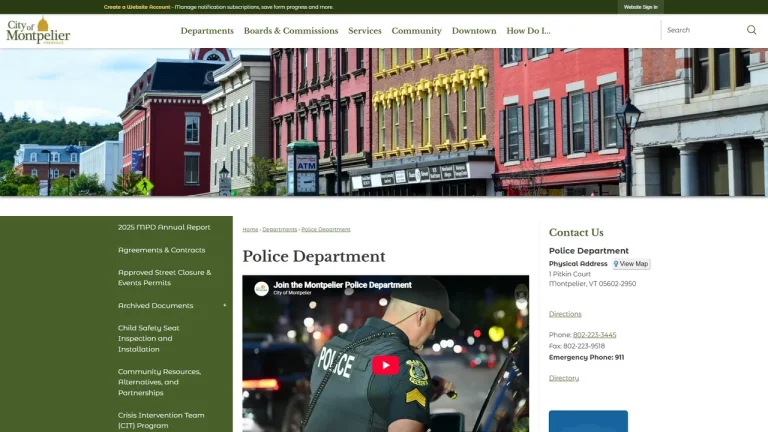
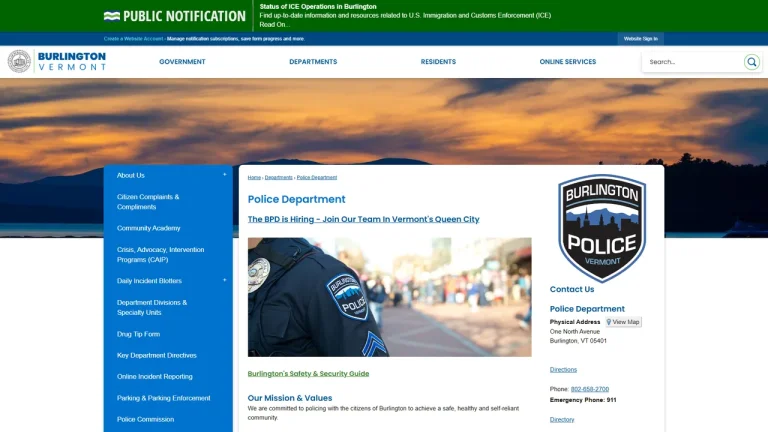
In Vermont, public safety and law enforcement operations are coordinated among municipal police departments, fourteen county sheriff departments, and the Vermont State Police. Municipal police departments-such as the Burlington Police Department, South Burlington Police Department, Rutland City Police, and Barre City Police-maintain primary law enforcement authority within incorporated cities and major towns. Municipal officers handle emergency responses, local criminal investigations, and enforce municipal ordinances within city borders.
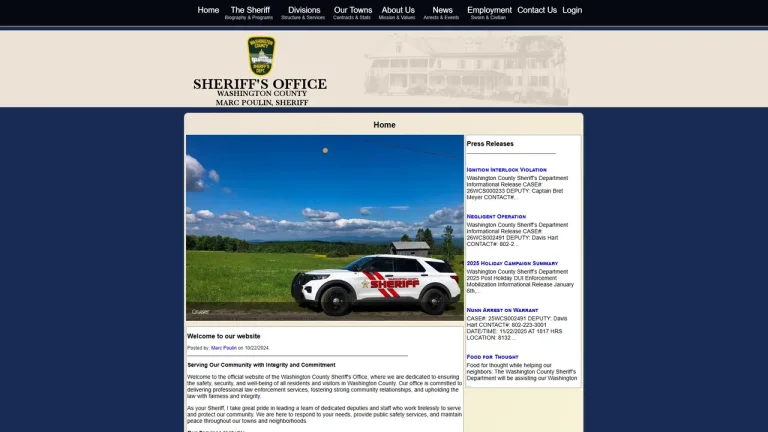
County Sheriffs in Vermont hold a constitutional office established under Chapter II, Section 50 of the Vermont Constitution and governed by 24 V.S.A. § 291. Operating in all fourteen counties-including Chittenden County (Burlington), Washington County (Montpelier), Rutland County, and Windham County (Brattleboro)-sheriffs oversee courtroom security for the Vermont Superior Court, transport criminal detainees, execute civil process (such as subpoenas, writs of possession, and evictions), and provide contracted highway patrol services for rural towns lacking municipal police departments.
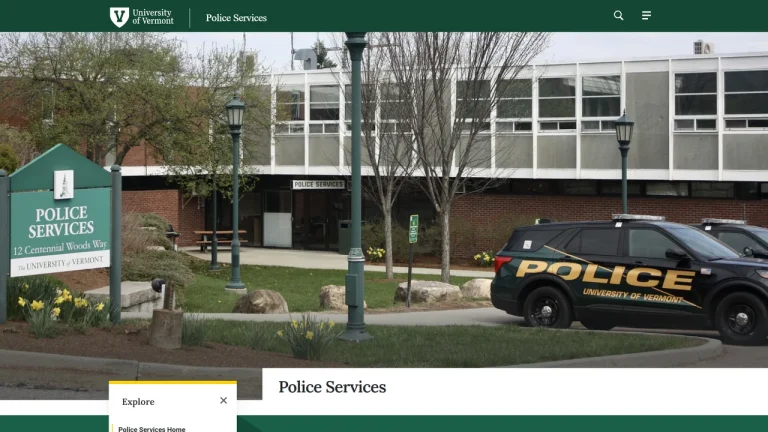
In towns without local municipal police, the Vermont State Police-operating under the Department of Public Safety headquartered in Waterbury and deployed from regional field barracks-provides primary criminal investigation and traffic patrol. Individuals arrested by any law enforcement agency are processed and transferred to regional correctional facilities operated by the Vermont Department of Corrections, such as the Northwest State Correctional Facility in St. Albans or the Chittenden Regional Correctional Facility in South Burlington. Understanding which agency holds jurisdiction ensures accurate document retrieval and legal representation.
Law Enforcement Services, Document Requests, and Statutory Fees
| Service / Matter | Required Documents / Prerequisites | Statutory Fee (USD) | Processing Timeline |
|---|---|---|---|
| Police Incident & Collision Report Request | Public records request, incident case number, date, location, government ID | $12.00-$20.00 statutory copy fee | 3-5 business days under state law |
| Sheriff Civil Process Service (Subpoenas, Writs) | Original court process from Superior Court clerk, service instructions, fee payment | $50.00 statutory fee + state mileage | 5-10 business days |
| State Criminal Background Check (VCIC) | Fingerprint card, signed release form, completed VCIC application | $30.00 statutory fee | 7-14 business days via DPS |
| Pretrial Custody & Bail Verification | Full legal name of detainee, date of birth, arresting agency or correctional facility | $0.00 (public detention record) | Immediate upon completed intake |
Critical Legal Deadlines & Statutes in Vermont
Interactions with Vermont law enforcement agencies are controlled by strict procedural timelines established in state statutes and court rules. Under the Vermont Public Records Act, codified at 1 V.S.A. § 318, police departments and sheriff offices must respond to public records requests within three business days. If a request is exceptionally complex or requires archival retrieval, the agency may extend the response deadline up to ten business days by providing written notice to the requester.
For individuals taken into custody, constitutional and procedural protections require prompt judicial review. Under Vermont Rules of Criminal Procedure Rule 5 and 13 V.S.A. § 7554, an individual arrested without a warrant must receive a prompt bail and conditions of release determination by a judicial officer, typically within twenty-four to forty-eight hours of detention. County sheriffs executing civil process, such as writs of possession in landlord-tenant evictions, must serve and return documentation according to the statutory deadlines specified under 12 V.S.A. § 696.
Direct Agency Access vs. Legal Counsel
Citizens regularly interact with Vermont police departments and sheriff offices for standard administrative needs without attorney assistance. Requesting traffic collision reports for auto insurance claims, obtaining applicant fingerprint cards for employment, scheduling routine civil process service through the county sheriff, and requesting background records from the Vermont Crime Information Center are accessible directly through departmental service counters.
However, securing an experienced Vermont criminal defense attorney is vital whenever personal liberty or criminal charges are involved. Legal counsel is essential during custodial interrogations, representing defendants at emergency bail reviews and arraignments under 13 V.S.A. § 7554 in the Vermont Superior Court Criminal Division, challenging unconstitutional vehicle stops under Chapter I, Article 11 of the Vermont Constitution, or defending against civil relief from abuse protective orders served by the county sheriff under 15 V.S.A. § 1103.
Red Flags & Public Safety Warning Signs
- Imposter Warrant Phone Scams: Beware of telephone calls from individuals claiming to be Chittenden County or Washington County sheriff deputies demanding immediate payment via prepaid money cards or cryptocurrency to clear active arrest warrants. Real law enforcement agencies never collect fines or bail over the telephone.
- Predatory Background Check Brokers: Avoid commercial third-party websites charging subscription fees to view police blotters or arrest records that are accessible directly through public records requests.
- Unverified Process Service Providers: Ensure all civil court summonses and writs of execution are delivered exclusively by authorized county sheriff deputies or certified process servers in compliance with Vermont court rules.
- Unregulated Bail Facilitators: Do not engage unauthorized third-party bail fixers; bail in Vermont is processed exclusively through the court clerk or the custodial correctional facility.
Frequently Asked Questions
What is the difference between a Vermont county sheriff and a municipal police department?
Municipal police departments handle local emergency patrol and municipal criminal investigations, while county sheriffs oversee court security, prisoner transport, civil process service, and contracted rural patrols.
How do I obtain an accident report from the Vermont State Police?
Collision reports can be requested directly through the Department of Public Safety or the local state police barracks that investigated the incident by submitting a records request and the statutory fee.
How quickly must an arrested individual receive a bail hearing in Vermont?
Under Vermont court rules and state law, an individual arrested without a warrant must be brought before a judicial officer for an arraignment and bail determination without unnecessary delay, typically within 24 to 48 hours.
Who serves civil court summonses and evictions in Vermont?
Civil process, including summonses, subpoenas, and writs of possession for evictions, is officially served by the elected County Sheriff and deputy sheriffs in the county where service is required.
When should I retain a criminal defense attorney in Vermont?
You should retain a criminal defense attorney immediately if you are arrested, contacted for questioning by law enforcement, served with a criminal citation, or facing an arraignment in the Vermont Superior Court.