
Harassment Lawyers in Kansas
Retaining a dedicated Kansas harassment lawyer provides critical legal protection against hostile work environments, sexual misconduct, and civil stalking. Experienced local attorneys help victims secure emergency protection orders, file administrative complaints, and pursue substantial monetary damages. Explore our verified directory below to schedule a confidential consultation with a trusted Kansas advocate.

Fisher Patterson Sayler Smith - Overland Park, KS

Snyder Law Firm LLC - Overland Park, KS

Evans & Dixon, LLC - Overland Park, KS

Tara Eberline, Attorney at Law - Overland Park, KS

Jackson Lewis PC - Overland Park, KS
Law Office of Sean M. Dwyer - Wichita, KS

The Owens Law Firm, L.L.C. - Overland Park, KS

Colantuono Guinn Keppler LLC - Overland Park, KS

Littler Mendelson P.C. - Overland Park, KS
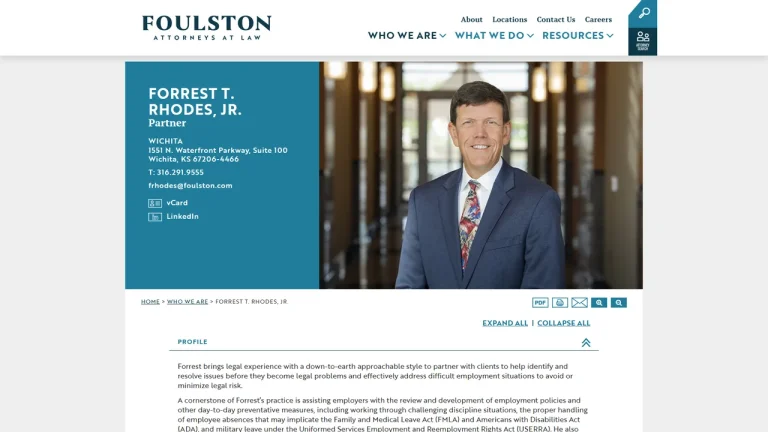
Forrest T. Rhodes Jr. - Wichita, KS
Swartz Law, LLC - Overland Park, KS
McAnany, Van Cleave and Phillips, P.A. - Kansas City, KS
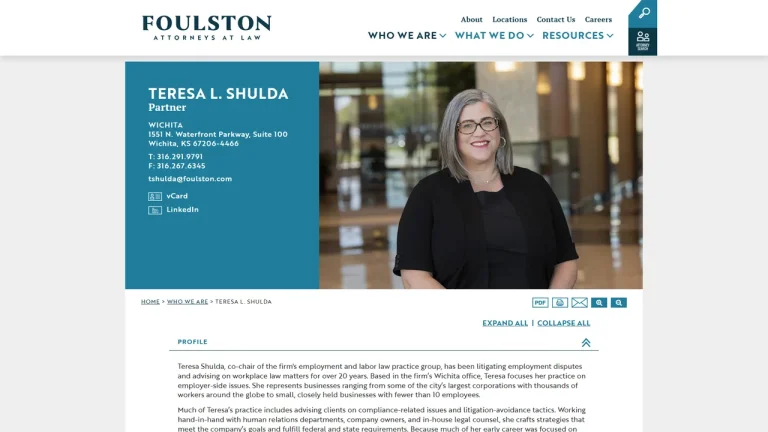
Teresa L. Shulda - Foulston Siefkin LLP - Wichita, KS
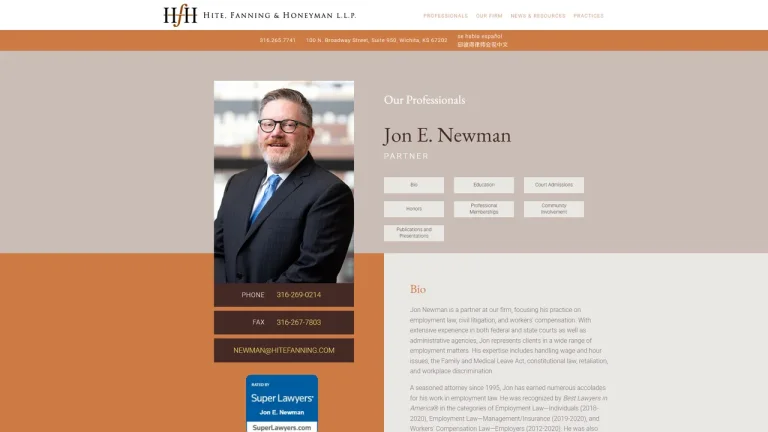
Jon E. Newman - Wichita, KS
Law Office of Albert F. Kuhl - Overland Park, KS
Doyle & Bruce LLC - Kansas City, KS
Dugan Schlozman - Overland Park, KS

Kansas Employee Lawyer - Hite, Fanning & Honeyman, LLP - Wichita, KS

Combating Workplace and Civil Harassment Across Kansas Courts
Facing persistent harassment-whether pervasive sexual hostility in the workplace, discriminatory intimidation, or menacing civil stalking-inflicts profound emotional trauma and disrupts daily life. Under Kansas law, victims possess robust legal avenues to halt abusive conduct and seek civil compensation.
Employment-related harassment claims proceed administratively through the Kansas Human Rights Commission (KHRC) in Topeka and the EEOC before entering the Kansas District Courts across thirty-one judicial districts. Major civil dockets operate in Johnson County (Olathe), Sedgwick County (Wichita), Shawnee County (Topeka), and Douglas County (Lawrence). Civil stalking and sexual assault restraining orders are adjudicated locally in county district courts, while federal hostile environment actions proceed in the United States District Court for the District of Kansas.
Statewide court documents are managed electronically via the Kansas Courts eFiling system. Retaining an attorney in good standing with the Kansas Bar Association ensures rapid protective order petitions, thorough documentation of hostile conduct, and decisive advocacy before district judges.
Kansas Harassment Case Scenarios and Fee Benchmarks
| Case Scenario | Fee Structure | Estimated Cost (USD) | Key Cost Determinants |
|---|---|---|---|
| Civil Protection from Stalking Order (PFS) Petition | Flat Fee or Hourly Rate | $1,500 - $3,500 | Emergency ex parte order hearings, sheriff service, evidentiary hearing in District Court under K.S.A. 60-31a05. |
| Workplace Hostile Work Environment & Sexual Harassment | Contingency Fee (33.33% - 40%) | $0 Upfront (Contingency Basis) | Pervasiveness of offensive conduct, documentation of reporting to HR, employer failure to remediate, lost earnings. |
| Retaliatory Demotion Following Harassment Complaint | Contingency or Hybrid Retainer | $0 Upfront ($2,500 - $6,000 Hybrid Retainer) | Direct proof of adverse employment action following protected complaint under K.S.A. 44-1009(a)(4), back-pay calculations. |
| Severe Workplace Harassment & Tort of Outrage Trial | Contingency (40%) + Advanced Costs | $0 Upfront ($20,000 - $50,000+ Advanced Costs) | Extreme and outrageous conduct proof under K.S.A. 60-513(a)(4), psychological expert evaluations, District Court jury trial. |
Critical Legal Deadlines & Statutes in Kansas
Workplace harassment claims in Kansas require strict compliance with administrative statutes of limitations. Under the Kansas Act Against Discrimination, workplace sexual harassment and hostile work environment claims are actionable as unlawful employment practices under K.S.A. § 44-1009. An administrative complaint must be filed with the Kansas Human Rights Commission within six months (one hundred eighty days) of the discriminatory harassment pursuant to K.S.A. § 44-1005(i). Dual-filing under federal Title VII (42 U.S. Code § 2000e-2) provides a three-hundred-day window with the EEOC.
For personal safety emergencies outside or within the workplace, the Protection from Stalking, Sexual Assault, or Human Trafficking Act at K.S.A. § 60-31a01 et seq. allows victims to obtain immediate court restraining orders under K.S.A. § 60-31a05. Civil lawsuits asserting the common law tort of outrage (intentional infliction of emotional distress) arising from extreme harassment carry a two-year statute of limitations under K.S.A. § 60-513(a)(4). Retaliation by an employer for reporting harassment is strictly prohibited by K.S.A. § 44-1009(a)(4).
Small Claims Court Restrictions vs. District Court Harassment Remedies
Under K.S.A. § 61-2703, the Small Claims Procedure Act sets a jurisdictional limit of $10,000. However, small claims courts are purely monetary recovery forums and are explicitly prohibited from issuing injunctions, restraining orders, or addressing statutory employment civil rights violations. Furthermore, under K.S.A. § 61-2707(a), attorneys are barred from representing parties in small claims court hearings.
Victims of harassment require urgent judicial remedies-including protective restraining orders under K.S.A. § 60-31a05, workplace policy changes, and comprehensive emotional distress compensation-that only the formal Kansas District Court can grant. Navigating these proceedings with legal representation ensures that electronic evidence, text messages, and internal complaint logs are authenticated according to the Kansas Rules of Evidence, insulating victims against ongoing abuse.
Red Flags When Selecting a Kansas Harassment Lawyer
- Failing to advise clients on filing a charge with the KHRC within the strict six-month deadline under K.S.A. § 44-1005(i) for workplace claims.
- Overlooking immediate civil protection options, such as emergency protective orders under K.S.A. § 60-31a05, when physical safety is threatened.
- Attorneys who advise deleting text messages, voicemails, or social media communications, which destroys indispensable evidence of a pattern of harassment.
- Vague fee schedules that charge substantial non-refundable retainers for preliminary evaluations without clear milestones.
Frequently Asked Questions
What constitutes illegal workplace harassment under Kansas law?
Under K.S.A. § 44-1009, illegal workplace harassment consists of unwelcome conduct based on sex, race, color, religion, national origin, ancestry, or disability that is sufficiently severe or pervasive to alter employment conditions and create an intimidating, hostile, or offensive working environment.
How do I obtain a Protection from Stalking (PFS) order in Kansas?
Under K.S.A. § 60-31a05, you can file a petition in the District Court of the county where you reside or where the stalking occurred. The court may issue an immediate ex parte temporary order followed by a formal hearing within twenty-one days to grant a final protection order.
What is the deadline to report workplace harassment in Kansas?
To preserve state statutory rights under the KAAD, you must file a formal complaint with the Kansas Human Rights Commission within six months (180 days) of the harassing conduct pursuant to K.S.A. § 44-1005(i).
Can I sue an employer if a supervisor sexually harassed me in Kansas?
Yes. Employers can be held strictly liable for harassment by a supervisor that results in a tangible employment action (such as firing or demotion), or liable for hostile work environment harassment if the company knew or should have known and failed to take immediate corrective action.
What evidence is required to prove a hostile work environment?
Crucial evidence includes contemporaneous notes and diaries, copies of emails, text messages, offensive photos, witness statements from co-workers, and formal written complaint reports submitted to human resources or management.