
Employment & Labor Lawyers in Pittsburgh
Consulting an experienced Pittsburgh employment lawyer safeguards your rights against workplace discrimination, unlawful wage theft, and wrongful termination. Local labor counsel effectively resolves employer disputes through pre-litigation negotiations and formal administrative filings. Review our directory below to connect with trusted Allegheny County advocates.
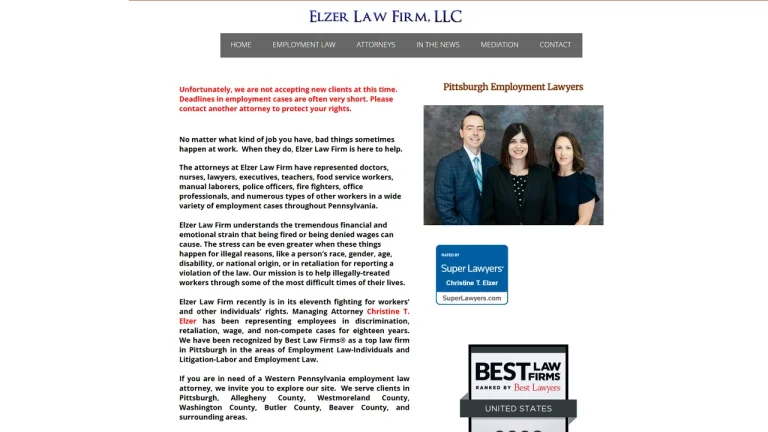
Elzer Law Firm, LLC - Pittsburgh, PA
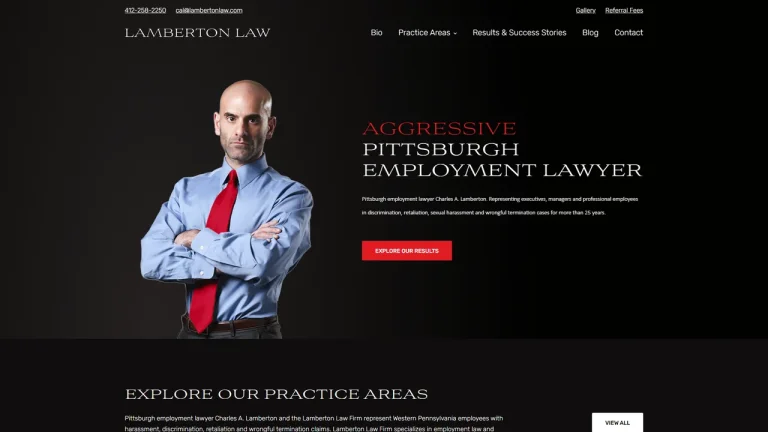
Lamberton Law Firm, LLC - Pittsburgh, PA

Quinn Logue LLC - Pittsburgh, PA
Levicoff Law Firm, P.C. - Pittsburgh, PA

Manes & Narahari LLC - Pittsburgh, PA
Keith L Eliou, Attorney at Law - Pittsburgh, PA
Maiello Brungo & Maiello, LLP - Pittsburgh, PA

Marshall Dennehey, P.C. - Pittsburgh, PA

Joel B. Kundin, Attorney At Law - Pittsburgh, PA
Jubelirer, Pass & Intrieri, P.C. - Pittsburgh, PA
J.P. Ward & Associates - Pittsburgh, PA

Strassburger, McKenna, Gutnick, & Gefsky - Pittsburgh, PA
Lynch Carpenter, LLP - Pittsburgh, PA
Noah Jordan at Rothman Gordon, P.C. - Pittsburgh, PA

Clark Hill PLC - Pittsburgh, PA
Elliott & Davis, PC - Pittsburgh, PA
O'Brien Coleman & Wright, LLC - Pittsburgh, PA

Littler Mendelson P.C. - Pittsburgh, PA
Saul Ewing LLP - Pittsburgh, PA

Strassburger McKenna Gutnick & Gefsky - Pittsburgh, PA

Sherrard, German & Kelly, P.C. - Pittsburgh, PA
Ogletree Deakins - Pittsburgh, PA
Kisner Law LLC - Pittsburgh, PA
Knox McLaughlin Gornall & Sennett, P.C. - Pittsburgh, PA
Protecting Employee Rights in Pittsburgh and Allegheny County
Workplace disputes across Western Pennsylvania involve a combination of state statutes and federal employment protections. In Pittsburgh, employment claims frequently originate through administrative agencies before entering the court system. Workers facing discrimination, harassment, or retaliation often initiate their complaints with the Pennsylvania Human Relations Commission (PHRC) regional office on Fifth Avenue or the U.S. Equal Employment Opportunity Commission (EEOC) Pittsburgh Area Office located within the William S. Moorhead Federal Building on Liberty Avenue.
When administrative conciliation does not resolve the dispute, employment lawsuits proceed to either the Civil Division of the Allegheny County Court of Common Pleas housed in the City-County Building on Grant Street, or the U.S. District Court for the Western District of Pennsylvania. Having an attorney steeped in the regional employment landscape-from healthcare systems and technology campuses in Oakland and Bakery Square to manufacturing hubs along the Monongahela and Ohio river valleys-provides a vital strategic edge.
An experienced local employment attorney assists employees with critical workplace transitions, including severance negotiation, non-compete covenant analysis, and wage-and-hour compliance. Because Pennsylvania adheres to an at-will employment doctrine with defined statutory exceptions, early legal guidance ensures that claims are properly framed around recognized public policy exemptions and statutory protections.
Common Employment Law Fee Arrangements in Pittsburgh
| Case Scenario | Fee Structure | Estimated Cost (USD) | Key Cost Determinants |
|---|---|---|---|
| Severance Agreement Review & Negotiation | Flat Fee / Hourly | $450 - $1,500 | Complexity of release terms, executive compensation, non-compete enforceability |
| Unpaid Wages & Overtime Violations | Contingency (Statutory Fee-Shifting) | 33.3% - 40% of Recovery | Number of affected employees, liquidated damages under WPCL, employer payroll records |
| Workplace Discrimination & Retaliation Lawsuit | Contingency / Hybrid Retainer | 33.3% - 40% (or $3,000 - $7,500 retainer) | Documented economic loss, emotional distress evidence, PHRC right-to-sue status |
| Executive Contract & Restrictive Covenant Dispute | Hourly Billing | $300 - $650 / hr | Preliminary injunction hearings, geographic trade secret scope, litigation exposure |
Critical Legal Deadlines & Statutes in Pennsylvania
Employees facing unfair employment practices in Pennsylvania must act under aggressive filing windows. To pursue state-level discrimination or hostile work environment claims under the Pennsylvania Human Relations Act, 43 P.S. § 955, a formal administrative complaint must be filed with the PHRC within 180 days of the unlawful action as mandated by 43 P.S. § 959. Missing this 180-day jurisdictional cutoff forever bars relief under Pennsylvania law.
If dual-filing under federal statutes such as Title VII of the Civil Rights Act under 42 U.S. Code § 2000e-5 or the Americans with Disabilities Act, claimants benefit from an extended 300-day window to file with the EEOC due to Pennsylvania being a deferral state. Once the EEOC or PHRC issues a right-to-sue notice, the employee has strictly 90 days to initiate a civil action in court.
For wage and hour claims, the Pennsylvania Wage Payment and Collection Law (WPCL), governed by 43 P.S. § 260.9a, imposes a three-year statute of limitations for recovering earned wages, unpaid bonuses, and statutory liquidated damages. In contrast, actions under the Pennsylvania Minimum Wage Act pursuant to 43 P.S. § 333.113 and the federal Fair Labor Standards Act under 29 U.S. Code § 255 carry a two-year limitations window, which expands to three years only upon establishing a willful employer violation.
Magisterial District Court Wage Claims vs. Comprehensive Legal Action
In Allegheny County, Magisterial District Courts hold civil jurisdictional authority for monetary disputes up to $12,000 under 42 Pa. C.S. § 1515. Employees seeking recovery of a final unpaid paycheck or minor commissions below this ceiling can file pro se claims without complex procedural pleading rules. The Pittsburgh Municipal Court and neighborhood district judges provide accessible dockets for straightforward, uncontested wage recovery where legal fees would otherwise exceed the amount owed.
However, when a dispute encompasses unlawful termination, systemic discrimination, whistleblower retaliation, or non-compete enforcement, self-representation becomes an immense liability. Pennsylvania civil procedure requires adherence to formal complaint rules, protective orders, and comprehensive electronic discovery protocols. Retaining an employment lawyer levels the field against institutional defense firms, opens avenues for statutory fee-shifting where the employer must pay your legal costs under 43 P.S. § 260.9a, and unlocks potential recovery for emotional distress and punitive damages.
Red Flags When Hiring a Pittsburgh Employment Attorney
- Unrealistic Settlement Promises: Be cautious of attorneys who quote substantial monetary recoveries during an initial intake before examining employer personnel records and performance evaluations.
- Hefty Non-Refundable Upfront Fees for Wage Claims: Under Pennsylvania wage statutes, prevailing employees are entitled to mandatory attorneys fees; lawyers demanding massive up-front payments for clear-cut unpaid overtime often lack commitment to litigating.
- Ignorance of PHRC Administrative Prerequisites: Failure by an attorney to prioritize the 180-day state administrative exhaustion deadline under 43 P.S. § 959 can permanently extinguish your claims under Pennsylvania law.
- No Federal Court Admission: Because significant employment litigation is removed to the U.S. District Court for the Western District of Pennsylvania, ensure your attorney is admitted to practice before the federal bench in Pittsburgh.
Frequently Asked Questions
What is the deadline to file a discrimination charge in Pittsburgh?
Under the Pennsylvania Human Relations Act, you must file a verified complaint with the PHRC within 180 days of the discriminatory act under 43 P.S. § 959. For federal claims filed through the EEOC in Pittsburgh, the dual-filing deadline extends to 300 days under 42 U.S. Code § 2000e-5, after which you may receive a right-to-sue authorization.
Is Pennsylvania an at-will employment state?
Yes, Pennsylvania is an at-will employment state, meaning employers can generally terminate an employee for any reason or no reason at all. However, exceptions apply when terminations violate statutory anti-discrimination protections under 43 P.S. § 955, breach an explicit contract, or infringe upon established public policy, such as retaliating against an employee for filing a workers compensation claim.
Can an employer enforce a non-compete agreement in Pittsburgh?
Pennsylvania courts enforce non-compete agreements only if they are incident to an employment relationship, supported by adequate legal consideration, and reasonably limited in temporal duration and geographic scope to protect legitimate business interests. An employment attorney can review the covenant to identify overbroad restrictions that Allegheny County courts may strike down.
What damages can I recover for unpaid wages in Pennsylvania?
Under the Pennsylvania Wage Payment and Collection Law, 43 P.S. § 260.9a, employees may recover all unpaid earned wages, reasonable attorney fees, and statutory liquidated damages equal to 25% of the total claim or $500 (whichever is greater) if wages remained unpaid for more than 30 days without a good-faith dispute.
Do I need an attorney to review a severance package?
Having an attorney review your severance agreement ensures you do not inadvertently surrender valuable statutory claims without adequate compensation. Counsel can evaluate release waivers, negotiate higher payouts, and verify compliance with the Older Workers Benefit Protection Act under 29 U.S. Code § 626, which mandates 21 days to review and 7 days to revoke for workers aged 40 and older.